
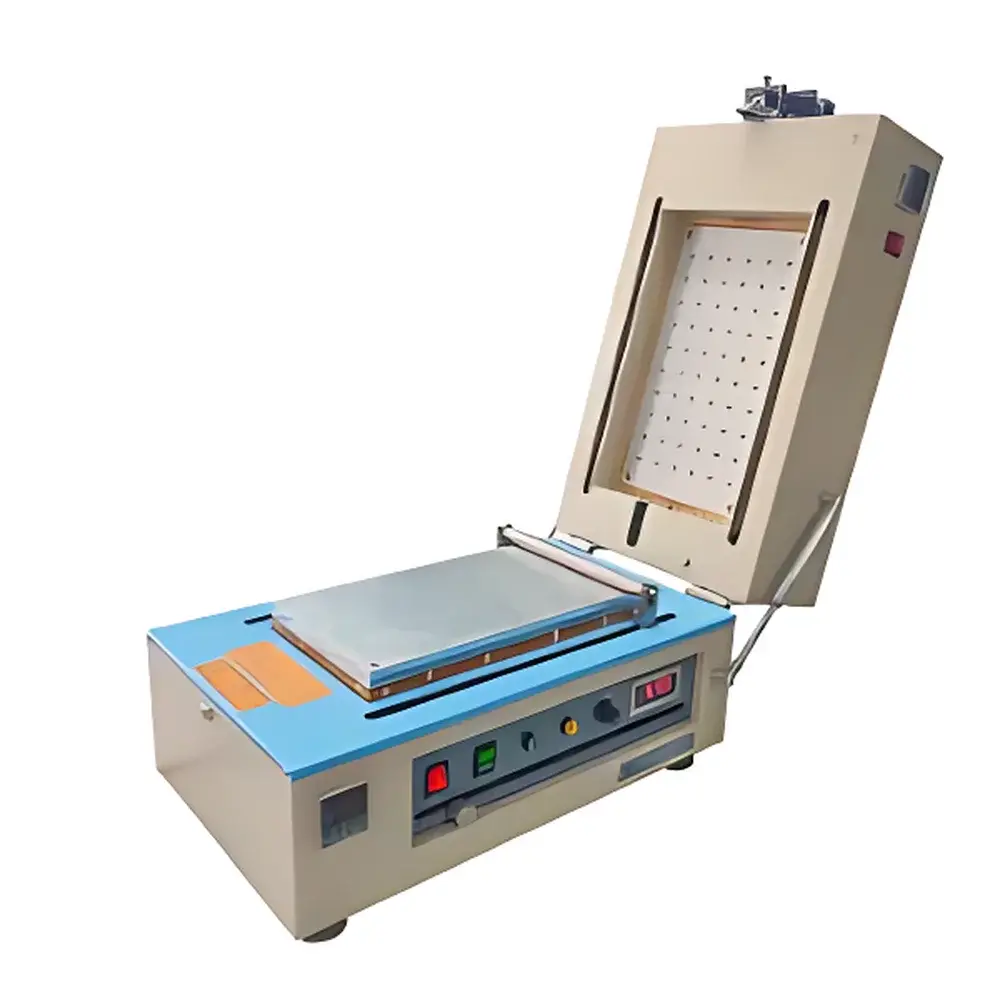
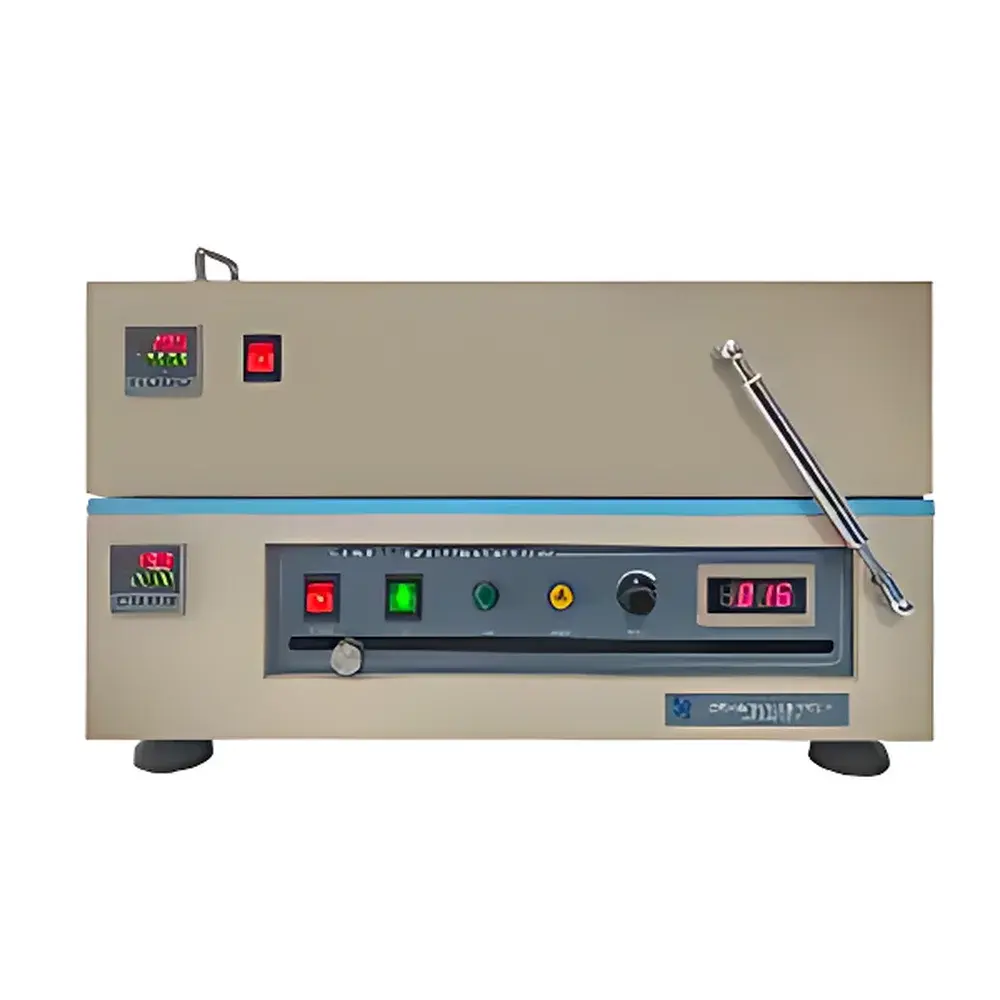
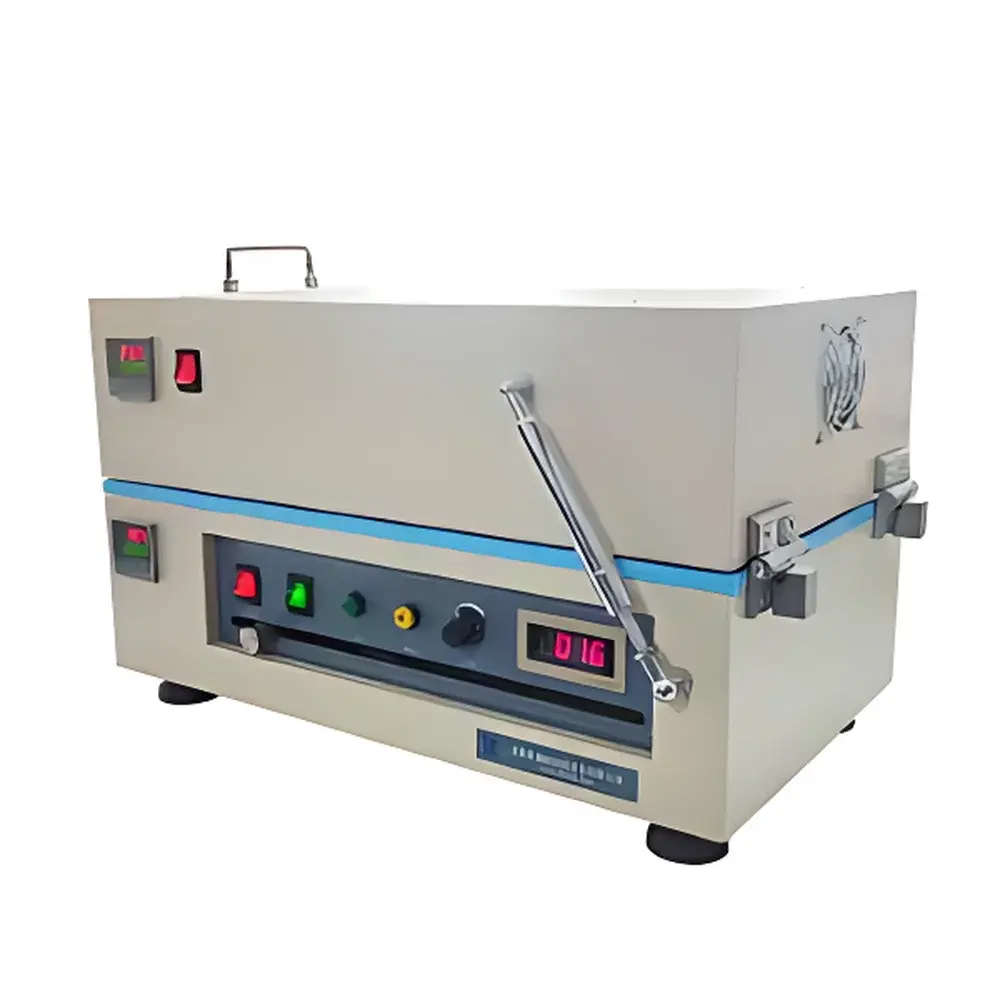
KJ GROUP MSK-AFA-IIID-G Dual-Zone Heated Doctor Blade Coater
| Brand | KJ GROUP |
|---|---|
| Origin | Liaoning, China |
| Manufacturer Type | Direct Manufacturer |
| Country of Origin | China |
| Model | MSK-AFA-IIID-G |
| Pricing | Upon Request |
| Power Supply | AC 220 V, 50 Hz (dual-circuit), 10 A per circuit |
| Total Power | 2050 W |
| Coating Base Dimensions (L×W) | 360 mm × 200 mm |
| Vacuum Adsorption Area (L×W) | 300 mm × 150 mm |
| Coating Speed | 10–100 mm/s (infinitely variable) |
| Adjustable Coating Length | 0–300 mm |
| Adjustable Doctor Blade | KTQ150 type, 150 mm wide, thickness range 0–3500 µm |
| Heating Method | Independent top cover + bottom vacuum platen heating |
| Max. Heating Temperature | 200 °C (top and bottom, separately controlled) |
| Temperature Control Accuracy | ±2 °C |
| Operating Ambient | 0–45 °C, 10–85% RH (non-condensing) |
| Dimensions (closed lid) | 610 mm × 390 mm × 340 mm |
| Dimensions (open lid) | 800 mm × 390 mm × 780 mm |
| Net Weight | 60 kg |
| Vacuum Requirement | External oil-free vacuum pump (e.g., AP-1400V, optional) |
Overview
The KJ GROUP MSK-AFA-IIID-G Dual-Zone Heated Doctor Blade Coater is an engineered laboratory-scale film casting and coating system designed for precise, reproducible preparation of uniform wet films from liquid or colloidal suspensions onto rigid or flexible substrates. It operates on the principle of controlled doctor blade shearing—where a precision-ground stainless-steel blade moves linearly across a substrate under vacuum adsorption, metering material thickness via mechanical gap adjustment. Unlike ambient-only coaters, the MSK-AFA-IIID-G integrates independently regulated top and bottom heating zones (up to 200 °C each), enabling simultaneous coating and in-situ thermal drying—a critical capability for solvent-evaporation-sensitive formulations such as polymer electrolytes, ceramic slurries, battery electrode slurries, and functional nanocomposites. Its robust aluminum alloy frame, dual-circuit power architecture, and CE-compliant electrical design ensure operational safety and long-term stability in academic, R&D, and pre-production environments.
Key Features
- Independent dual-zone heating system: Top cover heater and bottom vacuum platen heater operate with separate digital PID controllers, enabling precise thermal profiling during coating and post-deposition drying.
- Infinitely variable coating speed (10–100 mm/s) driven by brushless DC motor with encoder feedback, ensuring high repeatability and minimal shear-induced aggregation in sensitive dispersions.
- KTQ150 adjustable stainless-steel doctor blade (150 mm width), calibrated for thickness control from 0 to 3500 µm; blade weight and geometry optimized for consistent meniscus formation and edge uniformity.
- Vacuum-assisted substrate fixation on a 300 mm × 150 mm porous aluminum platen, minimizing lateral drift and enabling reliable adhesion of low-surface-energy substrates (e.g., PET, PI, copper foil).
- Integrated mechanical end-stop and auto-return mechanism: Programmable coating length (0–300 mm) with repeatable endpoint positioning and blade retraction to prevent over-coating or substrate damage.
- Dedicated waste collection tray positioned at the left edge of the vacuum stage, capturing excess slurry and preventing cross-contamination or residue buildup on critical motion components.
- Insulated hinged top cover with silicone gasket seal: Provides dust exclusion, thermal retention, and operator safety while maintaining ergonomic access and visual process monitoring.
Sample Compatibility & Compliance
The MSK-AFA-IIID-G accommodates a broad range of substrate types—including glass slides, silicon wafers, metal foils (Al, Cu), polymer films (PET, PI, PP), and ceramic plates—provided they fit within the 300 mm × 150 mm vacuum zone and exhibit sufficient flatness (<50 µm deviation). Substrate thickness is unrestricted, though optimal vacuum hold-down performance is achieved with materials ≤3 mm thick. The system complies with EU Machinery Directive 2006/42/EC and carries CE marking, confirming conformity with essential health and safety requirements. Electrical insulation, grounding continuity, and thermal cutoff protection meet IEC 61000-6-2 (immunity) and IEC 61000-6-4 (emission) standards. While not inherently GLP/GMP-certified, its digital temperature logging, repeatable mechanical actuation, and traceable parameter settings support audit-ready documentation when integrated into validated workflows (e.g., ASTM D823 for coated film preparation or ISO 2137 for viscosity-controlled film application).
Software & Data Management
The MSK-AFA-IIID-G operates via embedded microcontroller-based hardware with dual digital displays: one for bottom platen temperature (°C), another for top cover temperature (°C). Coating speed and length are set manually using rotary dials with LED indicators—no external PC or proprietary software is required. However, all operational parameters (speed, length, both zone temperatures) are retained in non-volatile memory across power cycles. Optional integration with external data acquisition systems is supported via analog voltage outputs (0–10 V) for real-time speed and temperature signals, compatible with LabVIEW, MATLAB, or SCADA platforms. For regulated environments, users may implement manual logbooks or electronic batch records aligned with FDA 21 CFR Part 11 requirements using third-party validation packages—though the instrument itself does not include electronic signature or audit trail functionality.
Applications
This coater is routinely deployed in advanced materials development laboratories for fabricating thin-film electrodes (Li-ion, solid-state batteries), dielectric layers (capacitors, sensors), optical coatings (anti-reflective, conductive oxides), and functional membranes (fuel cells, filtration). Its dual-zone heating enables solvent-gradient drying strategies—e.g., rapid surface skinning followed by bulk solvent removal—to suppress cracking, dewetting, or phase separation in multicomponent slurries. Researchers also use it for preparing calibration standards (e.g., NIST-traceable thickness references), evaluating rheological modifiers, and screening binder systems under thermally accelerated conditions. In academic settings, it serves as a teaching platform for coating physics, interfacial phenomena, and thermal mass transfer modeling.
FAQ
What vacuum pump specifications are recommended?
A minimum ultimate vacuum of –80 kPa (–0.8 bar) is required; the optional AP-1400V oil-free diaphragm pump (14 L/min flow rate, <5 Pa ultimate vacuum) is fully compatible and chemically resistant to common organic solvents.
Can the coater handle high-viscosity pastes (>10,000 mPa·s)?
Yes—when paired with the HDS-150 hybrid extrusion-type blade (optional), which applies pressure-assisted metering rather than pure shear, enabling uniform deposition of viscous battery cathode slurries and ceramic tapes.
Is substrate pre-heating possible before coating initiation?
Yes—the bottom platen can be stabilized at target temperature prior to vacuum activation and blade travel, ensuring thermal equilibrium between substrate and incoming slurry.
How is film thickness verified post-coating?
Users typically employ contact profilometry (e.g., Dektak), optical interferometry, or gravimetric analysis (coating weight per unit area) calibrated against known solids content; the KTQ150 blade’s micrometer scale provides initial thickness estimation but requires empirical correlation for each formulation.
Does the system support inert-atmosphere operation?
Not natively—but the sealed top cover allows purging with N₂ or Ar via external gas inlet (custom port installation required); full glovebox integration is feasible with mounting bracket adaptation.



