
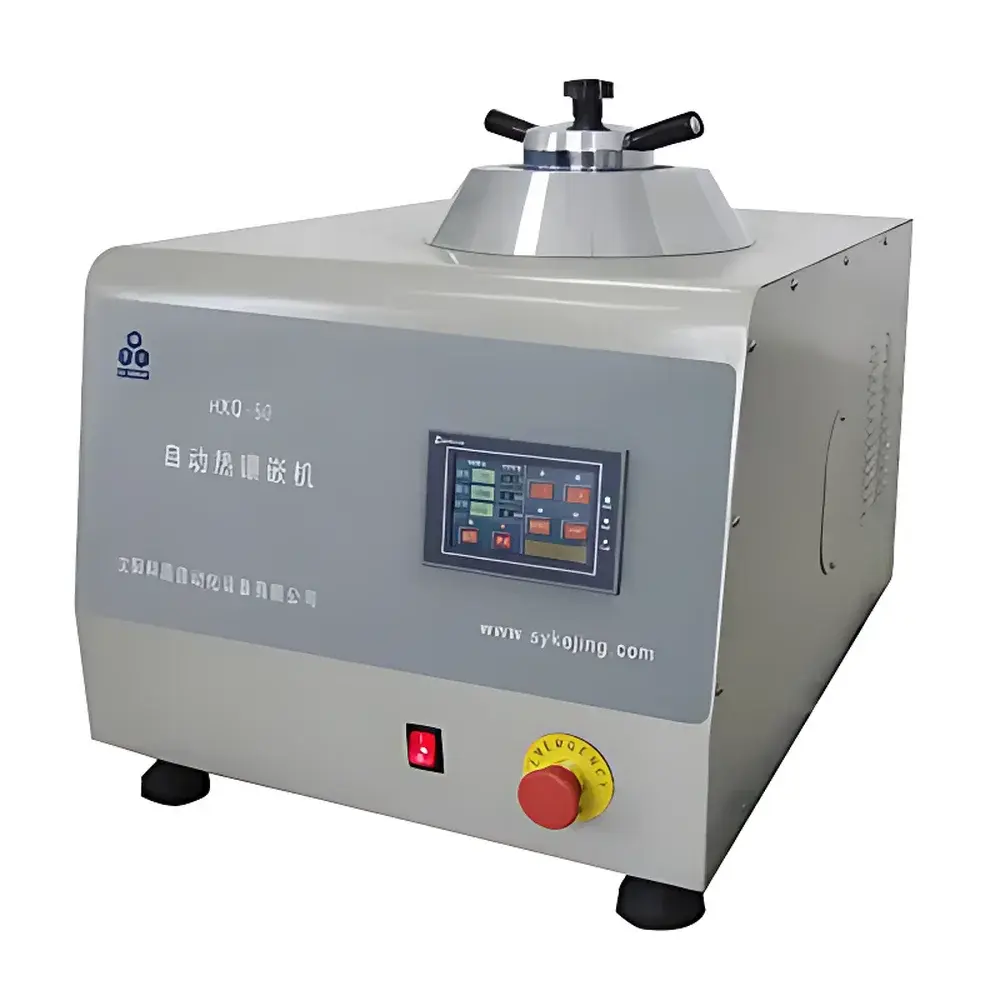
KJ GROUP HXQ-50 Automatic Hot Mounting Press
| Brand | KJ GROUP |
|---|---|
| Origin | Liaoning, China |
| Model | HXQ-50 |
| Instrument Type | Hot Mounting Press |
| Power Supply | AC 220 V, 50 Hz |
| Rated Power | 1200 W |
| Temperature Range | 30–180 °C |
| Pressure Range | 10–2000 kPa |
| Holding Time | 1–900 min |
| Cooling Method | Water-cooled (auto-stop at ≤50 °C) |
| Mold Diameters | Ø25 / Ø30 / Ø40 / Ø50 mm |
| Max. Samples per Cycle | 2 |
| Dimensions (W×D×H) | 600 × 490 × 550 mm |
| Weight | 100 kg |
| Ambient Requirements | ≤1000 m altitude, 10–40 °C ambient, 45–65 %RH |
| Water Connection | Required (inlet & drain) |
| Ventilation | Mandatory |
Overview
The KJ GROUP HXQ-50 Automatic Hot Mounting Press is an engineered solution for reproducible, high-integrity specimen encapsulation in metallurgical, materials science, and failure analysis laboratories. It operates on the principle of thermosetting resin compression molding under controlled temperature and pressure—leveraging the viscoelastic behavior of phenolic, epoxy, or acrylic mounting media during phase transition. Unlike manual or semi-automatic systems, the HXQ-50 integrates programmable thermal ramping, pneumatic/hydraulic pressure application, and active water-based cooling into a single autonomous cycle. This ensures uniform heat distribution, minimized void formation, and dimensional stability across heterogeneous or irregularly shaped specimens—including fractured metals, ceramic composites, electronic packages, and geological thin sections. Designed to meet routine throughput demands in ISO/IEC 17025-accredited labs, the system eliminates operator-dependent variability while maintaining full traceability of process parameters.
Key Features
- Full-cycle automation: Sequential execution of heating, pressurization, dwell (isothermal hold), and controlled cooling—without manual intervention.
- Four interchangeable mold sets (Ø25 mm, Ø30 mm, Ø40 mm, Ø50 mm) support standardized specimen geometry per ASTM E3, ISO 14577, and GB/T 9445 requirements.
- Dual-sample capacity enables parallel processing of identical or dissimilar specimens—reducing per-sample turnaround time by up to 40% versus single-cavity systems.
- Water-cooling circuit with temperature feedback loop terminates cooling automatically upon reaching user-defined endpoint (default: ≤50 °C), preventing thermal shock-induced microcracking.
- Robust mechanical architecture: Cast-iron frame with precision-machined platens ensures load uniformity ±2.5% across full pressure range (10–2000 kPa).
- Compliance-ready interface: All parameter settings (temperature setpoint, pressure target, hold duration, cooling threshold) are stored in non-volatile memory with timestamped logs—supporting GLP/GMP documentation workflows.
Sample Compatibility & Compliance
The HXQ-50 accommodates a broad spectrum of thermally stable and thermally sensitive specimens, including ferrous/non-ferrous alloys, sintered carbides, polymer matrix composites, PCB cross-sections, and mineral aggregates. Its adjustable temperature (30–180 °C) and pressure (10–2000 kPa) ranges align with standard mounting protocols for both low-viscosity acrylic resins (e.g., Crystal-Bond™) and high-temperature phenolics (e.g., Bakelite®). The system complies with electrical safety standards IEC 61010-1 and electromagnetic compatibility directive 2014/30/EU. While not certified to UL or CSA, its design adheres to risk-assessment principles outlined in ISO 12100 for laboratory equipment. Ventilation requirement ensures safe dissipation of volatile organic compounds (VOCs) released during resin polymerization—critical for adherence to OSHA 1910.1200 (Hazard Communication Standard).
Software & Data Management
The HXQ-50 employs a dedicated embedded microcontroller with a tactile membrane keypad and LCD display. Parameter programming is performed via intuitive menu navigation: users define target temperature, ramp rate (fixed slope), dwell time, applied pressure, and cooling termination threshold. All executed cycles generate immutable records containing date/time stamp, operator ID (manual entry), and final measured values (actual peak temperature, achieved pressure, cooling endpoint). These logs are exportable via USB port in CSV format for integration into LIMS or QMS platforms. Though lacking network connectivity or FDA 21 CFR Part 11-compliant electronic signatures, the audit trail satisfies basic GLP documentation requirements for internal QA/QC and third-party accreditation audits.
Applications
- Preparation of metallographic specimens for optical microscopy (OM), scanning electron microscopy (SEM), and energy-dispersive X-ray spectroscopy (EDS).
- Encapsulation of brittle or friable materials—including graphite electrodes, battery cathode layers, and additive-manufactured lattice structures—to prevent edge rounding or pull-out during grinding/polishing.
- Routine quality control in foundries and heat-treatment facilities where batch-to-batch consistency of microstructure assessment is mandated by ASME BPVC Section II or EN 10027.
- Forensic metallurgy and failure analysis, where preservation of interfacial integrity between dissimilar joined components (e.g., welds, brazes, solder joints) is essential.
- Academic research labs requiring repeatable mounting conditions for comparative studies on grain growth kinetics, phase transformation behavior, or corrosion product morphology.
FAQ
What types of mounting resins are compatible with the HXQ-50?
The system supports all commercially available thermosetting resins—including phenolic, epoxy, and acrylic formulations—provided their recommended cure temperature falls within the 30–180 °C operating range.
Is compressed air required for operation?
No. The HXQ-50 utilizes an integrated electromechanical or hydraulic pressure actuation system; no external air supply is needed.
Can the machine be used in a non-ventilated room?
No. Active ventilation is mandatory to remove VOCs generated during resin polymerization and to maintain safe ambient conditions per OSHA and local occupational health regulations.
Does the HXQ-50 support remote monitoring or Ethernet connectivity?
No. It is a standalone instrument with local HMI control only. Data export is limited to USB-hosted CSV files.
What maintenance intervals are recommended?
Annual inspection of sealing gaskets, calibration verification of temperature and pressure sensors, and descaling of the water-cooling circuit (if using hard tap water) are advised per manufacturer guidelines.



