
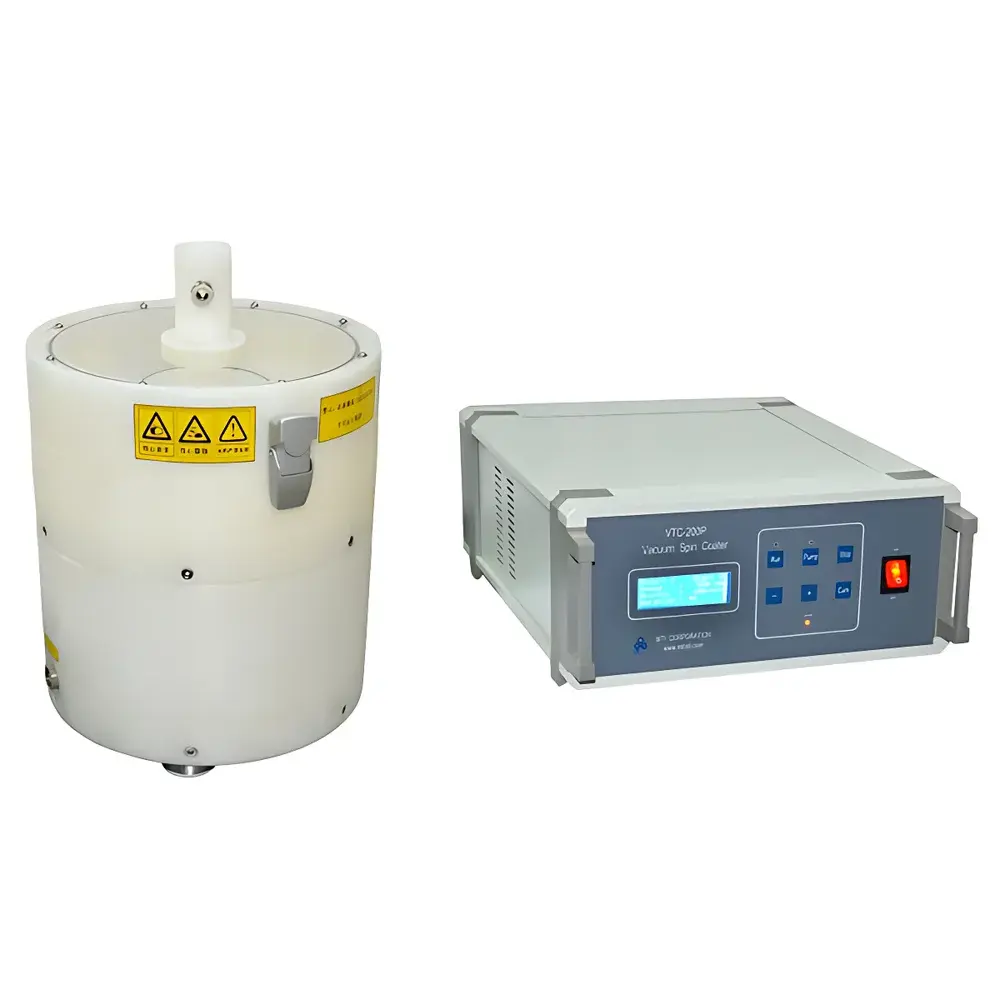
KJ GROUP VTC-200P Vacuum Spin Coater
| Brand | KJ GROUP |
|---|---|
| Origin | Liaoning, China |
| Manufacturer Type | Authorized Distributor |
| Country of Origin | China |
| Model | VTC-200P |
| Pricing | Upon Request |
| Chamber Material | Polypropylene (PP) |
| Vacuum Adsorption Pressure | −0.08 MPa |
| Max Speed | 6000 rpm |
| Speed Stability | ±1% |
| Acceleration/Deceleration Rate | 100–2000 rpm/s per stage |
| Program Storage | 12 programs × 6 stages each |
| Stage Duration | 0–60 s |
| Power Supply | AC 220 V, 50 Hz (10 A), ≤150 W (host only) |
| Dimensions (Host) | Φ250 × 360 mm |
| (Controller) | 330 × 380 × 150 mm |
| Weight | 15 kg |
| Optional Heating | RT–100 °C (±2 °C accuracy, 1000 W heater, PTFE-coated heated chuck) |
Overview
The KJ GROUP VTC-200P Vacuum Spin Coater is an engineered solution for precision thin-film deposition in research and development laboratories. It operates on the principle of centrifugal force-driven solvent evaporation—where a controlled volume of coating solution is dispensed onto a rotating substrate, and rapid angular acceleration induces uniform radial spreading, followed by solvent volatilization under ambient or inert atmosphere. Unlike vacuum-chamber spin coaters, the VTC-200P employs vacuum-assisted substrate fixation via a polypropylene vacuum chuck rather than chamber evacuation, enabling compatibility with corrosive chemistries—including strong acids and bases—while maintaining structural integrity and long-term chemical resistance. Its compact footprint, modular design, and glovebox-compatible architecture make it suitable for cleanroom-adjacent workflows, inert-atmosphere processing (e.g., N₂ or Ar), and integration into multi-instrument fabrication lines. The system is widely deployed in academic labs, materials science centers, and semiconductor R&D facilities for fabricating photoresist layers, perovskite precursors, polymer electrolytes, sol-gel oxides, and organic semiconductor films.
Key Features
- Vacuum adsorption system with adjustable −0.08 MPa holding pressure ensures stable, repeatable substrate immobilization across diverse wafer and substrate geometries.
- Twelve user-programmable protocols, each comprising six independently configurable stages—supporting ramped acceleration profiles (100–2000 rpm/s), dwell times (0–60 s), and final spin speeds up to 6000 rpm—to optimize film uniformity and minimize material waste.
- Polypropylene monocoque chamber construction provides exceptional resistance to hydrochloric acid, sulfuric acid, sodium hydroxide, and organic solvents—eliminating corrosion-related calibration drift and extending service life beyond conventional aluminum or stainless-steel alternatives.
- 24 V DC brushless motor delivers smooth, low-vibration rotation with ±1% speed stability, fast startup response (<500 ms to target speed), and negligible thermal drift during extended operation.
- Integrated centering tooling kit—including alignment pins and concentric locator—reduces eccentric loading and prevents sample ejection or thickness non-uniformity caused by off-center placement.
- Optional PTFE-coated heated chuck (RT–100 °C, ±2 °C control accuracy) enables thermally assisted spin-casting of high-viscosity precursors, facilitating improved wetting and reduced coffee-ring effects.
- Glovebox-ready configuration: main unit fits inside standard argon/nitrogen gloveboxes; controller and oil-free dual-piston vacuum pump remain externally mounted to preserve internal atmosphere integrity.
Sample Compatibility & Compliance
The VTC-200P accommodates substrates up to Ø100 mm, including silicon wafers, glass slides, ITO-coated PET, quartz crystals, and flexible polymer foils. Interchangeable vacuum chucks (available in multiple diameters) allow rapid adaptation to varying sample formats without recalibration. All wetted components—chamber walls, chuck surface, O-rings, and fluid-handling accessories—are chemically inert per ASTM D543 and ISO 10993-5 standards. The device complies with IEC 61000-6-3 (EMC emission limits) and IEC 61010-1 (safety requirements for laboratory equipment). While not certified for GMP manufacturing, its programmable protocol logging, non-volatile memory retention, and hardware interlocks (e.g., lid-open emergency deceleration) support GLP-aligned documentation practices in regulated academic and preclinical settings.
Software & Data Management
The VTC-200P utilizes an embedded PCB-based controller with LCM graphical interface—displaying real-time rpm, elapsed time per stage, vacuum status, and active program ID. All 12 protocols are stored in non-volatile flash memory with write-protection against accidental overwrite. No proprietary software or PC dependency is required; however, optional RS-232 or USB-to-serial adapters enable external logging of runtime parameters (speed, time, vacuum level) into CSV files for traceability. Audit trails are manually reconstructible from displayed timestamps and saved program IDs—suitable for basic FDA 21 CFR Part 11 compliance when paired with lab notebook entries and operator sign-offs.
Applications
- Photoresist spin-coating for microfabrication and mask aligner processes.
- Deposition of metal oxide precursors (e.g., TiO₂, ZnO) for dye-sensitized and perovskite solar cells.
- Uniform casting of PEDOT:PSS, P3HT:PCBM, and other conductive polymer blends in organic electronics.
- Preparation of thin-film solid-state electrolytes for battery research (e.g., LiPON analogues).
- Controlled solvent casting of biopolymer films (chitosan, alginate) in biomaterials studies.
- Rapid prototyping of anti-reflective, hydrophobic, or functionalized coatings on optical components.
FAQ
Can the VTC-200P operate inside a nitrogen-filled glovebox?
Yes—the main unit is fully compatible with inert-atmosphere gloveboxes; only the vacuum pump and controller require external placement.
Is heating functionality standard or optional?
Heating is optional and requires factory-installed PTFE-coated chuck and independent temperature controller; standard configuration includes no heating.
What vacuum pump specifications are recommended?
A dry, oil-free dual-piston pump with ≥70 L/min free-air displacement and ultimate vacuum ≤−0.09 MPa is advised for reliable chuck actuation and minimal maintenance.
Does the system support automatic dispensing?
No—dispensing is manual using the included 20 mL syringe and bracket; automated dispensers are third-party add-ons.
How is positional accuracy ensured during spin-up?
Mechanical centering tools (four-pin locator + concentric guide ring) ensure sub-0.2 mm radial offset, minimizing imbalance-induced vibration at high rpm.
What maintenance intervals are recommended?
Inspect O-rings and chuck surface quarterly; clean PP chamber with isopropanol after corrosive use; verify vacuum seal integrity monthly using a calibrated pressure gauge.



