
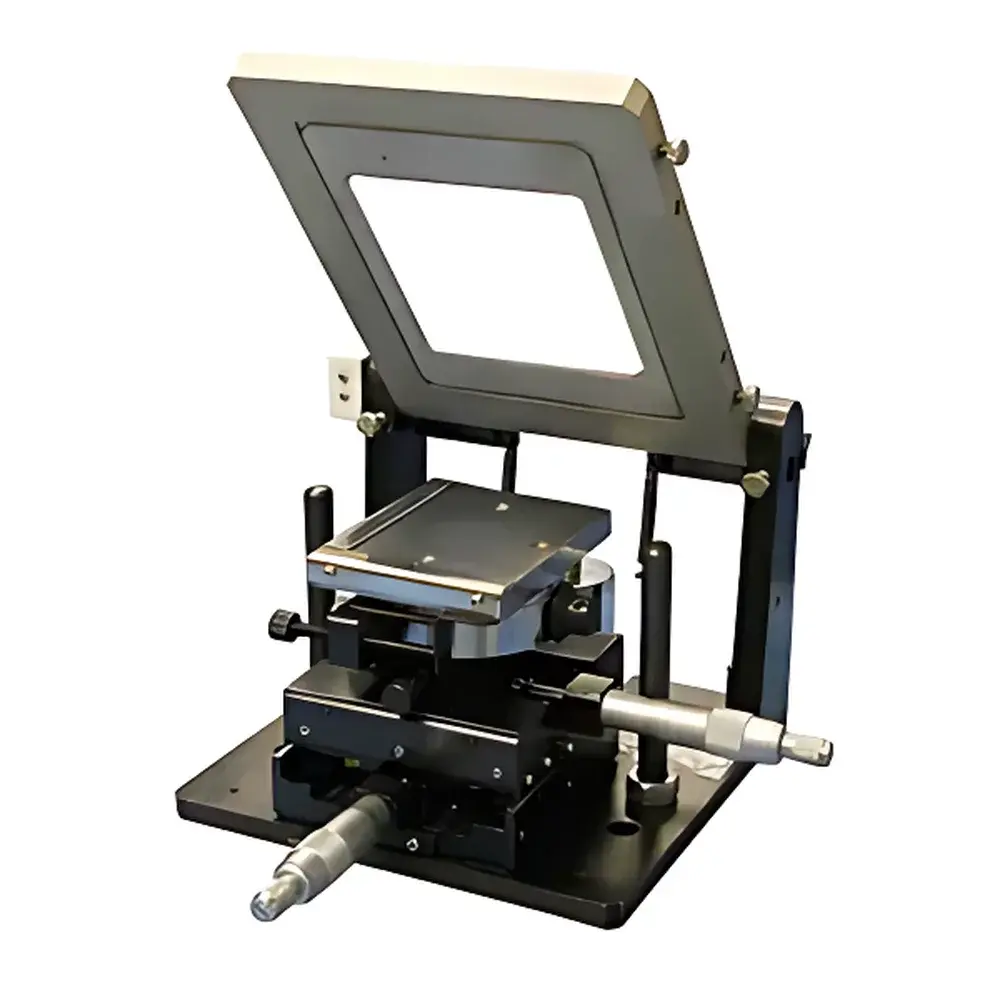
KJ GROUP SPC-1 Miniature Screen Printing Coater
| Brand | KJ GROUP |
|---|---|
| Origin | Liaoning, China |
| Manufacturer Type | Authorized Distributor |
| Country of Origin | China |
| Model | SPC-1 |
| Pricing | Upon Request |
| Max Print Area | 70 mm × 50 mm |
| Min Print Area | 16 mm × 12 mm |
| X/Y Adjustment Range | ±20 mm (±0.01 mm resolution) |
| Z Adjustment Range | 3 mm (±0.05 mm resolution) |
| Screen Angle Adjustment | ±10° |
| Substrate Holding | Vacuum Chuck |
| Frame Dimensions (Top Outer) | 180 mm × 130 mm |
| Frame Dimensions (Bottom Outer) | 125 mm × 108 mm |
| Overall Dimensions (Closed) | 300 mm × 240 mm × 170 mm |
| Overall Dimensions (Open) | 300 mm × 240 mm × 330 mm |
| Weight | 11 kg |
| Operating Ambient | Altitude < 1000 m, Temperature 10–40 °C, Relative Humidity 45–65 %RH |
| Power Supply | AC 380 V, 50 Hz, 63 A circuit breaker with dedicated earth ground |
| Cooling | Integrated recirculating chiller (deionized or distilled water) |
| Process Gas | High-purity argon (≥99.99 %), supplied via Ø6 mm double-ferrule fitting |
Overview
The KJ GROUP SPC-1 Miniature Screen Printing Coater is a manually operated, high-precision benchtop instrument engineered for controlled deposition of functional inks, pastes, and slurries onto substrates via screen printing—a contact-based, stencil-driven patterning technique rooted in shear-controlled material transfer. Unlike automated industrial systems, the SPC-1 prioritizes repeatability at microscale dimensions (down to 16 mm × 12 mm), making it suitable for R&D laboratories developing thin-film devices such as perovskite solar cells, flexible sensors, printed electronics, and micro-batteries. Its core architecture integrates three-axis micrometric adjustment (X, Y, Z), fine angular alignment of the mesh screen (±10°), and vacuum-assisted substrate immobilization—enabling consistent registration accuracy and layer thickness control under non-cleanroom conditions. The system operates without internal vacuum pumps or plasma sources; instead, it relies on external argon purging to maintain inert ambient during sensitive material processing—particularly relevant for air-sensitive precursors used in metal oxide or halide perovskite ink formulation.
Key Features
- Three-axis manual micrometer stages (X/Y: ±20 mm, ±0.01 mm resolution; Z: 3 mm, ±0.05 mm resolution) for precise squeegee-to-screen and screen-to-substrate gap control
- Vacuum chuck substrate holder compatible with rigid and semi-flexible wafers, glass slides, and ceramic plates up to 70 mm × 50 mm
- Modular screen frame design supporting rapid mesh replacement; top frame outer dimension 180 mm × 130 mm, bottom frame 125 mm × 108 mm
- Adjustable screen tilt (±10°) to optimize ink fill and release behavior across varying mesh counts (commonly 100–300 T/inch)
- Integrated recirculating water chiller (requires deionized or distilled water) to stabilize thermal drift during extended operation
- Compact footprint (300 mm × 240 mm × 170 mm closed; 330 mm height when frame is raised) and low mass (11 kg) for easy integration into fume hoods or gloveboxes
- Dedicated argon inlet (Ø6 mm double-ferrule fitting) enabling localized inert atmosphere maintenance within the print zone
Sample Compatibility & Compliance
The SPC-1 accommodates standard laboratory substrates including silicon wafers (up to 4-inch), fused silica, ITO/PET films, alumina ceramics, and stainless-steel foils. Its vacuum chuck supports flatness tolerances ≤25 µm over 50 mm span. While not certified to ISO 14644 cleanroom classes, the unit meets mechanical stability requirements outlined in ASTM D4946 (Standard Practice for Evaluating Screen Printing Equipment). For regulated environments, the absence of internal electronics in the print chamber allows straightforward qualification under GLP or GMP-aligned protocols when paired with documented calibration of micrometer scales and vacuum pressure gauges. Argon purge compatibility aligns with USP guidance for inert-atmosphere processing of moisture- or oxygen-sensitive active pharmaceutical ingredients (APIs) in printed dosage form development.
Software & Data Management
The SPC-1 is fully manual and does not incorporate embedded firmware, touchscreen interface, or digital control software. All operational parameters—including squeegee angle, snap-off distance, stroke speed, and pressure—are set mechanically and recorded manually in lab notebooks or electronic lab notebooks (ELNs) compliant with 21 CFR Part 11. Users are advised to implement standardized operating procedures (SOPs) referencing traceable micrometer calibrations (e.g., NIST-traceable gauge blocks) and vacuum gauge verification logs. Optional integration with time-lapse imaging systems (via external USB camera mounts) enables post-process registration analysis using open-source tools like ImageJ or commercial metrology platforms such as Keysight PathWave.
Applications
- Prototyping of patterned electrodes for solid-state batteries (LiCoO₂, LFP inks) and electrochromic devices
- Deposition of silver nanoparticle inks for RFID antenna fabrication on flexible polyimide substrates
- Functional layer printing in organic photovoltaics (OPV), including PEDOT:PSS hole transport layers and ZnO electron extraction layers
- Micro-scale ceramic thick-film resistor and capacitor fabrication for hybrid microelectronics packaging
- Controlled deposition of hydrogel bioinks in tissue engineering scaffold patterning (when combined with biocompatible screen meshes)
- Calibration and validation of rheological models for paste extrusion and shear-thinning behavior under constrained gap conditions
FAQ
Is the SPC-1 compatible with glovebox integration?
Yes—the unit’s external argon port, low power demand, and absence of internal outgassing components enable seamless installation inside nitrogen- or argon-purged gloveboxes (O₂/H₂O < 1 ppm). Structural mounting brackets are available upon request.
What mesh count ranges are supported?
The frame geometry accommodates standard stainless-steel or polyester meshes from 100 to 400 threads per inch (TPI); optimal performance is observed between 150–250 TPI for sub-50 µm feature definition.
Does the system include squeegee blades?
Yes—two interchangeable polyurethane squeegees (60A and 80A durometer) are supplied with each unit, along with torque-adjustable blade holders for consistent edge pressure.
Can the vacuum chuck accommodate curved substrates?
No—the chuck surface is planar and designed exclusively for flat or near-planar substrates with total indicator reading (TIR) ≤25 µm over the active area.
Is electrical safety certification provided?
The SPC-1 complies with IEC 61010-1:2010 for laboratory electrical equipment; CE marking documentation and factory test reports are available under NDA upon order confirmation.



