
KJ GROUP SP-MSM32 High-Throughput Arc Melting System
| Brand | KJ GROUP |
|---|---|
| Origin | Anhui, China |
| Manufacturer Type | Authorized Distributor |
| Country of Origin | China |
| Model | SP-MSM32 |
| Pricing | Upon Request |
| Vacuum Glove Box Dimensions | 1200 × 900 × 750 mm (W×D×H), Front-Opening |
| Transition Chamber | 360 × 600 mm / 150 × 300 mm |
| Purification Capacity | H₂O/O₂ < 1 ppm (auto-regenerating) |
| Oxygen Analyzer Accuracy | ±0.1 ppm (0–999 ppm range) |
| Arc Electrode | Ø4 mm tungsten, water-cooled |
| Electrode Travel Range | ≥200 × 400 × 50 mm (X-Y-Z) |
| Water-Cooled Crucibles | 32 × Ø25 mm |
| Max Melting Temperature | 3000 °C |
| Adjustable Output Current | 10–250 A (AC 220 V, 50 Hz) |
| Optional Power Supply | 300 A (AC 380 V, 50 Hz) |
| Cooling System | KJ-5000 recirculating chiller |
| Protective Atmosphere | 5N Ar or 5% H₂ + 95% Ar |
| Safety | Integrated UV/IR shielding, mandatory eyewear during operation |
Overview
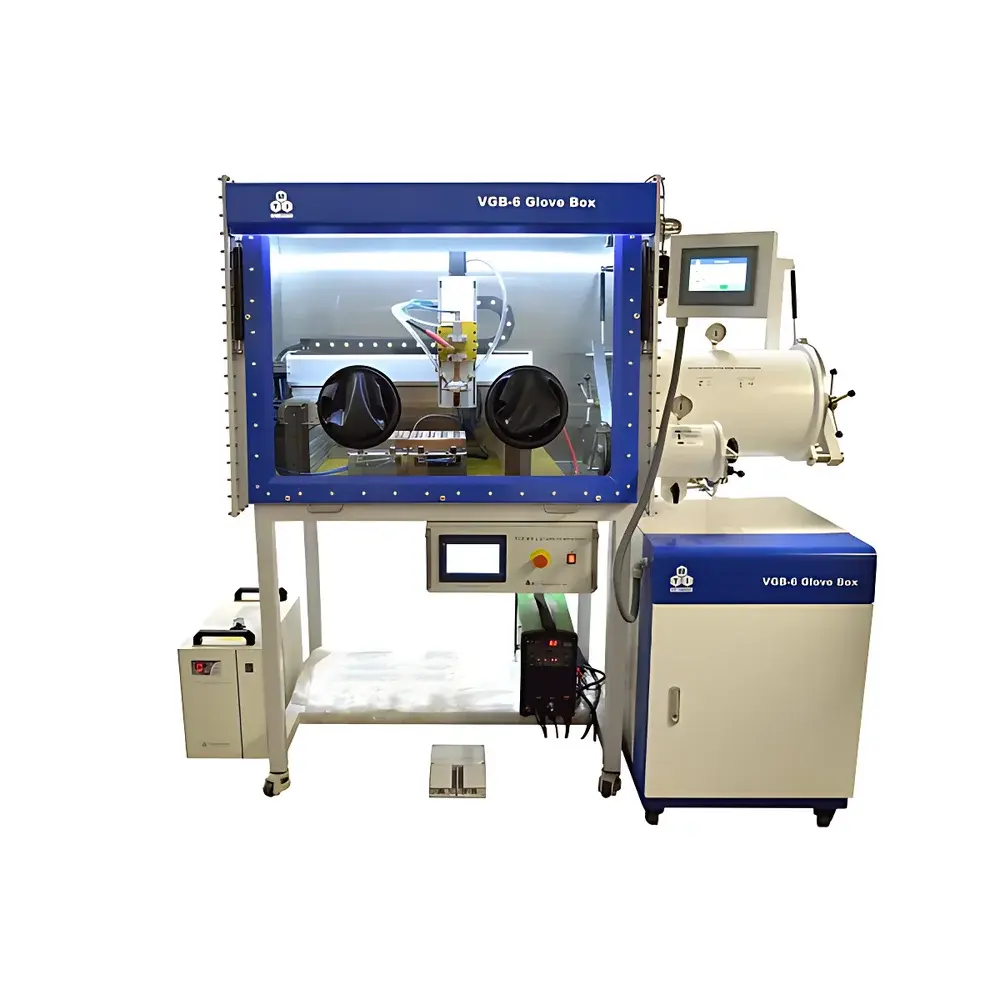
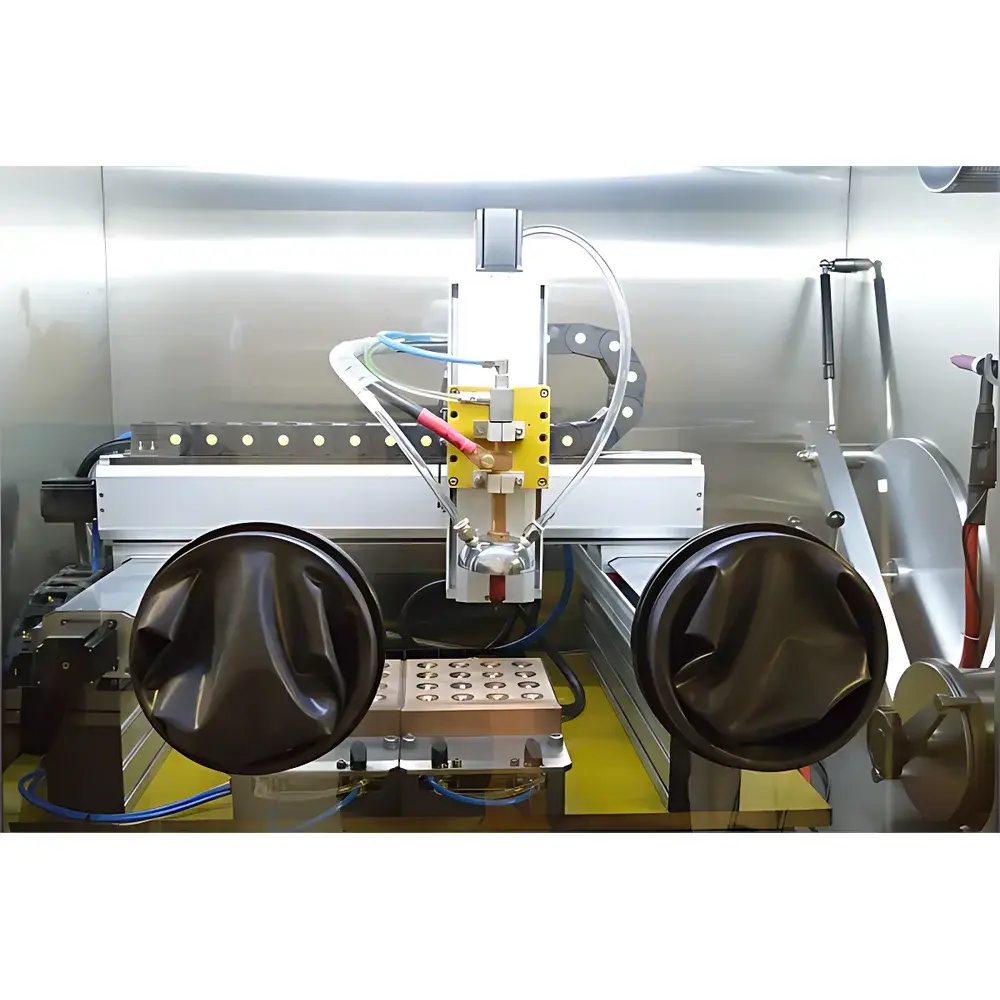
The KJ GROUP SP-MSM32 High-Throughput Arc Melting System is an integrated, vacuum-compatible materials synthesis platform engineered for rapid, parallel metallurgical processing under inert or reducing atmospheres. It combines a Class-1000 inert-atmosphere glove box, a precision X-Y-Z programmable electrode positioning system, and a high-current DC arc melting unit to enable simultaneous melting of up to 32 discrete alloy compositions in a single thermal cycle. The system operates on the principle of direct-current arc discharge between a consumable tungsten electrode and conductive samples placed in water-cooled copper crucibles—generating localized plasma temperatures exceeding 3000 °C without furnace heating. This enables rapid solidification kinetics, minimal interstitial contamination, and high compositional fidelity—critical for phase diagram mapping, combinatorial alloy screening, and development of next-generation Ni-, Co-, and refractory-based superalloys. Its architecture supports full process isolation from ambient air, ensuring oxygen and moisture levels remain below 1 ppm throughout sample handling, melting, and post-melting cooling.
Key Features
- Integrated vacuum glove box with front-opening design (1200 × 900 × 750 mm), constructed from 3 mm 304 stainless steel and fitted with high-strength tempered glass viewing windows.
- Dual 180 × 180 mm water-cooled copper crucible arrays mounted on insulated base plates, each accommodating 32 individual Ø25 mm sample positions.
- Programmable X-Y-Z motion controller with intuitive color touchscreen interface; pre-defined sequences automate electrode traversal across all 32 crucibles with repeatable positional accuracy.
- Auto-regenerating gas purification system featuring dual-bed sorbents (copper-based deoxygenation and molecular sieve dehydration), monitored in real time by embedded dew point and oxygen analyzers (±0.1 ppm resolution).
- KJ-5000 closed-loop recirculating chiller providing stable coolant flow and temperature control (< 25 °C) to both electrode and crucible assemblies during sustained high-current operation.
- Modular power supply architecture supporting standard 10–250 A output (220 V AC) and optional 300 A upgrade (380 V AC), enabling precise current ramping and stabilization for reproducible melt pool geometry and thermal history.
Sample Compatibility & Compliance
The SP-MSM32 accommodates metallic feedstock in pellet, chip, or pre-alloyed button form (≤ Ø25 mm × 15 mm height), including but not limited to Ni-, Fe-, Co-, Ti-, Al-, Mo-, Nb-, and W-based systems. Non-conductive or ceramic-containing compositions require conductive binders or hybrid crucible liners. All internal wetted surfaces are electropolished 304 SS or oxygen-free high-conductivity (OFHC) copper, compliant with ASTM F86 for surface finish and ISO 10993-1 biocompatibility prerequisites where applicable. The glove box meets ISO 14644-1 Class 7 (10,000) cleanroom equivalency when operated under continuous purge. Gas purity control (≤1 ppm O₂/H₂O) satisfies ASTM E29 standard practice for trace contaminant management in high-temperature metallurgy and aligns with GLP documentation requirements for alloy development workflows.
Software & Data Management
System operation is coordinated via an embedded industrial-grade HMI with non-volatile program storage (≥1000 recipes). Each melting sequence logs timestamped metadata—including setpoint current, arc voltage, electrode Z-height, chamber O₂/H₂O concentration, and chiller outlet temperature—to onboard SD card storage in CSV format. Exported datasets are compatible with MATLAB, Python (pandas), and commercial statistical analysis platforms (e.g., JMP, OriginPro) for multivariate correlation of composition–processing–microstructure relationships. Audit trails comply with FDA 21 CFR Part 11 requirements when paired with optional networked user authentication and electronic signature modules. No cloud connectivity is enabled by default; all data remains on-device unless manually exported via USB.
Applications
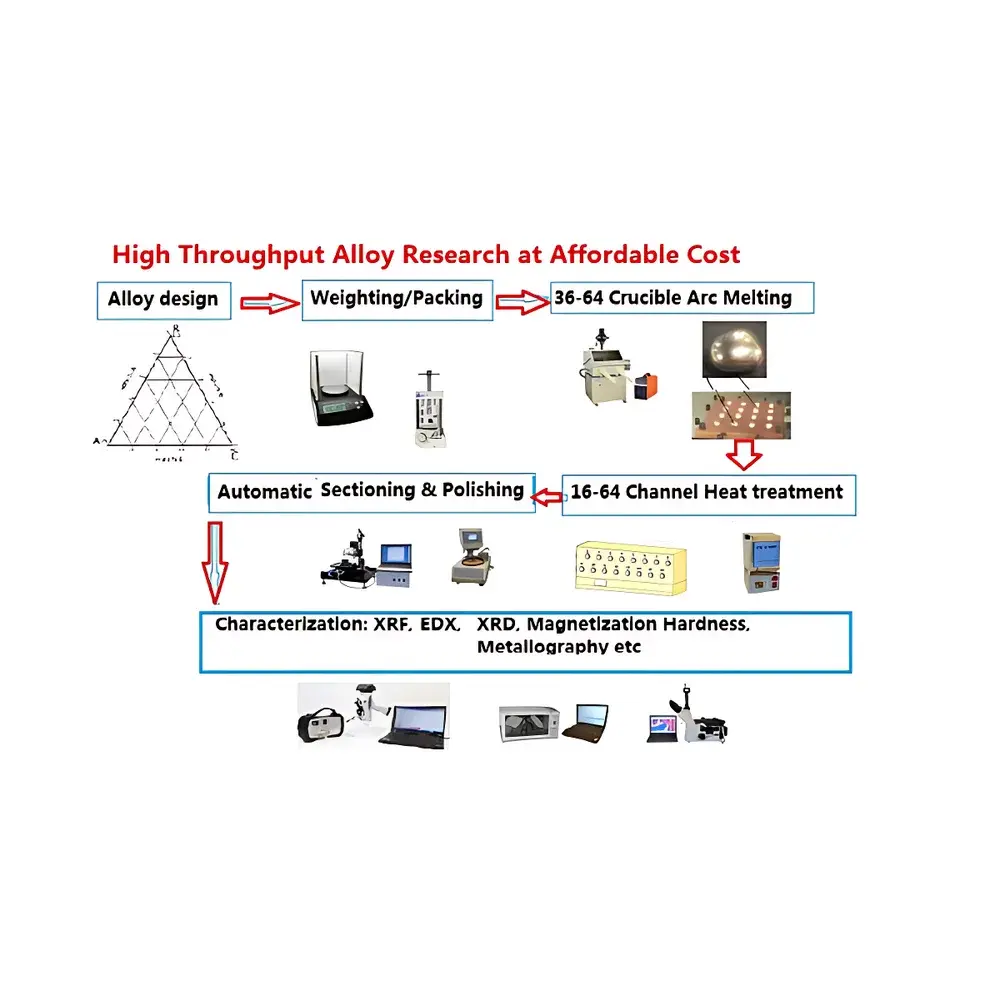
- High-throughput phase diagram construction for multi-component alloy systems (e.g., quaternary Ni–Cr–Al–Ta).
- Rapid screening of oxidation-resistant coatings and refractory metal intermetallics (e.g., Nb–Si–Ti, Mo–Si–B).
- Preparation of master alloys for subsequent casting, additive manufacturing feedstock qualification, or CALPHAD model validation.
- In-situ homogenization and remelting of rapidly solidified ribbons or atomized powders under controlled redox potential (H₂/Ar mixtures).
- Teaching and method development in graduate-level metallurgy and materials science laboratories requiring hands-on arc melting exposure with industrial-grade safety and repeatability.
FAQ
What protective atmosphere is required for optimal oxide suppression?
High-purity argon (5N, ≤5 ppm O₂/H₂O) is standard; for reactive systems (e.g., Ti-, Mg-, or rare-earth-containing alloys), a 5% H₂/95% Ar mixture is recommended to thermodynamically suppress oxide formation at elevated temperatures.
Can the crucible array be reconfigured for non-standard sample geometries?
Yes—custom crucible plates (e.g., rectangular slots, tapered wells, or embedded thermocouple ports) are available as OEM-engineered accessories upon technical review and mechanical compatibility verification.
Is remote monitoring or automation integration supported?
The system provides RS-485 and Ethernet ports for Modbus TCP communication; PLC-level integration with lab-wide MES or SCADA systems is achievable using documented register maps and protocol guides supplied with purchase.
What maintenance intervals are recommended for the gas purification system?
Sorbent regeneration cycles are automatically triggered based on real-time sensor drift; full bed replacement is advised after 12 months of continuous operation or following 2000 hours of cumulative glove box runtime, whichever occurs first.
Does the system meet electromagnetic compatibility (EMC) standards for installation in shared laboratory spaces?
Yes—the arc power supply conforms to EN 61000-6-3 (emission) and EN 61000-6-2 (immunity) for industrial environments; ferrite-core filtered input lines and shielded signal cabling are factory-installed.



