
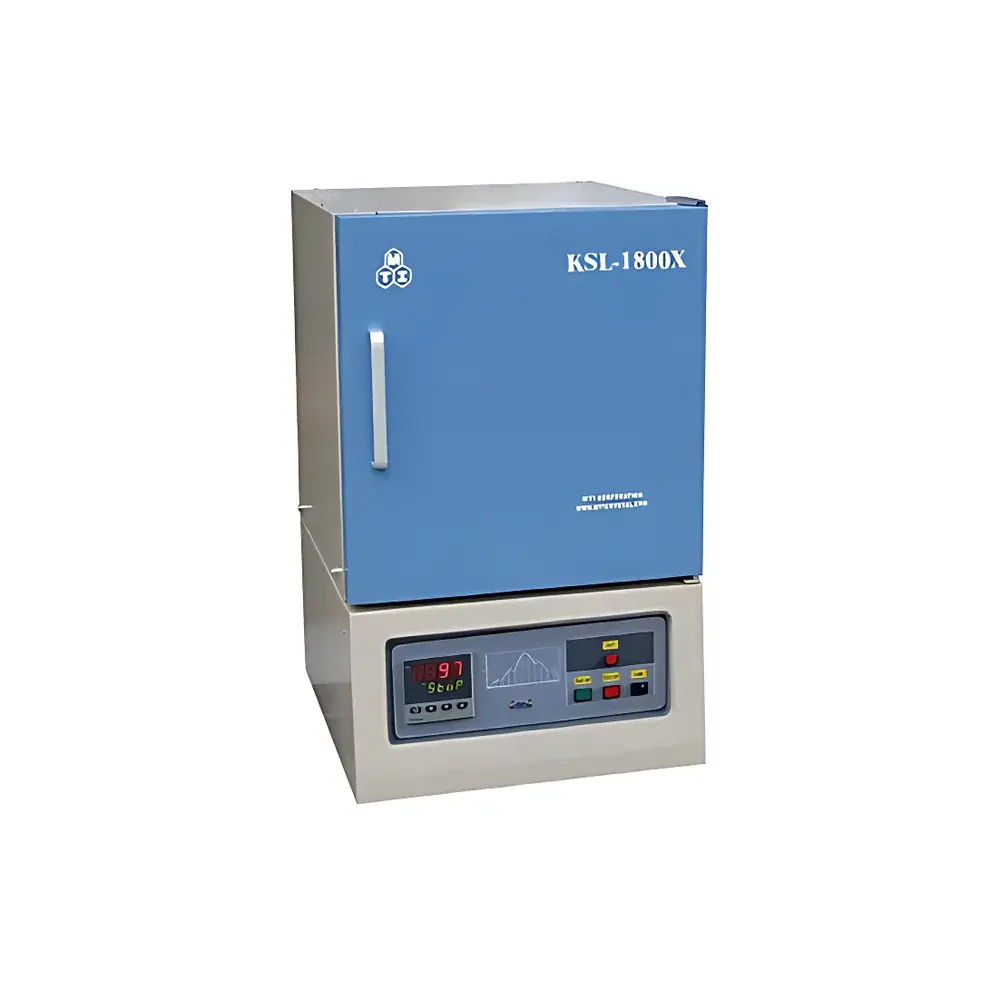
KJ GROUP KSL-1800X-A1 High-Temperature Box Furnace (3.4 L, 1800 °C)
| Brand | KJ GROUP |
|---|---|
| Origin | Anhui, China |
| Manufacturer Type | Authorized Distributor |
| Equipment Type | Box-Type Muffle Furnace |
| Model | KSL-1800X-A1 |
| Max Temperature | 1800 °C (≤2 h), Continuous Operation ≤1750 °C |
| Temperature Uniformity | ±1 °C |
| Power Supply | AC 220 V, 50 Hz, 2 kW |
| Heating Rate | 10 °C/min (to max temp) |
| Heating Element | Kanthal Super-1900 MoSi₂ Rods |
| Internal Chamber Dimensions | 150 mm × 150 mm × 150 mm (3.4 L) |
| Insulation | Multi-Crystal Alumina Fiber + Zirconia Liner |
| Thermocouple | Type B Dual Platinum-Rhodium |
| Certification | CE Compliant |
| External Dimensions | 500 mm × 490 mm × 700 mm |
| Net Weight | 120 kg |
Overview
The KJ GROUP KSL-1800X-A1 is a compact, high-precision box-type muffle furnace engineered for demanding high-temperature thermal processing in research laboratories and materials development facilities. Designed around a robust dual-shell architecture with multi-layered insulation—comprising high-purity multi-crystalline alumina fiber and a zirconia-coated inner liner—the furnace achieves stable, repeatable operation up to 1800 °C for short-duration treatments (≤2 hours), and sustained continuous operation at 1750 °C. Its core heating system utilizes Kanthal® Super-1900 molybdenum disilicide (MoSi₂) rods, known for exceptional oxidation resistance and long-term stability in air atmospheres above 1600 °C. The furnace supports controlled-atmosphere operation via dedicated gas inlet/outlet ports, enabling use under inert (Ar, N₂), oxidizing (air, O₂), or reducing (H₂/N₂ mixtures, with appropriate safety protocols) conditions—though vacuum sealing and flammable gas introduction are explicitly excluded per design limitations.
Key Features
- Dual-shell structural design with active air-gap cooling ensures external surface temperature remains below 60 °C during full-load operation, enhancing operator safety and reducing ambient heat load.
- High-density multi-crystalline alumina fiber insulation combined with a zirconia-reinforced inner liner delivers superior thermal retention, minimizing energy consumption while maintaining uniform temperature distribution across the 3.4 L chamber (150 mm × 150 mm × 150 mm).
- PID-based temperature controller with 30-segment programmable ramp-soak profiles enables precise thermal protocol execution—from slow annealing cycles to rapid sintering schedules—while supporting real-time deviation monitoring and auto-correction.
- Side-opening door mechanism with reinforced ceramic gasket minimizes heat loss during sample loading/unloading and improves accessibility compared to top- or bottom-hinged configurations.
- Integrated Type B (Platinum–30% Rhodium / Platinum–6% Rhodium) thermocouple provides traceable, high-accuracy temperature measurement across the full operational range (0–1800 °C), with inherent stability and low drift under prolonged exposure.
- CE-marked construction complies with EN 61000-6-3 (EMC emission) and EN 61000-6-2 (immunity) standards, ensuring electromagnetic compatibility in shared laboratory environments.
Sample Compatibility & Compliance
The KSL-1800X-A1 accommodates standard high-temperature crucibles—including alumina, zirconia, and silicon carbide—and is routinely used for sintering advanced ceramics (e.g., YSZ, Si₃N₄), heat-treating refractory metals (Mo, W, Nb), ashing high-purity polymers, and synthesizing oxide-based battery cathode materials (e.g., NMC, LFP). It meets general laboratory safety requirements under ISO/IEC 17025:2017 for equipment qualification and supports GLP-compliant documentation when paired with external data loggers. While not certified to UL or ASTM E119 fire-resistance standards, its CE marking confirms conformity with the EU Machinery Directive 2006/42/EC and Low Voltage Directive 2014/35/EU. Users intending to introduce reactive or corrosive gases (e.g., H₂S, Na vapor) must consult KJ GROUP prior to operation; optional zirconia-enhanced liner treatments are available upon request to mitigate chemical degradation.
Software & Data Management
The furnace operates via an embedded PID controller with local keypad interface and LED display. While no proprietary PC software is bundled, the controller supports analog 0–5 V or 4–20 mA output signals compatible with third-party SCADA systems (e.g., LabVIEW, Ignition, Siemens Desigo) for centralized monitoring and archival. Optional RS485 Modbus RTU communication modules enable integration into automated lab networks compliant with ISA-88/ISA-95 frameworks. All temperature setpoints, ramp rates, soak durations, and real-time readings are locally stored with timestamping. For regulated environments requiring audit trails (e.g., FDA 21 CFR Part 11), external validation-grade data loggers with electronic signature capability are recommended to meet ALCOA+ principles (Attributable, Legible, Contemporaneous, Original, Accurate, Complete, Consistent, Enduring, Available).
Applications
- Sintering of ultra-high-temperature ceramics (UHTCs) such as ZrB₂–SiC composites and HfC-based systems.
- Thermal gravimetric analysis (TGA) pre-conditioning and residue quantification in geochemical and pharmaceutical QA/QC workflows.
- Crystallization studies of rare-earth-doped phosphors and solid-state electrolytes for solid oxide fuel cells (SOFCs).
- Controlled oxidation of transition metal foils (e.g., Ni, Co) to generate nanostructured oxide layers for catalysis research.
- Heat treatment of dental and orthopedic bioceramic implants (e.g., hydroxyapatite coatings on Ti-6Al-4V substrates) per ISO 13779-2.
- Calibration reference source for blackbody radiometry and infrared sensor validation at temperatures exceeding 1600 °C.
FAQ
What is the maximum recommended heating/cooling rate to ensure furnace longevity?
The manufacturer specifies 10 °C/min as the upper limit for both heating and cooling cycles to minimize thermal stress on the MoSi₂ elements and insulation matrix.
Can this furnace be operated under vacuum?
No. The KSL-1800X-A1 lacks vacuum-rated seals and chamber integrity; it is designed exclusively for atmospheric or gas-purged (non-vacuum) environments.
Is the furnace suitable for hydrogen atmosphere processing?
Hydrogen can be introduced only in diluted form (e.g., ≤5% H₂ in N₂ or Ar) and requires prior consultation with KJ GROUP to assess compatibility with gasket materials and thermocouple protection tubes.
How often should the B-type thermocouple be recalibrated?
For ISO/IEC 17025-compliant applications, annual calibration against a NIST-traceable reference standard is advised; field verification using fixed-point cells (e.g., Pd–Cu eutectic at 1527 °C) is recommended every 200 operational hours.
What maintenance is required for the alumina fiber insulation?
Visual inspection every 100 operating hours is recommended; minor surface cracking is normal and does not impair performance. Reapplication of colloidal alumina coating restores emissivity and surface integrity without disassembly.
Related Products



