
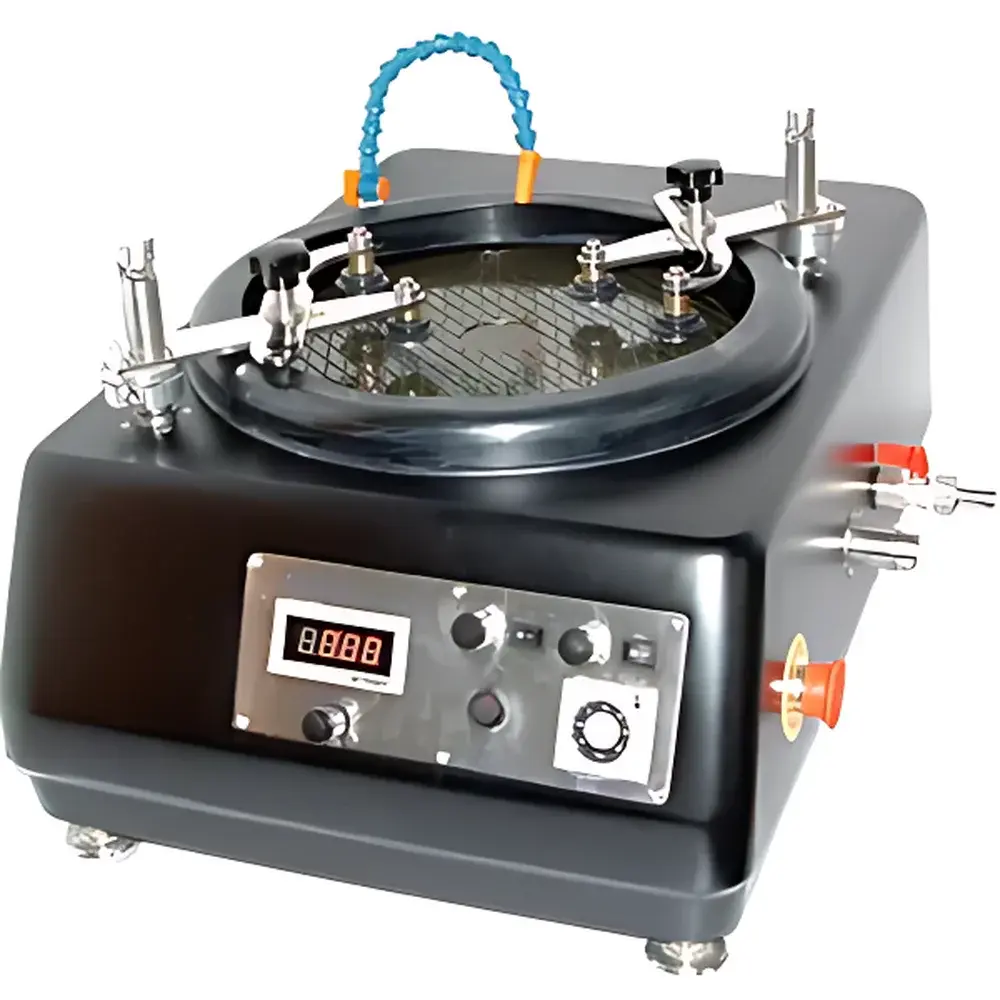
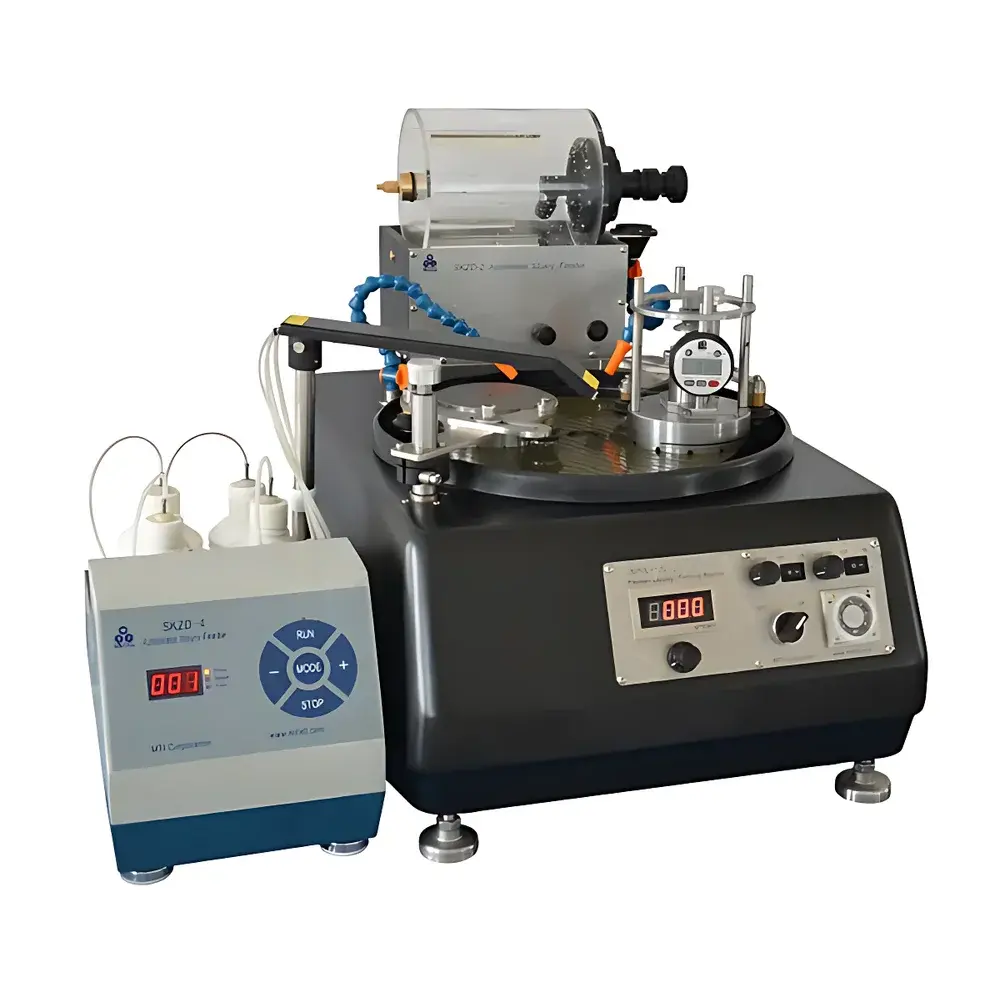
KJ GROUP UNIPOL-1202 Automated Precision Lapping and Polishing Machine
| Brand | KJ GROUP |
|---|---|
| Origin | Liaoning, China |
| Model | UNIPOL-1202 |
| Dimensions (L×W×D) | 700 mm × 420 mm × 350 mm |
| Number of Platters | 1 |
| Platter Diameter | 300 mm |
| Rotational Speed Range | 10–125 rpm |
| Workstations | 2 |
| Carrier Plate Diameter | ≤105 mm |
| Swing Frequency | 0–9 cycles/min |
| Spindle Runout | ≤0.008 mm per 250 mm |
| Power Supply | AC 220 V / 50 Hz |
| Rated Power | 275 W |
| Operating Temperature | 10–40 °C |
| Relative Humidity | 45–65 % RH |
| Weight | 80 kg |
Overview
The KJ GROUP UNIPOL-1202 Automated Precision Lapping and Polishing Machine is an engineered solution for high-fidelity planar surface preparation of hard and brittle materials in research laboratories and quality control environments. It operates on the principle of controlled mechanical abrasion—combining rotational motion of a precision-ground platter with synchronized orbital oscillation of dual sample carriers—to achieve uniform material removal and exceptional surface flatness without edge rounding or subsurface damage. Designed for reproducible specimen preparation prior to optical microscopy, electron backscatter diffraction (EBSD), X-ray fluorescence (XRF), or thin-section analysis, the system delivers deterministic kinematics through its dual-axis motion architecture: the carrier block rotates about its own axis while simultaneously orbiting the center of the 300 mm diameter platter at adjustable frequencies (0–9 cycles/min). This multi-degree-of-freedom motion ensures statistically isotropic abrasion trajectories across the entire sample surface, minimizing directional artifacts and enhancing inter-sample consistency.
Key Features
- Precision-engineered 300 mm lapping/polishing platter with surface flatness ≤0.0025 mm per 25 mm × 25 mm area—verified per ISO 10791-7 metrology standards.
- Dual independent workstations accommodating specimens up to Ø105 mm circular or ≤105 mm diagonal square geometry; each equipped with high-precision cylindrical carrier blocks machined to ≤0.005 mm parallelism and ≤0.003 mm planarity.
- Stepless speed control of main spindle (10–125 rpm) with digital tachometric display and integrated timer (0–300 h range) enabling repeatable process parameter logging.
- Low-runout spindle assembly with total indicated runout (TIR) ≤0.008 mm over 250 mm measurement length—critical for maintaining consistent pressure distribution during fine polishing stages.
- Magnetic retention system for rapid exchange of abrasive media including diamond-impregnated resin pads, alumina-coated sandpaper, polyurethane polishing cloths, and synthetic leather substrates.
- Modular auxiliary interface supporting optional accessories: SKZD-series programmable dispensers for controlled slurry delivery; YJXZ-12 recirculating coolant pump; GPC-50A/GPC-80A precision process controllers compliant with GLP audit trail requirements.
Sample Compatibility & Compliance
The UNIPOL-1202 is validated for use with crystalline, ceramic, metallic, geological, and optoelectronic substrates—including silicon, germanium, ZnS, ZnSe, sapphire, fused silica, alumina, tungsten carbide, basalt thin sections, and FR-4 PCB laminates. Its mechanical design conforms to IEC 61000-6-2 (immunity) and IEC 61000-6-4 (emission) electromagnetic compatibility directives. When operated with GPC-80A controller and SKZD-4 auto-dropper, the system supports ASTM E3-22 (preparation of metallographic specimens) and ISO 14577-1:2022 (instrumented indentation testing sample prep). All electrical components meet CE marking requirements for laboratory equipment under Directive 2014/35/EU (LVD) and 2014/30/EU (EMC). No compressed air or external vacuum is required; operation relies solely on standard AC mains power and gravity-fed water drainage.
Software & Data Management
While the base UNIPOL-1202 operates via front-panel controls, integration with optional GPC-50A or GPC-80A controllers enables full digital process management. These units provide password-protected user profiles, time-stamped operational logs, parameter locking for SOP enforcement, and exportable CSV reports compatible with LIMS platforms. The GPC-80A variant includes FDA 21 CFR Part 11-compliant electronic signature capability, audit trail generation, and role-based access control—making it suitable for regulated environments governed by ISO/IEC 17025 or GMP Annex 11. All firmware updates are delivered via secure USB interface with cryptographic signature verification.
Applications
- Geological thin section preparation for petrographic microscopy and cathodoluminescence imaging.
- Planarization of semiconductor wafers and IR-transmissive optical windows prior to coating or metrology.
- Surface conditioning of metallurgical samples for grain structure analysis per ASTM E112.
- Edge-preserving flattening of brittle ceramics and composite laminates used in aerospace structural testing.
- Preparation of cross-sectional TEM lamellae where minimal topography and absence of beveling are mandatory.
- Routine QC grinding of refractory materials (e.g., firebrick, castables) for compressive strength correlation studies.
FAQ
What types of abrasive media are compatible with the UNIPOL-1202?
Magnetic-backed diamond pads (15–0.25 µm), alumina-impregnated sandpaper (P80–P2000), polyurethane polishing cloths, synthetic leather, and microfiber pads—all adhering via the integrated ferromagnetic platter surface.
Can the machine be used for both coarse grinding and final polishing?
Yes. By selecting appropriate abrasive grits (e.g., 15 µm diamond for rough lapping, 0.05 µm colloidal silica for final polish) and adjusting rotational speed, dwell time, and oscillation frequency, the system supports full-process specimen preparation from initial sectioning to optical-grade finish.
Is the UNIPOL-1202 suitable for preparing samples for EBSD analysis?
When configured with vibration-isolated mounting, sub-micron diamond suspension delivery (via SKZD-4), and low-speed (6 cycles/min) parameters, it achieves the near-perfect planarity and damage-free surface required for reliable EBSD indexing.
Does the system support automated slurry dosing?
Optional SKZD-4 automatic dispenser provides programmable, pulse-width-modulated slurry delivery synchronized with rotation phase—enabling precise control of abrasive concentration and reducing operator variability.
What maintenance intervals are recommended?
Platter surface flatness should be verified quarterly using optical flats and interferometry; carrier block parallelism checked biannually; magnetic chuck cleaned weekly to prevent particulate buildup; and all lubrication points serviced every 500 operating hours per manufacturer’s technical bulletin TB-UNIPOL-2023-04.



