
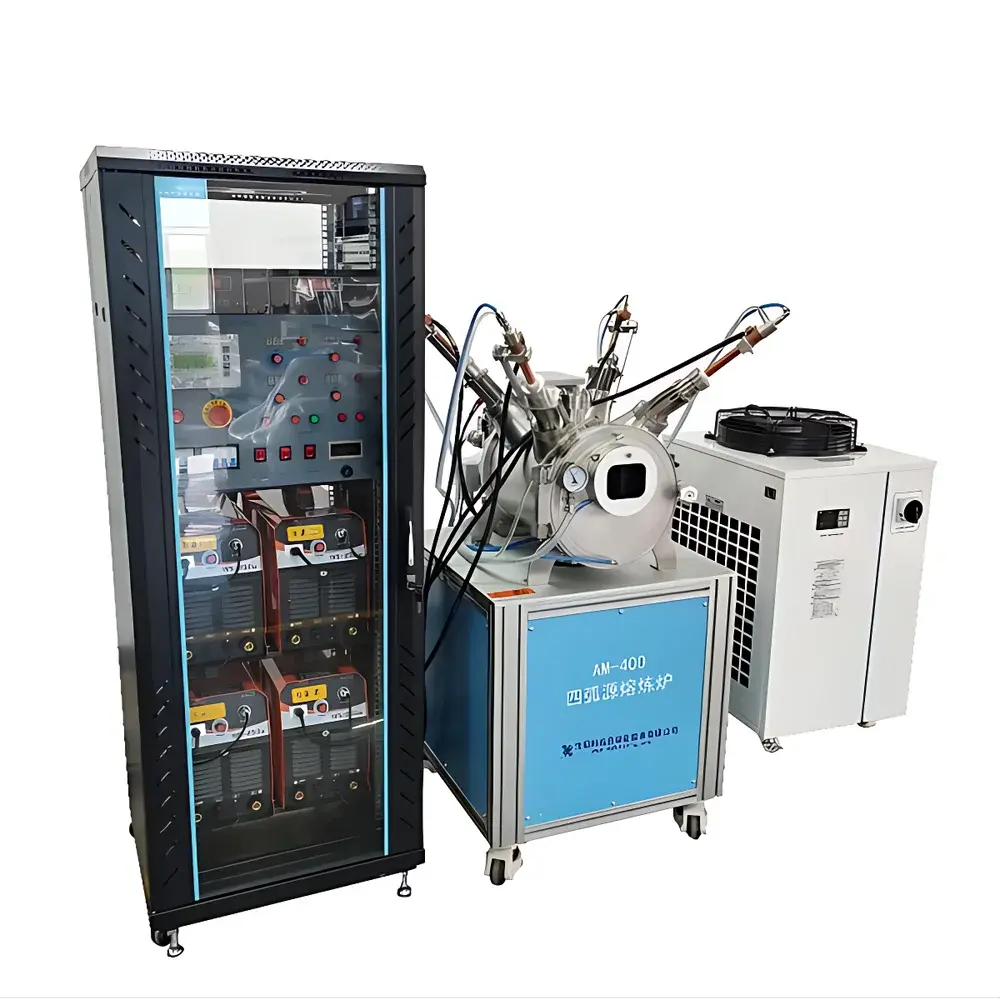
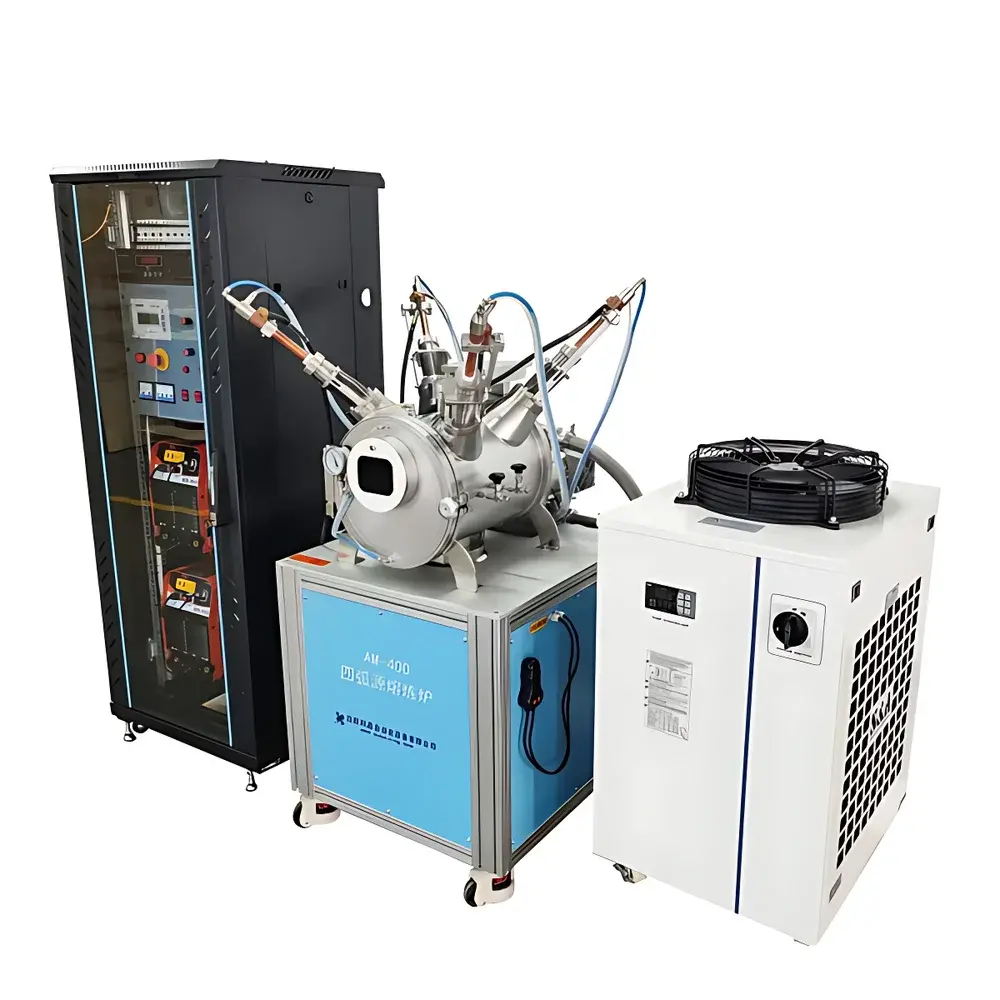
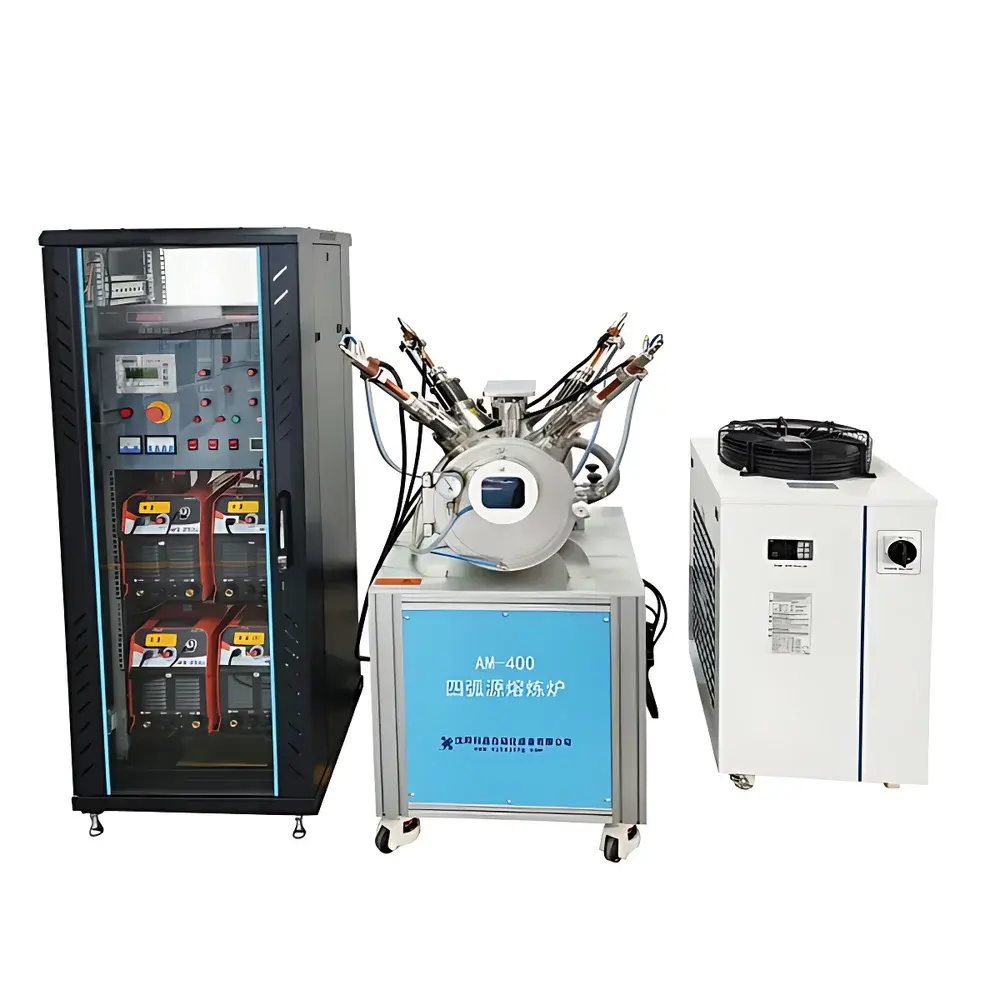
KJ GROUP SP-AM-400 Quadruple Arc-Melting Furnace
| Brand | KJ GROUP |
|---|---|
| Origin | Liaoning, China |
| Manufacturer Type | Direct Manufacturer |
| Country of Origin | China |
| Model | SP-AM-400 |
| Pricing | Upon Request |
| Ultimate Vacuum | 8×10⁻⁴ Pa |
| System Leak Rate | 5.0×10⁻⁷ Pa·L/s |
| Pumping Time (Atmosphere → 7×10⁻³ Pa) | ≤30 min |
| Operating Pressure Range | −0.5 MPa |
| Power Consumption | <60 kW |
| Crucible Dimensions | Φ100 mm × 15 mm |
| Max Sample Mass | 300 g |
| Sample Stage Rotation Speed | 1–20 rpm (continuously adjustable) |
| Cooling System | Closed-loop deionized water chiller |
| Process Atmosphere | High-purity argon (≥99.99%) |
| Safety Protections | Water flow/pressure monitoring, phase sequence detection, thermal overheat protection, vacuum integrity interlock |
Overview
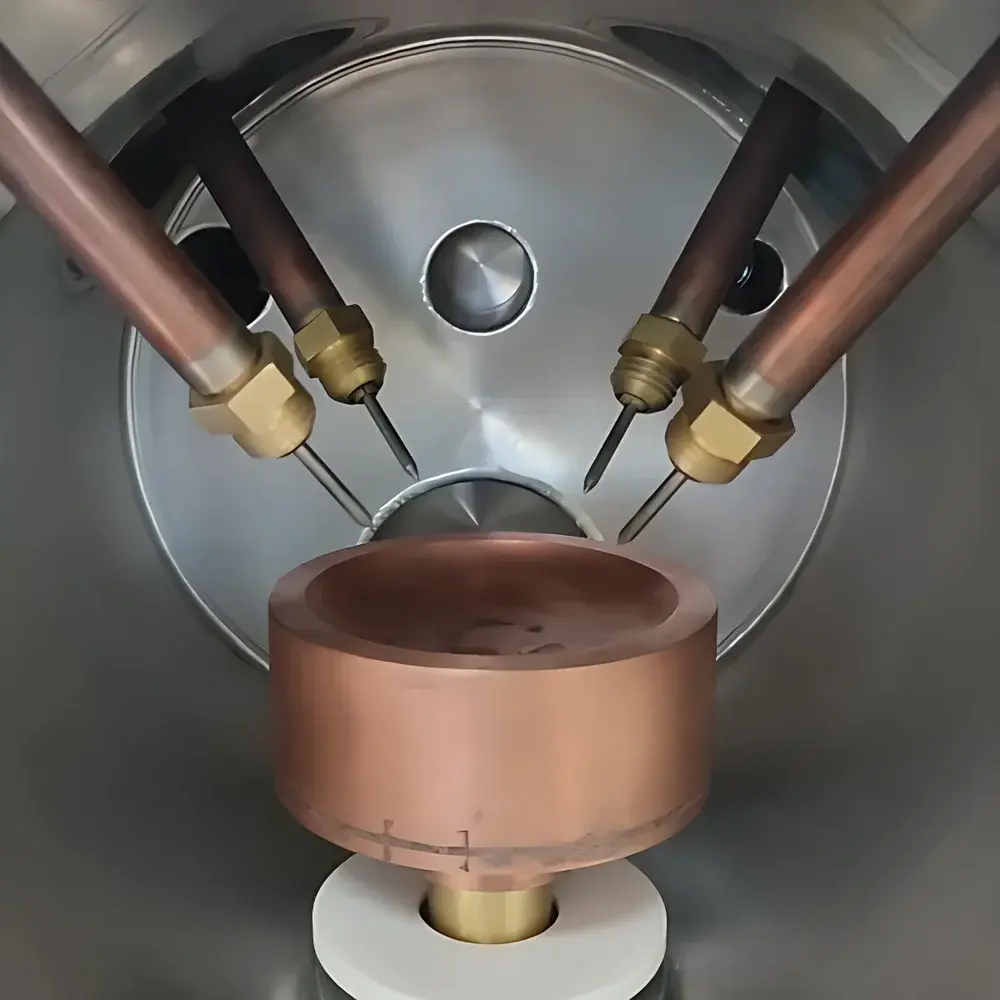
The KJ GROUP SP-AM-400 Quadruple Arc-Melting Furnace is a high-precision, laboratory-scale arc melting system engineered for the preparation of homogeneous metallic alloys, intermetallic compounds, and refractory metal ingots under controlled inert atmospheres. Utilizing four independently controllable tungsten electrodes operating in direct-current (DC) arc mode, the furnace enables uniform energy distribution across the molten pool—minimizing localized overheating, reducing elemental segregation, and improving compositional reproducibility in cast buttons or preforms. Designed for metallurgical R&D labs, materials synthesis facilities, and nuclear fuel development programs, the SP-AM-400 integrates ultra-high vacuum capability (≤8×10⁻⁴ Pa), robust pressure regulation (−0.5 MPa operational range), and real-time rotational control of the copper crucible to support directional solidification studies and microstructure refinement.
Key Features
- Quadruple DC arc configuration with four 4 mm tungsten electrodes—each individually adjustable for current, position, and arc stability optimization.
- High-vacuum chamber (Φ300 mm × 320 mm) constructed from 304 stainless steel with electropolished interior and double O-ring sealed observation ports (three 100 mm diameter viewports).
- Integrated HICube80 turbo-molecular pump group achieving base pressure ≤8×10⁻⁴ Pa; pumping speed sufficient to reach 7×10⁻³ Pa from atmosphere in ≤30 minutes.
- Rotating copper crucible (Φ100 mm × 15 mm depth) with continuous speed control (1–20 rpm) via precision stepper motor—enabling controlled convection suppression and macrosegregation mitigation during solidification.
- Full safety interlock architecture: real-time monitoring of coolant flow rate/pressure, electrical phase sequence, electrode temperature, vacuum integrity, and emergency arc quenching logic.
- Modular gas handling subsystem supporting high-purity argon backfill (≥99.99%) via dual 1/4″ VCR-style needle valves and calibrated pressure transducer (−0.1 to +0.15 MPa range).
Sample Compatibility & Compliance
The SP-AM-400 accommodates a broad spectrum of conductive metallic feedstock—including Ti, Zr, Nb, Ta, Mo, W, Ni-based superalloys, Fe–Al, Co–Cr, and rare-earth-containing systems—provided raw materials are in granular, chip, or pressed pellet form (max. 300 g per melt). Crucible rotation and multi-electrode arc geometry collectively reduce vaporization loss and promote stoichiometric retention in volatile elements (e.g., Mn, Al, Si). The system conforms to ISO 27401:2022 (vacuum equipment safety), ASTM F2627-20 (arc melting practice for reactive metals), and supports GLP-compliant operation through configurable audit trails in optional data logging firmware. All wetted surfaces meet USP Class VI biocompatibility requirements for post-melt handling of biomedical alloy candidates.
Software & Data Management
While the base SP-AM-400 operates via front-panel digital interface with manual parameter entry, optional KJ-FusionLink™ software (v3.2+) enables PC-based supervision via RS485/USB-C bridge. This module records time-stamped logs of arc current/voltage, crucible RPM, chamber pressure, coolant temperature, and interlock event timestamps—exportable as CSV or XML for traceability. Data files comply with FDA 21 CFR Part 11 requirements when paired with user-defined electronic signatures and role-based access controls. Historical melt cycles can be replayed for process correlation with SEM-EDS or XRD characterization results.
Applications
- Synthesis of master alloys for subsequent casting, powder metallurgy, or additive manufacturing feedstock production.
- Preparation of calibration standards for ICP-OES/MS requiring certified homogeneity at ±0.5% relative standard deviation (RSD) across 10 mm diameter buttons.
- Phase diagram validation experiments involving rapid solidification of ternary and quaternary systems under reproducible thermal gradients.
- Recycling and re-alloying of scrap titanium or nickel alloys with minimal oxidation and nitrogen pickup.
- Small-batch prototyping of neutron-absorbing alloys (e.g., hafnium–zirconium–niobium) for nuclear component qualification testing.
FAQ
What vacuum level is required before initiating arc melting?
A stable base pressure ≤1×10⁻³ Pa must be achieved using the HICube80 turbo-molecular pump group prior to argon backfill and arc ignition.
Is the crucible water-cooled?
Yes—the OFHC copper crucible is actively cooled via integrated channels connected to the KJ (CW)-6200 closed-loop chiller unit using deionized water.
Can the system operate under positive pressure?
No—the SP-AM-400 is rated for vacuum and negative gauge pressure only (up to −0.5 MPa); it is not designed for sustained positive overpressure operation.
Are replacement tungsten electrodes supplied with the system?
Each furnace ships with four pre-aligned 4 mm diameter tungsten rods; additional electrodes (ASTM B777 Grade W-1, 99.95% purity) are available as consumables under part number KJ-WE-0400.
Does the system include vacuum gauging hardware?
Yes—a full suite is provided: Pirani gauge for rough vacuum (10⁵ to 10⁻¹ Pa), cold cathode gauge for medium vacuum (10⁻¹ to 10⁻⁴ Pa), and Bayard–Alpert hot cathode ionization gauge for high vacuum (10⁻⁴ to 10⁻⁷ Pa).



