
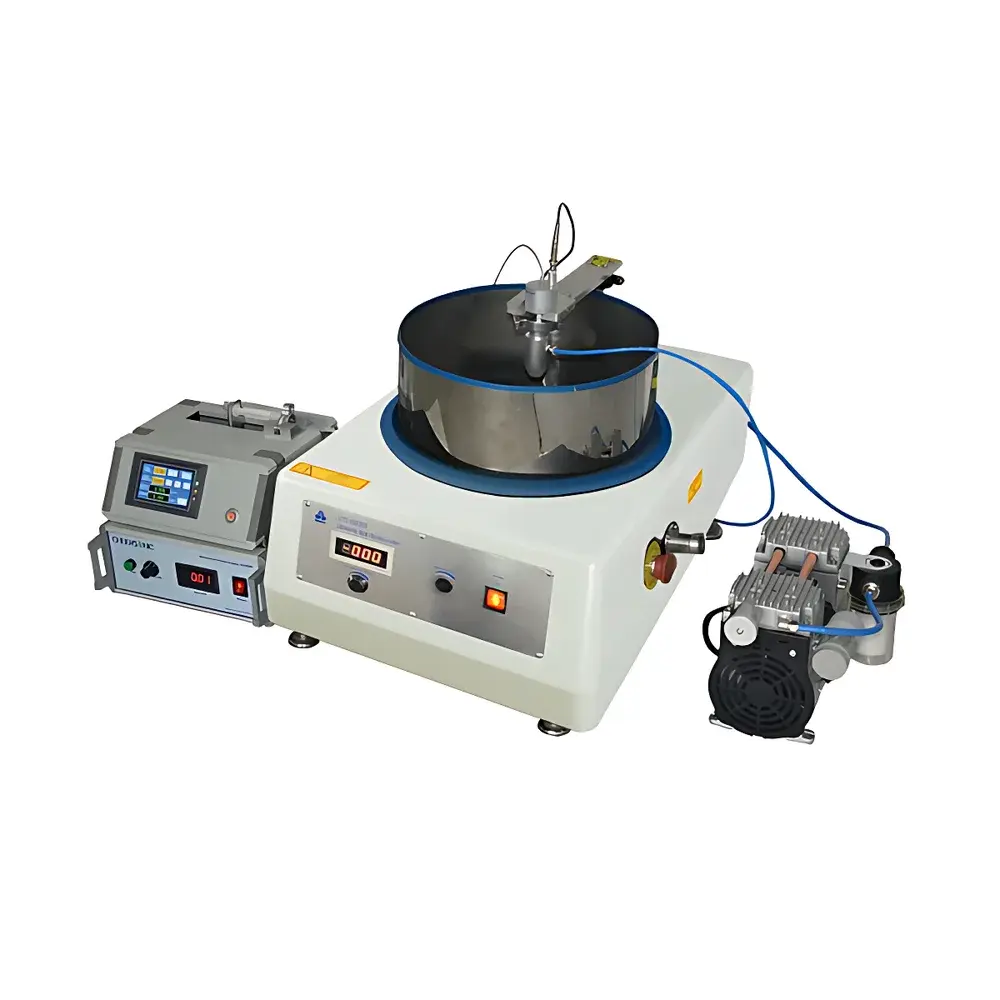
KJ GROUP VTC-300USS Ultrasonic Nebulization Spin Coater
| Brand | KJ GROUP |
|---|---|
| Origin | Liaoning, China |
| Manufacturer Type | Authorized Distributor |
| Country of Origin | China |
| Model | VTC-300USS |
| Pricing | Available Upon Request |
| Input Voltage | 208–240 V AC, 50/60 Hz |
| Max Substrate Diameter | 300 mm (12") |
| Max Spin Speed | 3000 rpm |
| Nebulizer Particle Size | 10–20 µm |
| Solution Flow Rate | 0.6 pL–4 mL/min |
| Max Solid Content | ≤10 wt% |
| Max Solution Viscosity | ≤100 cP |
| Substrate Heating | Optional Integrated Hotplate or IR Lamp (Up to 200 °C) |
| Air Supply Required | Yes (Regulated Compressed Air, 0.4–0.6 MPa) |
| Operating Environment | Altitude <1000 m, Ambient Temp. 10–40 °C, RH 45–65% |
| Footprint | ≥2 m² |
| Ventilation | Local Exhaust Ventilation Recommended |
Overview
The KJ GROUP VTC-300USS Ultrasonic Nebulization Spin Coater is an engineered platform for controlled thin-film deposition via ultrasonic spray-assisted spin coating—a hybrid technique combining precise volumetric liquid delivery, high-frequency piezoelectric atomization, and rotational substrate dynamics. Unlike conventional spin coaters relying solely on centrifugal dispersion, the VTC-300USS introduces a spatially directed nebulized aerosol stream onto a rotating substrate, enabling conformal, low-waste, and stoichiometrically preserved film formation—particularly critical for multi-cation precursor systems such as perovskite absorbers (e.g., MAPbI₃, FAPbBr₃), metal oxide semiconductors (e.g., SnO₂, NiOₓ), and transparent conductive oxides (e.g., ITO, AZO). The system operates on the principle of capillary-driven ultrasonic vibration at 1.7 MHz, generating monodisperse droplets in the 10–20 µm range; these are then carried by a regulated carrier gas stream onto the substrate surface, where solvent evaporation and solute condensation occur under synchronized rotation and optional thermal assistance.
Key Features
- Precision fluid handling via micro-stepper-driven peristaltic or syringe pump (configurable single/multi-channel, with optional solution preheating up to 80 °C)
- Adjustable ultrasonic nebulizer mounted on a motorized swing arm for dynamic nozzle-to-substrate distance control (0–150 mm range), ensuring radial uniformity across 300 mm wafers
- Dual-mode substrate stage: standard ambient-stage configuration with vacuum chuck (Φ300 mm), plus optional integrated resistive hotplate or top-mounted IR lamp (temperature range: RT–200 °C, ±1 °C stability)
- Programmable spin profile support: multi-step acceleration/deceleration ramps, dwell time control, and real-time RPM feedback via optical encoder
- Modular pneumatic interface compatible with standard industrial compressed air sources (0.4–0.6 MPa, filtered and dried); includes integrated pressure regulator and flow meter
- CE-compliant electrical architecture with EMI shielding, grounded chassis, and overcurrent/overtemperature protection circuits
Sample Compatibility & Compliance
The VTC-300USS accommodates rigid and semi-flexible substrates including silicon wafers, glass slides (microscope, borosilicate, quartz), ITO/PET films, and ceramic plates—up to 300 mm in diameter and ≤10 mm in thickness. Its open-access chamber design permits rapid tooling changes and in-situ inspection. From a regulatory standpoint, the system supports GLP-compliant process documentation when paired with optional audit-trail-enabled software (see Software & Data Management). While not certified to ISO 13485 or FDA 21 CFR Part 11 out-of-the-box, its deterministic motion control, repeatable fluid dosing, and thermal traceability align with foundational requirements for materials qualification per ASTM D724–22 (Standard Test Method for Surface Wettability of Paper), ISO 25178–602 (Surface Texture – Areal Measurement), and USP (Coating Uniformity). CE marking applies to the base unit per 2014/30/EU (EMC Directive) and 2014/35/EU (LVD Directive).
Software & Data Management
The VTC-300USS is operated via an embedded 7-inch TFT touchscreen HMI running a real-time Linux-based controller firmware. All process parameters—including spin speed (0–3000 rpm, resolution ±1 rpm), nebulizer duty cycle (0–100%), solution flow rate (programmable ramp profiles), substrate temperature setpoint, and pneumatic pressure—are stored in non-volatile memory with timestamped logging (CSV export via USB). Optional PC-hosted software (KJ-CoatControl v3.x) enables remote operation, recipe management, interlock monitoring (vacuum status, temperature deviation, airflow fault), and integration into LabVIEW or Python-based automation frameworks via TCP/IP or RS-485 Modbus RTU. Audit trail functionality—required for GMP-aligned R&D environments—records user login, parameter modification history, and execution logs with SHA-256 hashing for integrity verification.
Applications
- Perovskite photovoltaic research: scalable deposition of uniform CH₃NH₃PbI₃, CsFA-based triple-cation layers with minimized pinhole density and controlled crystallinity
- Electron/hole transport layer fabrication: SnO₂ ETLs, NiOₓ HTLs, and PEDOT:PSS alternatives with tunable thickness (10–200 nm) and surface roughness (Ra < 2 nm)
- Functional oxide coatings: LiCoO₂ cathode precursors, VO₂ thermochromic films, and TiO₂ photocatalytic layers on large-area substrates
- Lab-scale prototyping of anti-reflective, hydrophobic, or gas-barrier coatings using sol-gel or polymer dispersions (e.g., PDMS, PMMA, cellulose nanocrystals)
- Microelectronics: photoresist priming, under-bump metallization (UBM) seed layer conditioning, and MEMS packaging encapsulation trials
FAQ
What types of precursor solutions are compatible with the VTC-300USS?
Solutions must exhibit viscosity ≤100 cP and solid content ≤10 wt%. Common compatible chemistries include metal nitrates/acetates in alcohol/water mixtures, organometallic complexes in DMF/DMSO, and aqueous polymer dispersions. Highly volatile or corrosive solvents (e.g., HF, fuming nitric acid) require custom wetted material upgrades.
Is vacuum substrate holding mandatory?
Yes—the vacuum chuck (−80 kPa typical) ensures mechanical stability during high-speed rotation (up to 3000 rpm) and prevents edge lift-off that compromises film uniformity. Non-porous substrates may require perforated carriers or auxiliary clamping.
Can the system operate without compressed air?
No—the ultrasonic nebulizer requires a clean, dry, pressure-regulated carrier gas (compressed air or inert gas) to transport aerosol droplets toward the substrate. An external air compressor (≥10 L/min @ 0.6 MPa) or nitrogen cylinder with dual-stage regulator is required.
What maintenance intervals are recommended?
Ultrasonic transducer cleaning every 50 operating hours; nebulizer tip inspection and ultrasonic bath soak weekly; vacuum filter replacement monthly; and full calibration verification (RPM, temperature, flow rate) quarterly per internal SOP-SPIN-003.
Does KJ GROUP provide application support for perovskite film optimization?
Yes—application engineers offer protocol development services, including precursor formulation screening, spin/nebulization parameter mapping (DoE), and cross-sectional SEM/AFM correlation analysis, available under separate technical support agreements.
Related Products



