
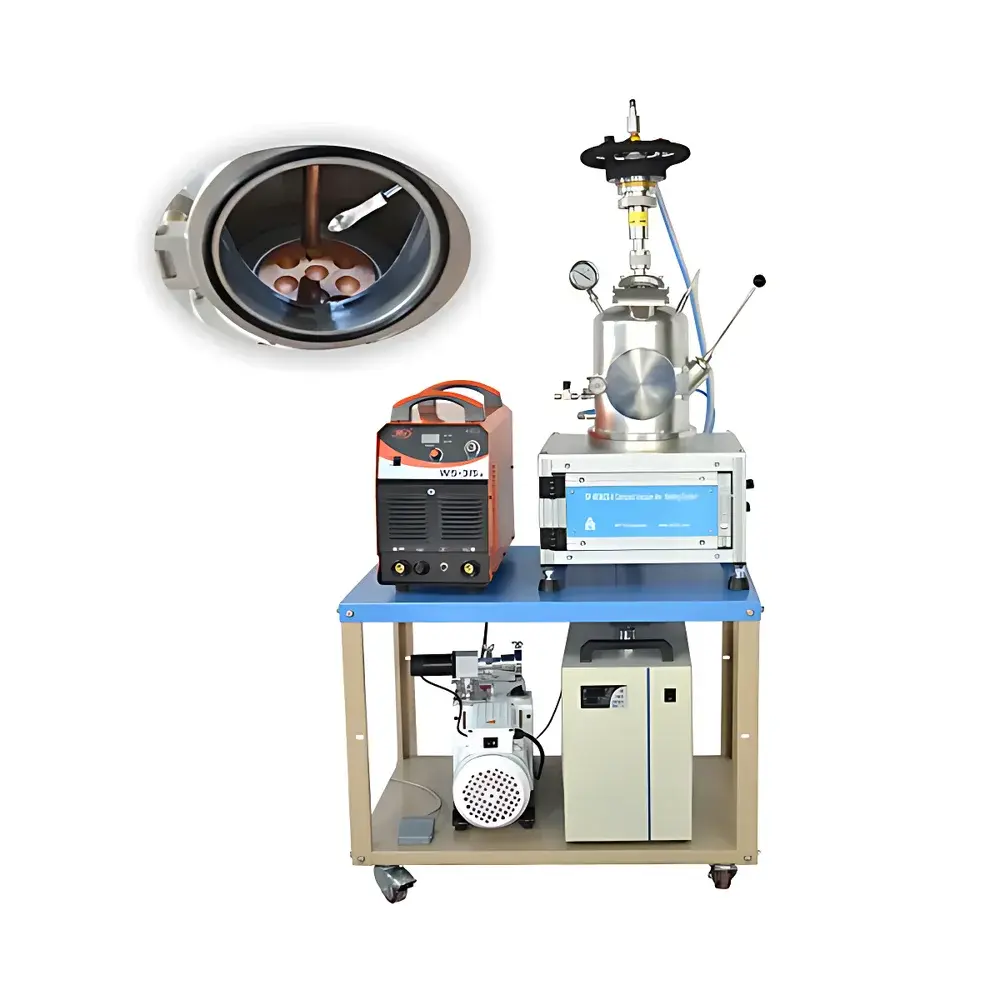
KJ GROUP MSM20-7 Non-Consumable Electrode Miniature Arc Melting Furnace
| Brand | KJ GROUP |
|---|---|
| Origin | Liaoning, China |
| Model | MSM20-7 (Non-Consumable) |
| Dimensions (L×W×D) | 470 mm × 315 mm × 880 mm |
| Maximum Operating Temperature | 4000 °C |
| Temperature Control Accuracy | ±1 °C within ≤3500 °C |
| Sample Capacity | ≤200 g total |
| Vacuum Chamber | Ø200 mm × 300 mm |
| Vacuum Level (Standard) | ≤10⁻³ mbar |
| Vacuum Level (with Optional Molecular Pump) | ≤10⁻⁵ mbar |
| Electrode Material | Tungsten (W) |
| Output Current Range | 20–315 A |
| Number of Melting Positions | 7 |
| Crucible Diameter | Ø25 mm (depth: 8 mm, customizable) |
| Cooling | Integrated Recirculating Chiller (KJ-5000) with Deionized Water |
| Power Supply | AC 380 V, 50 Hz, ≤12 kW |
| Net Weight | 50 kg |
Overview
The KJ GROUP MSM20-7 Non-Consumable Electrode Miniature Arc Melting Furnace is a compact, high-vacuum, inert-atmosphere arc melting system engineered for precise, repeatable metallurgical synthesis and purification of refractory and reactive metals and alloys. It operates on the principle of direct-current (DC) arc discharge between a non-consumable tungsten electrode and the sample—generating localized plasma temperatures exceeding 3500 °C without electrode erosion. This enables full melting of nearly all metallic elements and intermetallic compounds—including Ni-, Co-, Fe-, Mo-, Nb-, and Ti-based superalloys—as well as high-entropy alloys (HEAs), bulk metallic glasses (BMGs), and ultra-high-purity reference standards. Designed for laboratory-scale R&D, the furnace integrates vacuum integrity, gas-tight atmosphere control (Ar ≥99.99% purity), and mechanical sample manipulation—all within a footprint under 0.15 m². Its modular architecture supports GLP-compliant operation in academic, national lab, and industrial materials development environments.
Key Features
- Seven independent Ø25 mm water-cooled copper crucibles allow parallel preparation of up to seven distinct alloy compositions per cycle—minimizing cross-contamination and maximizing throughput.
- Non-consumable tungsten electrode (melting point: 3422 °C) ensures stable arc initiation, consistent energy input, and zero electrode-derived impurities during repeated melting cycles.
- Dual quartz observation windows (front and rear) provide real-time optical monitoring of arc ignition, melt pool dynamics, and solidification behavior—critical for process optimization and failure analysis.
- Integrated mechanical flip mechanism enables in-situ, atmosphere-preserving inversion of solidified ingots for multi-pass homogenization—eliminating vacuum breakage and oxidation risk between re-melts.
- High-precision vertical positioning via ergonomic steering-wheel actuation ensures reproducible electrode-to-sample gap control (±0.1 mm resolution), directly influencing arc stability and thermal gradient uniformity.
- Full water-cooling circuit (electrode, crucible, and vacuum chamber walls) maintains structural integrity at sustained 4000 °C operational ceiling and prevents thermal fatigue over extended duty cycles.
- Front-loading Ø120 mm access port with O-ring sealed door facilitates rapid sample insertion, crucible exchange, and post-melt inspection—reducing downtime between experiments.
Sample Compatibility & Compliance
The MSM20-7 accommodates elemental metals (e.g., Al, Cu, Mg, Zr, Ta), master alloys, pre-alloyed powders, and sintered compacts weighing ≤200 g total across all seven positions. It is compatible with ASTM E1477 (spectral emission analysis of metals), ISO 11577 (arc melting for reference material production), and USP particulate matter testing protocols requiring ultra-clean metal matrices. The system meets IEC 61000-6-2/6-4 EMC requirements and incorporates redundant safety interlocks (vacuum pressure threshold lockout, coolant flow sensor, over-temperature cutoff). When operated with optional GZK-103D2 high-vacuum package and EQ-PCG-554 digital vacuum gauge, it satisfies ISO 20483:2017 criteria for residual gas analysis in high-purity metallurgy applications.
Software & Data Management
While the base MSM20-7 operates via analog current/voltage controls and manual vacuum gauging, optional integration with KJ-LabControl™ v3.2 enables digital logging of arc current (20–315 A), chamber pressure (10⁻⁵–10³ mbar), cooling water temperature (±0.2 °C), and elapsed melt time. All parameters are timestamped and exportable to CSV or Excel for traceability. Audit trails comply with FDA 21 CFR Part 11 requirements when paired with user authentication and electronic signature modules. Data files support batch record generation aligned with ISO/IEC 17025 calibration management workflows.
Applications
- Synthesis of multi-principal-element alloys (MPEAs) and high-entropy alloys (HEAs) with controlled stoichiometry and minimal segregation.
- Purification of reactive metals (e.g., Ti, Zr, V) via volatile impurity volatilization under high-vacuum arc conditions.
- Preparation of homogeneous master alloys for subsequent casting, additive manufacturing feedstock qualification, or XRF calibration standards.
- Rapid prototyping of compositionally graded samples for combinatorial materials discovery platforms.
- Thermal history studies—including undercooling behavior, dendritic growth kinetics, and solidification path mapping—via synchronized high-speed imaging through dual viewports.
- Production of oxygen-sensitive intermetallics (e.g., Ni₃Al, FeAl) under ultra-high-purity argon (≤1 ppm O₂ equivalent).
FAQ
What vacuum level is required for optimal arc stability during reactive metal melting?
For Ti, Zr, or Nb-based alloys, a base pressure ≤5×10⁻⁴ mbar is recommended prior to backfilling with argon; this minimizes oxide inclusion formation during arc ignition.
Can the MSM20-7 be used for non-metallic samples such as ceramics or oxides?
No—it is specifically engineered for conductive metallic systems; non-conductive materials cannot sustain a stable DC arc discharge.
Is the tungsten electrode replaceable, and what is its typical service life?
Yes; electrodes are field-replaceable standard components. Under nominal 3000 °C operation with proper cooling and arc alignment, service life exceeds 200 melts per tip.
Does the system support automated data acquisition for regulatory submissions?
Yes—when configured with KJ-LabControl™ and validated electronic signatures, it delivers 21 CFR Part 11–compliant raw data archives and audit-ready reports.
What are the minimum facility requirements for safe installation?
A dedicated 380 V/63 A grounded circuit, deionized water supply (≥1.5 L/min @ 20 °C), argon gas line with CGA-580 fitting, and floor-rated ventilation (≥150 m³/h exhaust) for ozone and metal fume abatement are mandatory.



