
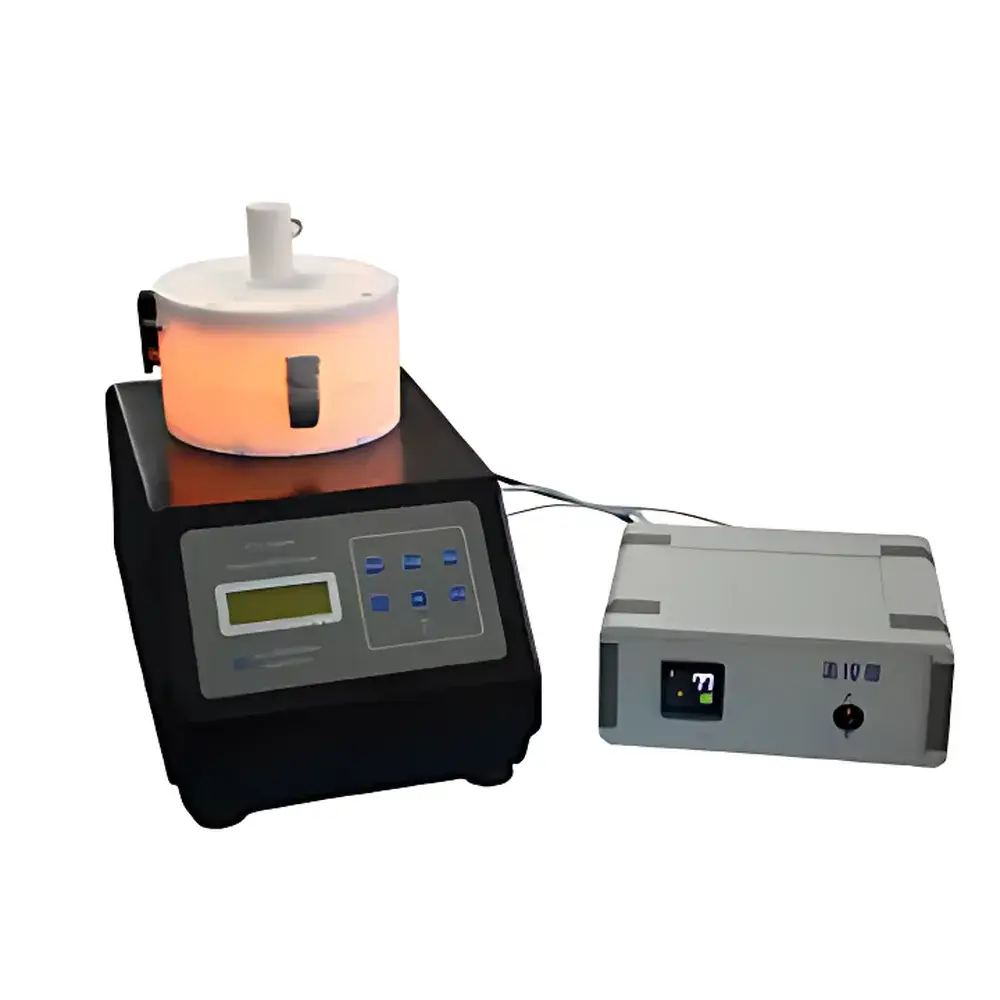
KJ GROUP VTC-100PA-I Vacuum Spin Coater
| Brand | KJ GROUP |
|---|---|
| Origin | Liaoning, China |
| Manufacturer Type | Direct Manufacturer |
| Country of Origin | China |
| Model | VTC-100PA-I |
| Pricing | Upon Request |
| Vacuum Level | −0.08 MPa |
| Rotational Speed Range | 500–10,000 rpm |
| Speed Stability | ±1% |
| Acceleration/Deceleration Rate | 100–2,000 rpm per stage |
| Program Storage | 12 user-defined programs (6 stages each) |
| Stage Duration | 0–60 s per stage |
| Heating Range | Ambient to 100 °C |
| Heating Accuracy | ±2 °C |
| Heating Power | 1000 W |
| Total Power Consumption | ≤1150 W (excl. vacuum pump) |
| Chamber Material | Polypropylene (PP) |
| Chuck Material | PTFE (Ø19 mm & Ø60 mm) |
| Vacuum Pump | Oil-free dual-piston, ≥70 L/min |
| Operating Atmosphere | Ambient air or inert gas (N₂, Ar) |
| Control Interface | LCM display + PCB-based microcontroller |
| Safety | Lid-open emergency deceleration |
| Dimensions (W×D×H) | 450 × 340 × 280 mm |
| Weight | 20 kg |
Overview
The KJ GROUP VTC-100PA-I Vacuum Spin Coater is an engineered solution for precision thin-film deposition via rotational fluid dynamics under controlled vacuum and thermal conditions. Based on the principle of centrifugal force-driven solvent evaporation and viscous flow redistribution, the system enables reproducible, thickness-controlled coating of photoresists, polymer solutions, sol-gels, and functional inks onto flat substrates. Its core architecture integrates vacuum-assisted substrate immobilization, programmable multi-stage acceleration profiles, and independent thermal regulation—making it suitable for R&D-scale fabrication in semiconductor processing, optical disk mastering, lithographic mask production, and advanced materials research. Designed for compatibility with aggressive chemistries—including concentrated acids and alkalis—the unit features chemically inert wetted surfaces and a sealed chamber environment that supports both ambient and inert-atmosphere operation.
Key Features
- Vacuum chucking system with dual PTFE-coated suction plates (Ø19 mm and Ø60 mm), achieving stable −0.08 MPa vacuum for secure, non-damaging substrate fixation.
- 24V brushless DC motor delivering smooth, low-vibration rotation across 500–10,000 rpm with ±1% speed stability—critical for uniform film thickness distribution and edge uniformity control.
- 12 programmable coating protocols, each comprising up to six independently configurable stages; parameters include target rpm, ramp rate (100–2000 rpm/s), dwell time (0–60 s), and optional heating activation.
- Integrated carbon-fiber heating module (ambient to 100 °C, ±2 °C accuracy) with electrical isolation from the main control board—enabling solvent boiling point modulation without cross-interference.
- Chemically resistant polypropylene chamber housing and PTFE-coated chucks ensure long-term durability against corrosive reagents and reduce cleaning downtime.
- Oil-free dual-piston vacuum pump (≥70 L/min) minimizes maintenance requirements and eliminates hydrocarbon contamination risks in cleanroom-adjacent environments.
- Lid-interrupt safety logic triggers immediate deceleration upon chamber opening—complying with IEC 61000-6-2 and lab equipment operational safety expectations.
- Full English UI on LCM display with tactile keypad navigation; firmware supports parameter recall, real-time rpm/temperature feedback, and error logging.
Sample Compatibility & Compliance
The VTC-100PA-I accommodates rigid, planar substrates including silicon wafers (up to 2″, 50 mm), glass slides, quartz plates, metal foils, and ceramic discs. Substrate centering is assisted by a precision alignment tool with four adjustable positioning pins, minimizing eccentric mass-induced vibration and “fly-off” events. The system complies with general laboratory safety standards for electrical appliances (IEC 61010-1), electromagnetic compatibility (IEC 61326-1), and mechanical integrity under routine handling. While not certified to ISO 13485 or FDA 21 CFR Part 11 out-of-the-box, its audit-ready parameter logging, non-volatile program storage, and deterministic control architecture support integration into GLP/GMP-aligned workflows when paired with documented SOPs and calibration records.
Software & Data Management
This model operates via embedded firmware running on a dedicated PCB-based microcontroller—no external PC dependency required. All 12 programs are retained in non-volatile memory, surviving power cycles without data loss. Each protocol stores complete stage-wise definitions (rpm setpoint, ramp slope, hold duration, heater state), enabling full traceability of coating history. The LCM interface displays real-time values for rotational speed, chamber temperature, vacuum status, and active program index. Although no native USB/RS-232 export is included, users may log operational timestamps manually or integrate third-party data acquisition via analog voltage outputs (available on request). For regulated environments, manual logbooks or spreadsheet-based batch records remain the recommended documentation method.
Applications
- Photoresist spin-coating for microfabrication and photolithography prototyping.
- Deposition of PEDOT:PSS, perovskite precursors, and conductive polymer films for flexible electronics.
- Preparation of anti-reflective, hydrophobic, or dielectric thin films on optical components.
- R&D-scale sol-gel coating of TiO₂, SiO₂, and ZnO layers for catalytic or sensing applications.
- Controlled solvent casting of biopolymer films (e.g., chitosan, cellulose acetate) under inert atmosphere.
- Uniform inkjet primer layer formation prior to direct-write patterning.
FAQ
What substrates can be used with the VTC-100PA-I?
Standard substrates include silicon wafers (≤50 mm), glass slides (≤75 × 25 mm), and rigid metallic or ceramic discs. Flexibility depends on vacuum seal integrity—substrates must be flat, non-porous, and ≥0.2 mm thick.
Is inert gas purging supported during spinning?
Yes. The chamber includes dedicated gas inlet/outlet ports compatible with N₂ or Ar supply lines (fittings not included); flow rates should be maintained below 500 mL/min to avoid turbulence-induced film defects.
Can the heating function operate simultaneously with rotation?
Yes. Thermal control is fully decoupled from motor control; the carbon-fiber heater activates independently per stage definition, allowing hot-spin processes such as thermally assisted dewetting or solvent annealing.
What maintenance is required for the vacuum pump?
The oil-free dual-piston pump requires only periodic inspection of intake filters and O-rings; no lubrication or oil changes are needed. Expected service life exceeds 5,000 operating hours under typical lab usage.
Does the system meet CE or UL certification requirements?
The unit conforms to EMC and safety fundamentals per IEC 61000-6-2 and IEC 61010-1. CE marking is available upon request for EU-market delivery with additional conformity assessment documentation.



