
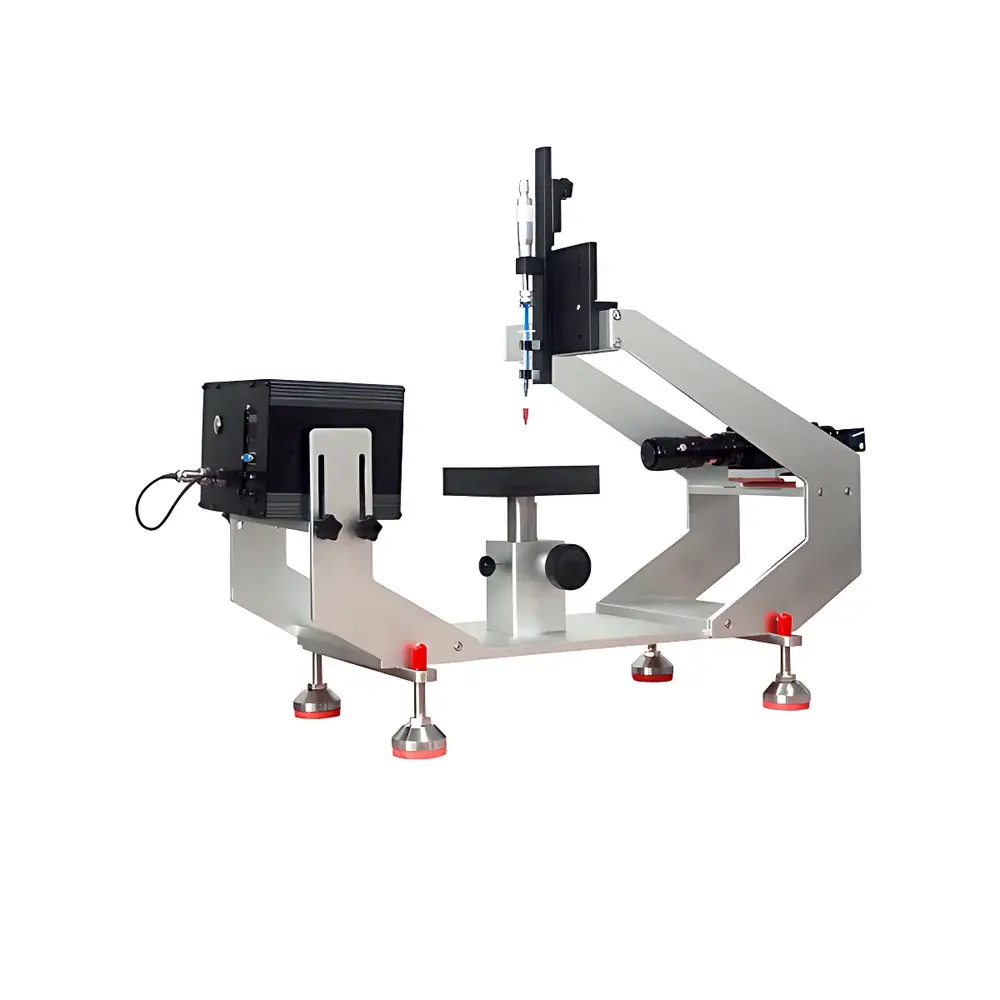
KJ GROUP DSA-X Optical Contact Angle Goniometer
| Brand | KJ GROUP |
|---|---|
| Origin | Liaoning, China |
| Manufacturer Type | Authorized Distributor |
| Country of Origin | China |
| Model | DSA-X |
| Pricing | Available Upon Request |
| Measurement Range | 0–180°, Resolution: 0.1° |
| Droplet Dispensing Accuracy | 0.01 µL (Manual Single-Drop System) |
| Power Supply | 88–264 V AC, 100 W, 50–60 Hz |
| Light Source | High-Power Tunable Blue LED (Brightness Continuously Adjustable) |
| Sample Stage | Manual XY Translation (120 × 120 mm), Z-Axis Manual Adjustment (70 mm Travel, 5 kg Load Capacity) |
| Sample Chamber Dimensions | 340 × ∞ × 145 mm (L × W × H) |
| Operating Temperature | +10°C to +40°C |
| Storage Temperature | −10°C to +70°C |
| Lens | 0.7–4.5× Telecentric Zoom Objective, 6.5:1 Magnification Ratio, 12 mm Fine Focus Adjustment |
| Camera | USB 3.0 High-Speed Global Shutter CMOS Sensor, 1/2″ Format, 1.3 MP Resolution, 210 fps Frame Rate |
| Software | TOUCH Contact Angle Analysis Module (Supports Sessile Drop Method with Ellipse, Circle, and Height-Width Fitting Algorithms |
Overview
The KJ GROUP DSA-X Optical Contact Angle Goniometer is a precision-engineered instrument designed for quantitative interfacial characterization of solid–liquid systems. Based on the sessile drop method, it optically captures the profile of a liquid droplet deposited on a solid substrate and computes the contact angle—the thermodynamically defined angle formed at the three-phase boundary between solid, liquid, and vapor. This measurement serves as a direct indicator of surface wettability, energy heterogeneity, and coating uniformity. The DSA-X integrates a telecentric optical path with a high-speed, global-shutter CMOS camera (210 fps, 1.3 MP) and continuously adjustable blue LED illumination to ensure consistent image contrast across diverse sample morphologies—including rough, porous, or low-contrast surfaces. Its mechanical architecture adheres to ergonomic design principles, enabling reproducible manual positioning of the sample stage (XY ±120 mm, Z ±70 mm) and optical train—critical for minimizing operator-induced variability in routine QC and R&D workflows.
Key Features
- High-fidelity imaging system: Telecentric zoom lens (0.7–4.5×, 6.5:1 ratio) with 12 mm fine-focus adjustment ensures minimal perspective distortion and pixel-level edge resolution across magnification ranges.
- Real-time dynamic capture: USB 3.0 interface supports sustained 210 fps acquisition, enabling kinetic analysis of spreading, absorption, or evaporation processes.
- Intelligent baseline detection: Proprietary image recognition algorithm automatically identifies substrate reference lines—even on textured or reflective surfaces—reducing manual intervention and inter-user bias.
- Multi-algorithm contact angle computation: Supports ellipse fitting (for asymmetric drops), circle fitting (idealized spherical cap), and height-width method (robust for partial wetting), each validated against ISO 19403-2 and ASTM D7334 standards.
- Modular hardware expandability: Compatible with optional accessories including vacuum-assisted sample holders (for thin films), motorized tilt stages (for roll-off and advancing/receding angle determination), and top-view optics (for concave or recessed substrates).
- GLP-aligned software architecture: TOUCH software provides full audit trail functionality—including user login timestamps, parameter change logs, and version-controlled analysis protocols—supporting FDA 21 CFR Part 11 readiness when deployed in regulated environments.
Sample Compatibility & Compliance
The DSA-X accommodates samples up to 5 kg and 340 mm in length, with unrestricted width due to its open-side chamber design. It supports rigid substrates (metals, ceramics, polymers), flexible films (PET, PI, PVDF), coated glass, and functionalized nanomaterials. Surface roughness (Ra < 10 µm) and optical reflectivity do not compromise measurement fidelity owing to adaptive LED brightness control and multi-threshold edge detection. All measurement methodologies conform to ISO 19403 (Parts 1–4) for contact angle determination and align with ASTM D7334 for surface energy estimation via Owens–Wendt–Rabel–Kaelble (OWRK) analysis. The instrument’s electrical safety complies with IEC 61010-1; CE marking applies to the base configuration.
Software & Data Management
TOUCH software operates as a unified control and analysis platform. It synchronizes camera triggering, light intensity modulation, syringe pump actuation (when motorized dispensing is added), and stage movement—all programmable via intuitive GUI or script-based automation. Each experiment generates a structured data package containing raw images, time-stamped metadata (operator ID, ambient T/RH if logged externally), fitted contour overlays, and numerical outputs (static θs, advancing θa, receding θr, hysteresis Δθ). Export options include CSV (for statistical process control), PDF (formatted reports with company branding), and Excel (pivot-ready datasets). Audit trails are stored locally in encrypted SQLite databases with SHA-256 hashing, supporting retrospective verification during internal or third-party GLP/GMP audits.
Applications
- Quality assurance of hydrophobic/hydrophilic coatings in medical device manufacturing (e.g., catheter surface modification validation per ISO 10993-6).
- Surface energy mapping of printed electronics substrates to optimize ink adhesion and film uniformity.
- R&D of anti-fouling membranes for water treatment, where contact angle hysteresis correlates with fouling resistance.
- Characterization of plasma-treated polymer films used in packaging—quantifying aging effects via time-lapsed contact angle decay studies.
- Validation of cleaning efficacy in semiconductor wafer processing by measuring residual organic contamination through water contact angle shifts.
FAQ
Does the DSA-X support automated dispensing?
Yes—while the base configuration includes a manual single-droplet system (0.01 µL resolution), a motorized precision syringe pump module can be integrated for programmable volume delivery, dispensing speed control, and multi-droplet sequence execution.
Can the instrument measure dynamic contact angles?
Yes—using the high-frame-rate camera and video playback function, users can manually or automatically extract frames at defined time intervals to compute advancing/receding angles, especially when combined with an optional motorized tilt stage.
Is the software compliant with 21 CFR Part 11 requirements?
The TOUCH software provides electronic signature capability, audit trail generation, and role-based access control. Full Part 11 compliance requires on-site validation protocol execution and integration with enterprise identity management systems—services available through KJ GROUP’s Application Support Team.
What calibration standards are recommended?
NIST-traceable contact angle calibration slides (e.g., 30°, 60°, 90°, 120° certified silicon wafers) are advised for periodic verification. KJ GROUP supplies a certified calibration kit with certificate of conformity and uncertainty budget per ISO/IEC 17025.
How is thermal drift managed during long-term measurements?
The DSA-X incorporates passive thermal shielding around the optical path and uses low-heat blue LED illumination (no IR emission) to minimize convection currents and substrate heating—ensuring stable droplet geometry over extended observation periods (>10 min).



