
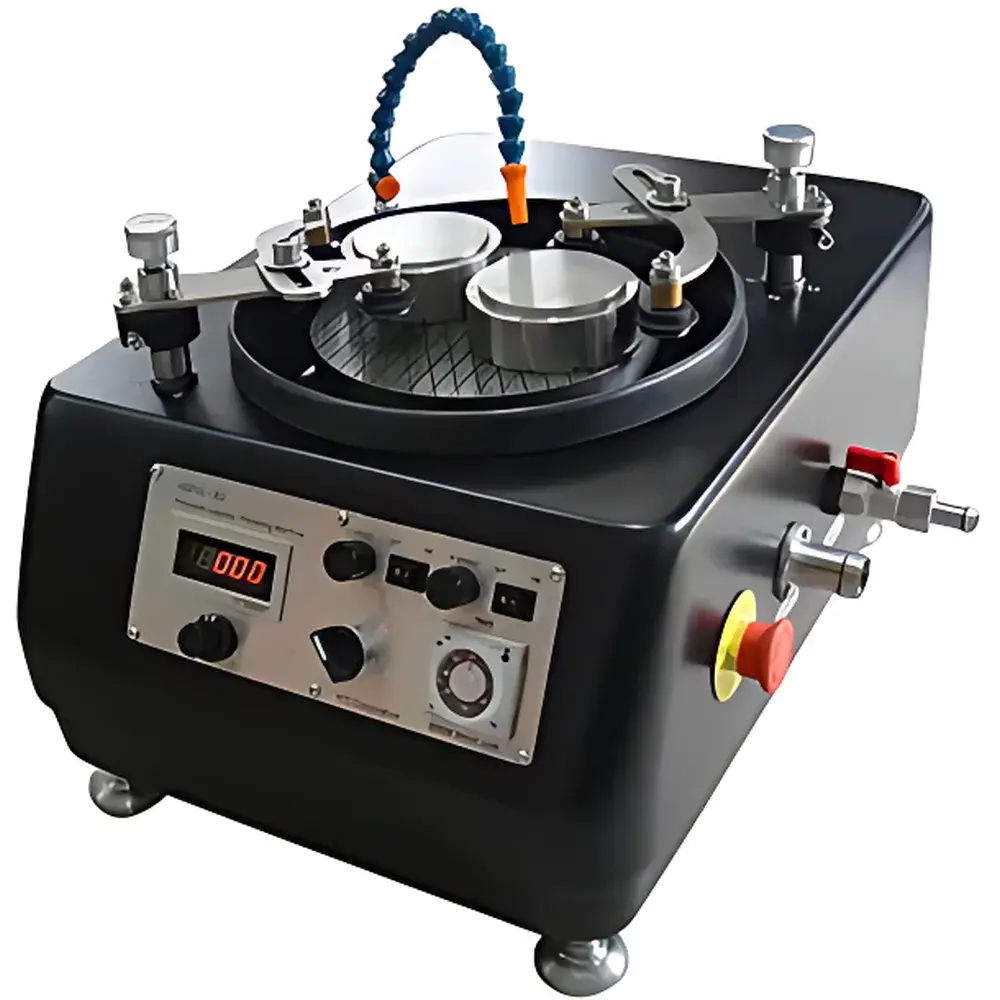
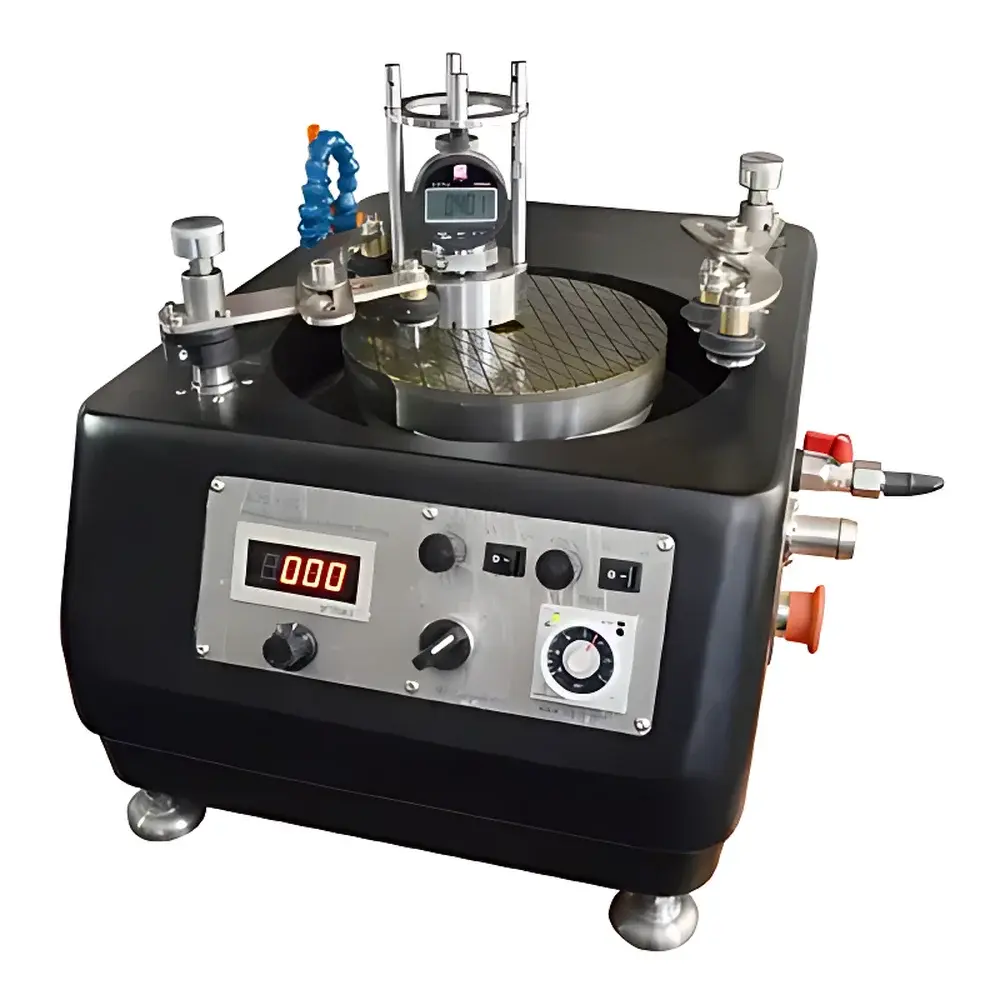
KJ GROUP UNIPOL-802 Automatic Precision Lapping and Polishing Machine
| Brand | KJ GROUP |
|---|---|
| Origin | Liaoning, China |
| Manufacturer Type | Authorized Distributor |
| Country of Origin | China |
| Model | UNIPOL-802 |
| Dimensions (L×W×D) | 580 mm × 420 mm × 350 mm |
| Number of Platters | 1 |
| Platter Diameter | Ø203 mm |
| Speed Range | 0–250 rpm |
| Spindle Runout | ≤0.008 mm / 180 mm |
| Workstation Count | 2 |
| Carrier Arm Oscillation Frequency | 0–9 cycles/min |
| Carrier Disk Diameter | Ø80 mm |
| Power Supply | AC 220 V, 50 Hz |
| Power Consumption | 275 W |
| Operating Temperature | 10–40 °C |
| Relative Humidity | 45–65 % RH |
| Weight | 68 kg |
| Timer Range | 0–300 h |
Overview
The KJ GROUP UNIPOL-802 Automatic Precision Lapping and Polishing Machine is an engineered solution for high-fidelity planar surface preparation of hard and brittle materials in research laboratories and quality control environments. It operates on the principle of controlled mechanical lapping and polishing using rotational motion combined with orbital oscillation—enabling uniform material removal while preserving geometric integrity. Unlike conventional single-axis grinders, the UNIPOL-802 employs a dual-station carrier system where each specimen rotates about its own axis while simultaneously orbiting the central platter axis. This compound motion ensures statistically isotropic abrasion distribution, minimizing edge rounding and enhancing surface flatness reproducibility across batches. The machine is designed to meet the stringent dimensional tolerancing requirements of optical component fabrication, semiconductor substrate processing, metallurgical metallography, and advanced ceramic R&D—where sub-micron thickness control and nanoscale surface roughness consistency are critical.
Key Features
- High-precision Ø203 mm lapping/polishing platter with flatness ≤0.0025 mm per 25 mm × 25 mm area—certified via interferometric measurement.
- Dual independent workstations accommodating specimens up to Ø80 mm; each equipped with precision-ground cylindrical carriers ensuring parallelism <0.005 mm and face flatness <0.003 mm.
- Infinitely variable speed control (10–250 rpm) with digital tachometer display and ±0.5 rpm repeatability under load.
- Oscillating carrier arm mechanism (0–9 cycles/min) synchronized with platter rotation to eliminate preferential wear patterns and improve surface uniformity.
- Low-runout spindle assembly (≤0.008 mm total indicator reading at 180 mm radius), minimizing vibration-induced micro-scratching during fine polishing.
- Integrated timer (0–300 h) with auto-shutdown function supporting unattended operation for extended lapping protocols.
- Magnetic retention system for rapid exchange of abrasive pads, diamond-impregnated discs, or coated papers—compatible with ISO-standard grit sizes from P120 to P4000 and beyond.
Sample Compatibility & Compliance
The UNIPOL-802 accommodates a broad spectrum of rigid, non-ductile substrates including single-crystal optics (ZnS, ZnSe, Si, Ge), sintered ceramics (Al₂O₃, SiC, YAG), refractory metals (Mo, W, Ta), geological thin sections, PCB laminates, and composite laminates. Its mechanical architecture conforms to IEC 61000-6-2 (EMC immunity) and IEC 61000-6-4 (EMC emissions) standards. When operated with GPC-50A Precision Lapping Controller (optional), the system supports GLP-compliant documentation workflows—including timestamped parameter logging, operator ID tagging, and audit-trail-enabled process validation—aligning with ISO/IEC 17025 and ASTM E3-22 requirements for metallographic sample preparation. No hazardous gas or vacuum interfaces are required; water-cooling or slurry delivery is managed externally via standard 6 mm OD tubing connections.
Software & Data Management
While the base UNIPOL-802 operates as a stand-alone electromechanical instrument, integration with the optional GPC-50A Precision Lapping Controller introduces programmable multi-stage lapping sequences, real-time force feedback (via load cell interface), and closed-loop thickness monitoring when paired with compatible non-contact displacement sensors (e.g., eddy-current or capacitive gauges). All GPC-50A-generated logs export to CSV or XML formats compliant with FDA 21 CFR Part 11 electronic record requirements—including digital signatures, version-controlled method files, and immutable audit trails. Data synchronization supports local network deployment and integration into LIMS platforms via OPC UA or Modbus TCP protocols.
Applications
- Preparation of optically polished wafers for infrared transmission spectroscopy (FTIR) and laser cavity alignment.
- Thickness-controlled lapping of thermoelectric modules and piezoelectric substrates prior to dicing or bonding.
- Edge-preserving planarization of geological thin sections for petrographic microscopy and SEM-EDS analysis.
- Surface conditioning of sputtering targets and evaporation boat materials to reduce arcing during PVD processes.
- Standardized metallographic specimen preparation per ASTM E3-22, ISO 14487, and GB/T 13298 for grain structure quantification.
- Routine quality assurance of PCB core laminate flatness prior to multilayer stack-up and drilling.
FAQ
What types of abrasives are compatible with the UNIPOL-802?
The machine accepts magnetic-backed diamond discs (resin-bonded or metal-bonded), coated abrasive papers (SiC or Al₂O₃), and polymer-based polishing pads (polyurethane, synthetic leather, or microfiber). Selection depends on material hardness and desired finish—e.g., 15 µm diamond slurry for coarse lapping of silicon carbide, followed by 0.05 µm colloidal silica on polyurethane for final optical polish.
Can the UNIPOL-802 be used for wet or dry processing?
It is configured exclusively for wet lapping and polishing. Integrated water inlet/outlet ports support continuous coolant or slurry circulation; optional SKZD-series automatic dispensers enable precise volumetric dosing of abrasive suspensions.
Is the UNIPOL-802 suitable for preparing TEM lamellae?
No—it is not designed for ultra-thin sectioning or ion milling. Its minimum achievable thickness is ~20 µm for brittle materials; TEM sample preparation requires dedicated FIB or ultramicrotome systems.
Does the system support automated thickness monitoring?
Not natively. Thickness feedback requires external instrumentation (e.g., Mitutoyo LV-5000 series or Keyence LK-H series sensors) interfaced via analog output or RS-485 to the GPC-50A controller.
What maintenance intervals are recommended?
Platter surface flatness should be verified quarterly using optical flats and monochromatic light interference; spindle bearings require re-lubrication every 1,500 operating hours; magnetic chuck surfaces must be cleaned after each use to prevent ferrous particle accumulation.



