
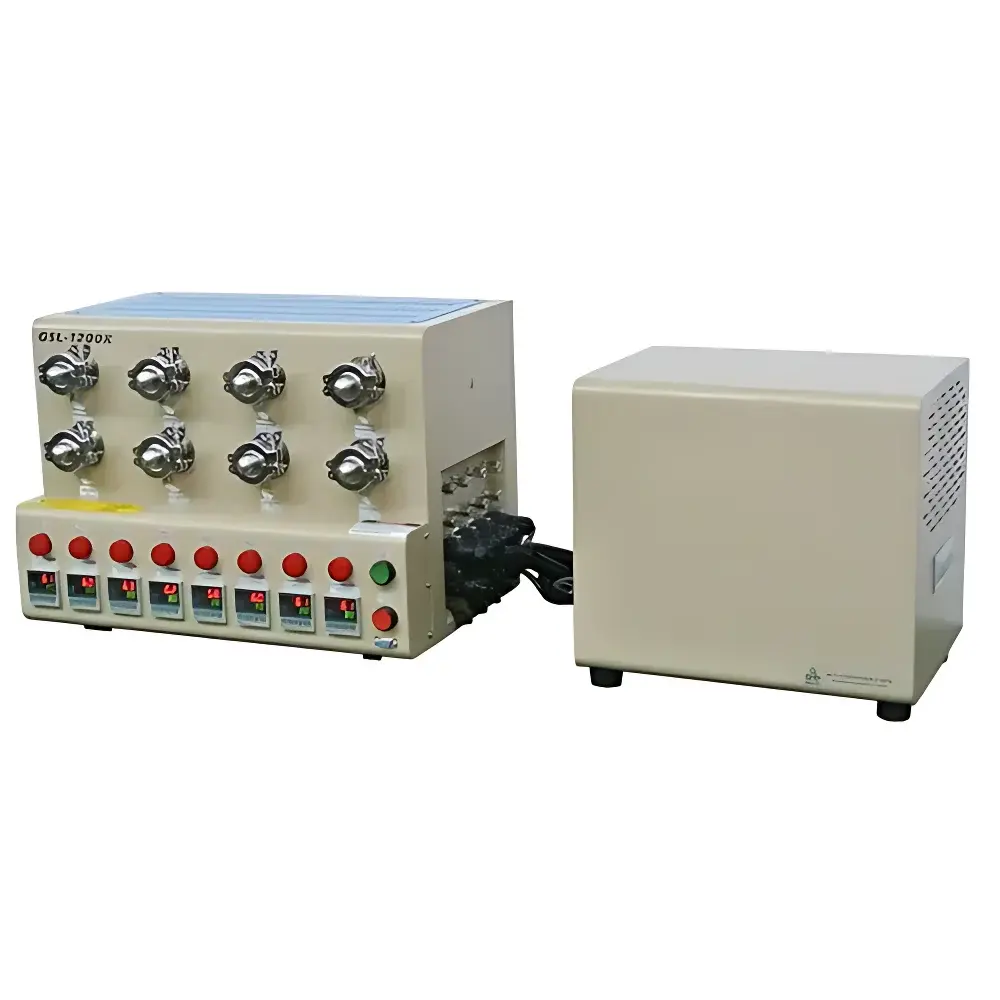
KJ GROUP GSL-1200X-MGI-8 High-Throughput 8-Channel Tube Furnace (1200 °C)
| Brand | KJ GROUP |
|---|---|
| Origin | Liaoning, China |
| Manufacturer Type | Authorized Distributor |
| Country of Origin | China |
| Model | GSL-1200X-MGI-8 |
| Heating Zone Length | 55 mm (±5 °C) |
| Uniform Temperature Zone Length | 20 mm (±2 °C) |
| Max Operating Temperature | 1200 °C (<1 hr) |
| Continuous Operating Temperature | 1100 °C |
| Max Ramp Rate | 10 °C/min |
| Temperature Control Accuracy | ±1 °C |
| Thermocouple Type | K-type (8 pcs, internal to each tube) |
| Tube Dimensions | 20 OD × 17 ID × 192 L mm (high-purity quartz) |
| Vacuum Level | 10⁻² Torr (mechanical pump), 10⁻⁵ Torr (turbo-molecular pump) |
| Power Rating | 2.4 kW |
| Voltage | 208–240 V AC, single-phase, 50/60 Hz |
| Enclosure Material | SS304 stainless steel |
| Sealing | KF25 flange with Φ3.5 mm silicone O-ring |
| Inlet/Outlet | Eight independent φ6.35 mm Swagelok-compatible ports per side |
| Heating Element | Mo-doped Fe-Cr-Al alloy with ZrO₂ coating |
| Certification | UL/MET/CSA/CE compliant (for components >24 V) |
Overview
The KJ GROUP GSL-1200X-MGI-8 is an engineered high-throughput thermal processing system designed for parallel, independent thermal treatment of up to eight samples under controlled vacuum or reactive/inert atmospheres. It integrates eight individual horizontal tube furnace modules—each featuring a high-purity fused quartz tube (20 mm OD, 17 mm ID, 192 mm L) and a dedicated Mo-doped Fe-Cr-Al heating element coated with protective zirconia—to deliver precise, reproducible heat profiles across diverse materials science workflows. Unlike conventional single-zone furnaces, this architecture enables true multi-temperature experimentation: each channel operates with its own PID-controlled thermoregulation loop, allowing simultaneous annealing, sintering, oxidation, reduction, or CVD precursor decomposition at distinct setpoints ranging from ambient to 1200 °C. The system’s compact footprint (570 × 380 × 430 mm), low thermal mass design, and efficient insulation support rapid ramp rates (up to 10 °C/min) and reduced energy consumption—critical for academic labs and R&D facilities optimizing throughput without compromising temperature uniformity or process repeatability.
Key Features
- Eight independent heating zones with isolated K-type thermocouples inserted directly into each quartz tube for real-time, in-situ temperature feedback and closed-loop control.
- PID-based temperature regulation with 30-segment programmable ramp/soak profiles per channel, supporting complex thermal cycles required for phase transformation studies or ceramic densification protocols.
- High-integrity vacuum and gas handling infrastructure: dual KF25 flanges per channel, eight independent inlet/outlet ports (φ6.35 mm Swagelok-compatible), and optional stainless steel needle valves for fine-tuned atmosphere modulation.
- Robust mechanical design with SS304 housing, manual-screw front flanges with silicone O-rings (Φ3.5 mm), and bolted rear flanges—enabling reliable sealing down to 10⁻² Torr (with two-stage rotary vane pump) or 10⁻⁵ Torr (with turbo-molecular pumping station).
- Thermally optimized heating elements: molybdenum-doped iron-chromium-aluminum alloy with zirconia surface passivation, extending service life under repeated thermal cycling and minimizing oxide spallation.
- Compliance-ready electrical architecture: all components rated above 24 V meet UL, MET, CSA, and CE safety standards—facilitating integration into GLP/GMP-aligned laboratories and easing audit preparation.
Sample Compatibility & Compliance
The GSL-1200X-MGI-8 accommodates standard crucibles, boats, or substrate holders compatible with 17 mm inner diameter quartz tubing—including alumina, graphite, and silicon carbide fixtures. Its modular configuration supports heterogeneous sample sets: e.g., combinatorial screening of battery cathode precursors, comparative sintering of metal-organic frameworks (MOFs), or parallel annealing of thin-film photovoltaic stacks. Each channel maintains strict thermal independence, eliminating cross-talk between adjacent zones—a critical requirement for ASTM E1113 (standard practice for thermal analysis interlaboratory comparisons) and ISO 11358-1 (polymer thermogravimetric analysis). Vacuum integrity and gas purity control align with USP for container closure system evaluation and ICH Q5C stability testing guidelines when used in pharmaceutical excipient thermal characterization.
Software & Data Management
While the base unit employs embedded digital controllers with local LCD interfaces, optional RS485/Modbus RTU connectivity enables integration with third-party SCADA or LIMS platforms. All eight temperature logs—including timestamps, setpoints, actual readings, and alarm events—are timestamped and exportable as CSV files. The system supports 21 CFR Part 11-compliant electronic record generation when paired with validated data acquisition software (e.g., LabVIEW with NI DAQ or custom Python-based logging solutions using Modbus TCP). Audit trails capture operator ID, parameter changes, and system faults—meeting GLP requirements for materials qualification reports and regulatory submissions.
Applications
- Combinatorial solid-state synthesis of oxide ceramics, phosphors, and multiferroics under varied pO₂ and temperature gradients.
- Accelerated aging and thermal stability assessment of polymer composites, catalysts, and encapsulation materials per ASTM D3045.
- Controlled atmosphere annealing of transition metal dichalcogenides (TMDs) and 2D heterostructures for defect engineering.
- Pre-sintering and debinding of powder metallurgy green bodies prior to hot isostatic pressing (HIP).
- Calibration and validation of thermocouples and pyrometers across multiple reference points simultaneously.
- Low-pressure CVD precursor decomposition for scalable nanomaterial synthesis (e.g., MoS₂, WS₂, h-BN).
FAQ
What vacuum level can be achieved with the standard configuration?
With a two-stage rotary vane pump, the system reaches ≤10⁻² Torr. For ultra-high vacuum applications (e.g., oxide epitaxy or contamination-sensitive reactions), a turbo-molecular pump with KF25 interface is recommended to achieve ≤10⁻⁵ Torr.
Can different gases be introduced into individual channels simultaneously?
Yes—eight independent gas inlets and outlets allow discrete atmosphere control per tube, enabling mixed-gas experiments (e.g., N₂/H₂ blends in Channel 1 vs. Ar/O₂ in Channel 5) without cross-contamination.
Is the furnace suitable for use with corrosive precursors in CVD processes?
Quartz tubes provide excellent resistance to halogenated and oxygen-containing precursors; however, prolonged exposure to HF or Cl₂ at elevated temperatures may degrade tube integrity—use quartz-lined stainless steel alternatives for such chemistries.
How is temperature uniformity verified across the 55 mm heating zone?
Uniformity is characterized during factory calibration using NIST-traceable thermocouples at five axial positions within the hot zone; deviation remains within ±5 °C over 55 mm and tightens to ±2 °C over the central 20 mm segment.
What maintenance intervals are recommended for consumables?
Quartz tubes, heating elements, and silicone O-rings are excluded from the 12-month warranty; typical replacement intervals are 6–12 months under daily operation at ≤1100 °C, depending on thermal cycling frequency and atmosphere chemistry.



