
KJ GROUP VGB-2Y Pressure-Controlled Glovebox
| Brand | KJ GROUP |
|---|---|
| Origin | Liaoning, China |
| Manufacturer Type | Authorized Distributor |
| Country of Origin | China |
| Model | VGB-2Y |
| Pricing | Upon Request |
| Power Supply | AC 110 V / 220 V |
| Main Chamber Dimensions | 875 mm × 480 mm × 500 mm |
| Airlock Chamber Dimensions | 230 mm × 230 mm × 230 mm |
| Overall Footprint | 1150 mm × 500 mm × 500 mm |
| Weight | 25 kg |
| Main Chamber Pressure Control Range | 95 kPa to 101 kPa (adjustable via dual solenoid valves) |
| Operating Pressure Range Relative to Ambient | 98 kPa to 101 kPa |
| Airlock Maximum Positive Pressure | 10 kPa |
| Vacuum Gauges | Dual digital vacuum gauges (main chamber + airlock) |
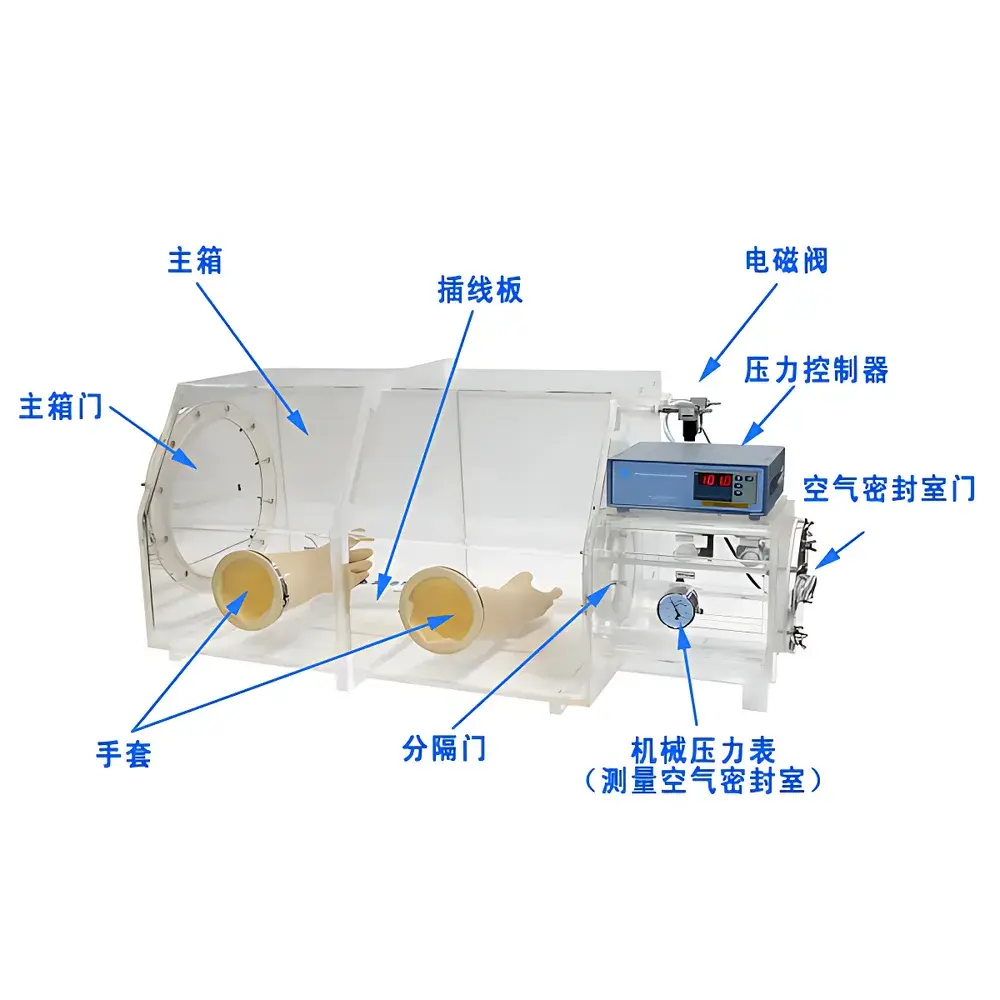
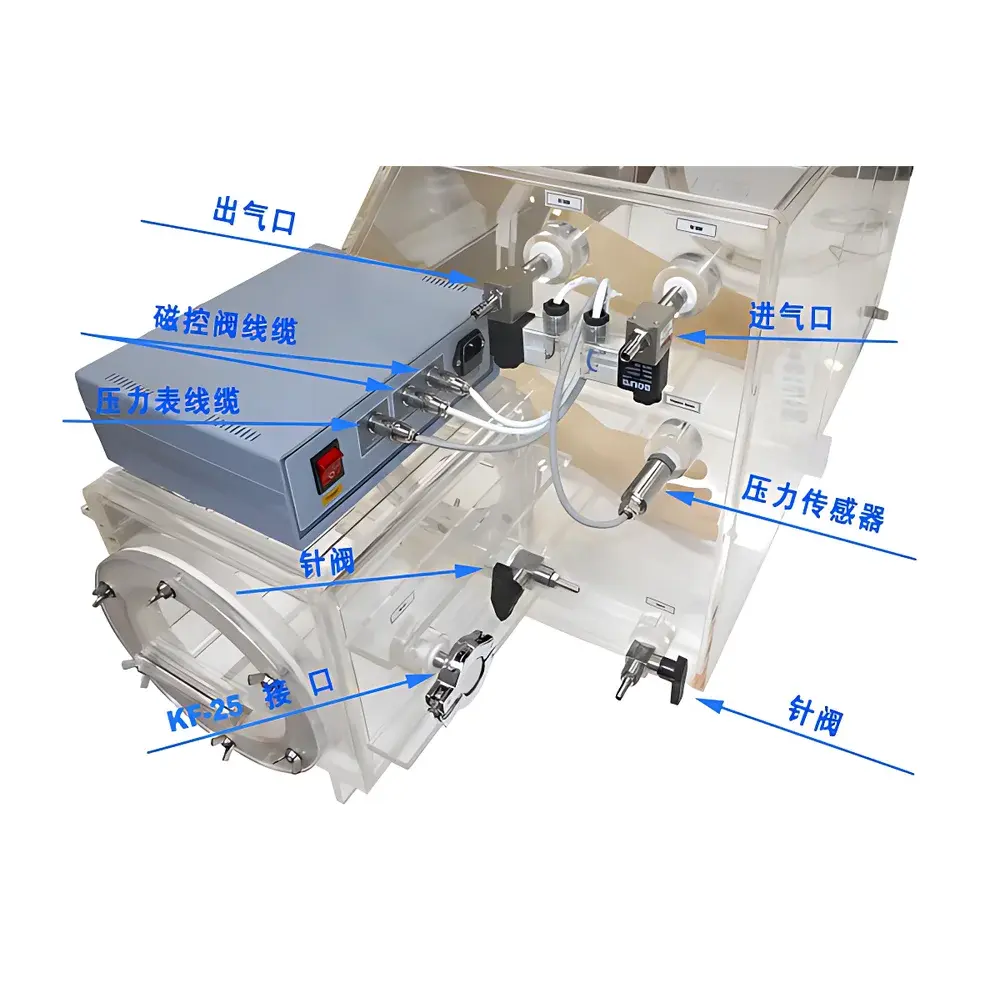
| Valves | 2 solenoid valves + 1 manual valve (main chamber) |
| Viewing Window Material | Optical-grade polycarbonate |
| Standard Accessories | Pair of elastomeric gloves |
| Optional Accessories | Additional pressure/temperature/humidity sensors |
Overview
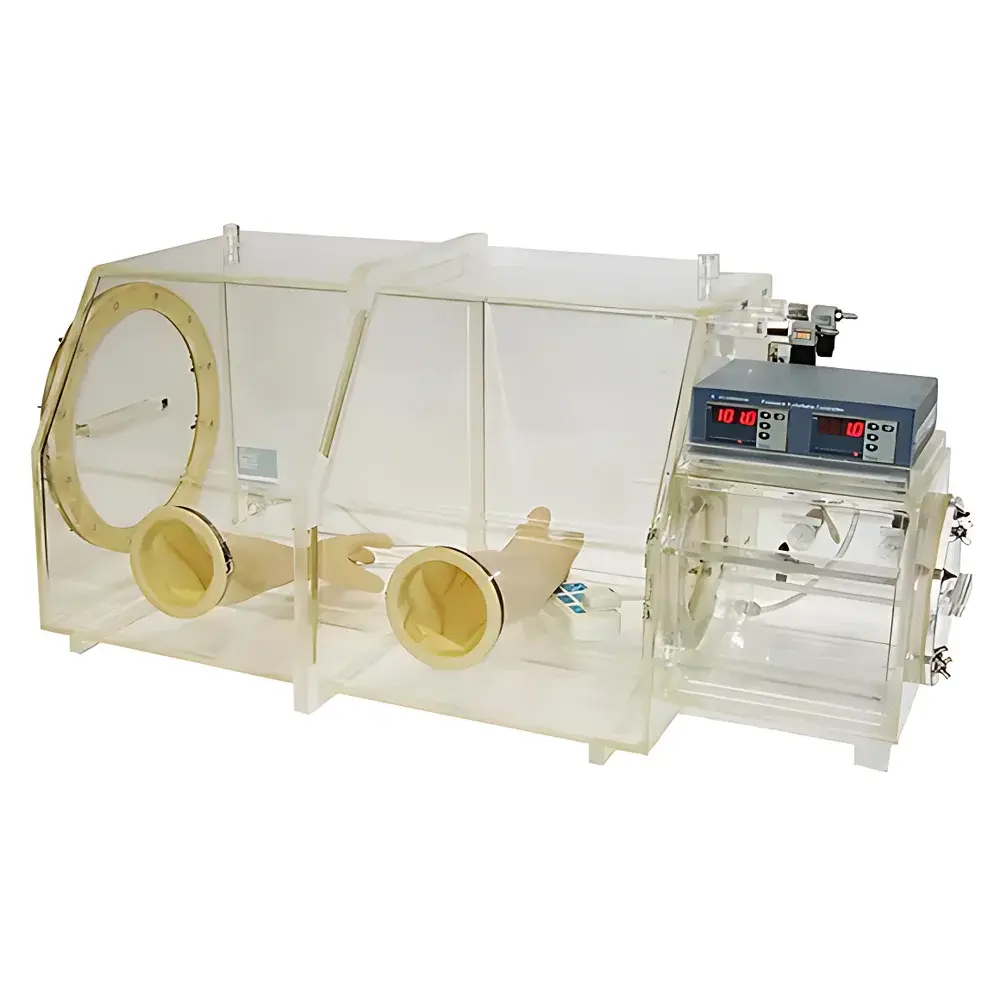
The KJ GROUP VGB-2Y Pressure-Controlled Glovebox is an engineered inert-atmosphere workstation designed for precise pressure regulation in research and development environments requiring strict exclusion of oxygen, moisture, or ambient contaminants. Unlike conventional gloveboxes relying solely on positive overpressure or passive purge strategies, the VGB-2Y implements active differential pressure control using dual solenoid valves and independent digital vacuum monitoring—enabling stable operation across a defined sub-atmospheric pressure range (95–101 kPa). This architecture supports applications where slight negative pressure relative to ambient minimizes inward leakage during material handling while maintaining compatibility with sensitive nanoscale synthesis and electrode fabrication protocols. The system integrates a dedicated airlock chamber for safe sample transfer without compromising main chamber integrity, and its fully transparent polycarbonate construction ensures unobstructed visual observation from all angles—critical for real-time process validation and operator ergonomics.
Key Features
- Dual independent digital vacuum gauges provide real-time, high-resolution pressure readouts for both the main chamber and airlock—enabling closed-loop verification of pressure differentials.
- Active pressure regulation via two programmable solenoid valves allows dynamic adjustment within the 95–101 kPa operating window, with fine-tuned response to internal or external perturbations.
- Optical-grade polycarbonate enclosure offers full 360° visibility, UV stability, and impact resistance compliant with ISO 10993-5 biocompatibility guidelines for non-invasive observation.
- Ergonomic airlock configuration (230 mm × 230 mm × 230 mm) with dual manual isolation valves permits sequential venting/purging cycles—reducing cross-contamination risk during sample ingress/egress.
- Modular accessory interface: Two standardized NPT or M12-compatible ports support integration of optional environmental sensors (e.g., O₂ <1 ppm, H₂O <0.1 ppm, temperature ±0.2 °C), facilitating GLP-aligned data logging.
- Smooth, non-porous interior surfaces and removable floor tray enable rapid decontamination using ethanol, isopropanol, or low-concentration hydrogen peroxide vapor—meeting ISO 14644-1 Class 5 cleanroom maintenance standards.
Sample Compatibility & Compliance
The VGB-2Y accommodates heterogeneous sample geometries—including powder batches (up to 2 L volume), coin-cell electrode stacks, thin-film substrates, and microfabricated devices—without spatial interference from internal fixtures. Its pressure-controlled architecture complies with ASTM D618 (conditioning of plastics), IEC 62619 (safety testing for industrial lithium batteries), and USP (microbiological control of aseptic processing environments) when paired with validated purge protocols. While not certified to ISO 14644-1 as a standalone cleanroom, the system meets ISO 8573-1:2010 Class 2 particulate limits (<100,000 particles/m³ ≥0.5 µm) after 30-minute nitrogen purge at 1.5 L/min flow rate. All elastomeric gloves conform to EN 374-3:2016 for chemical permeation resistance against common battery electrolyte solvents (e.g., EC/DMC, LiPF₆ solutions).
Software & Data Management
The VGB-2Y operates as a stand-alone hardware platform with no embedded firmware or proprietary software stack. Pressure setpoints and valve actuation are managed manually via front-panel controls; however, analog outputs (0–10 V DC) from both vacuum gauges are accessible via rear-panel terminals—enabling connection to third-party DAQ systems (e.g., National Instruments CompactDAQ, Keysight 34972A) for time-stamped pressure logging. When integrated into regulated laboratories, these signals may feed into LIMS or ELN platforms supporting 21 CFR Part 11-compliant audit trails, provided the host system implements electronic signatures, user access controls, and data integrity safeguards per ALCOA+ principles.
Applications
- Controlled-atmosphere synthesis of air-sensitive nanomaterials (e.g., metal–organic frameworks, black phosphorus, sodium metal anodes).
- Electrode slurry preparation and coin/button cell assembly under reproducible sub-atmospheric conditions to suppress solvent boiling and gas entrapment.
- Pre- and post-cycling characterization of lithium-sulfur or solid-state battery components requiring O₂/H₂O <0.1 ppm environments.
- Handling of pyrophoric catalysts (e.g., Ni(COD)₂, Co₂(CO)₈) where pressure stabilization reduces ignition risk during glove penetration.
- Calibration and functional testing of miniature gas sensors under defined partial-pressure gradients.
FAQ
What pressure ranges can the main chamber maintain, and how is stability achieved?
The main chamber operates between 95 kPa and 101 kPa absolute pressure. Stability is maintained through feedback-controlled actuation of two solenoid valves, modulated by readings from a dedicated digital vacuum gauge—achieving ±0.5 kPa repeatability over 8-hour continuous operation.
Is the airlock chamber capable of positive pressure operation?
Yes—the airlock supports up to +10 kPa gauge pressure, limited by polycarbonate structural integrity and seal compression. This enables dry, inert sample loading without back-diffusion into the main chamber.
Can third-party sensors be permanently installed?
Yes—two pre-threaded accessory ports (M12 or 1/8″ NPT) are provided on the main chamber wall, allowing direct mounting of calibrated pressure, humidity, or oxygen sensors with compatible electrical interfaces.
What maintenance intervals are recommended for long-term reliability?
Glove replacement every 6–12 months (depending on solvent exposure), annual calibration of vacuum gauges using NIST-traceable reference standards, and quarterly inspection of O-ring compression sets and solenoid valve response latency.
Does the system comply with electrical safety standards for international use?
The unit accepts universal AC input (110 V / 220 V, 50/60 Hz) and conforms to IEC 61010-1:2010 for laboratory electrical equipment, including dielectric strength testing and protective earth continuity verification. CE marking is available upon request with regional voltage configuration.



