
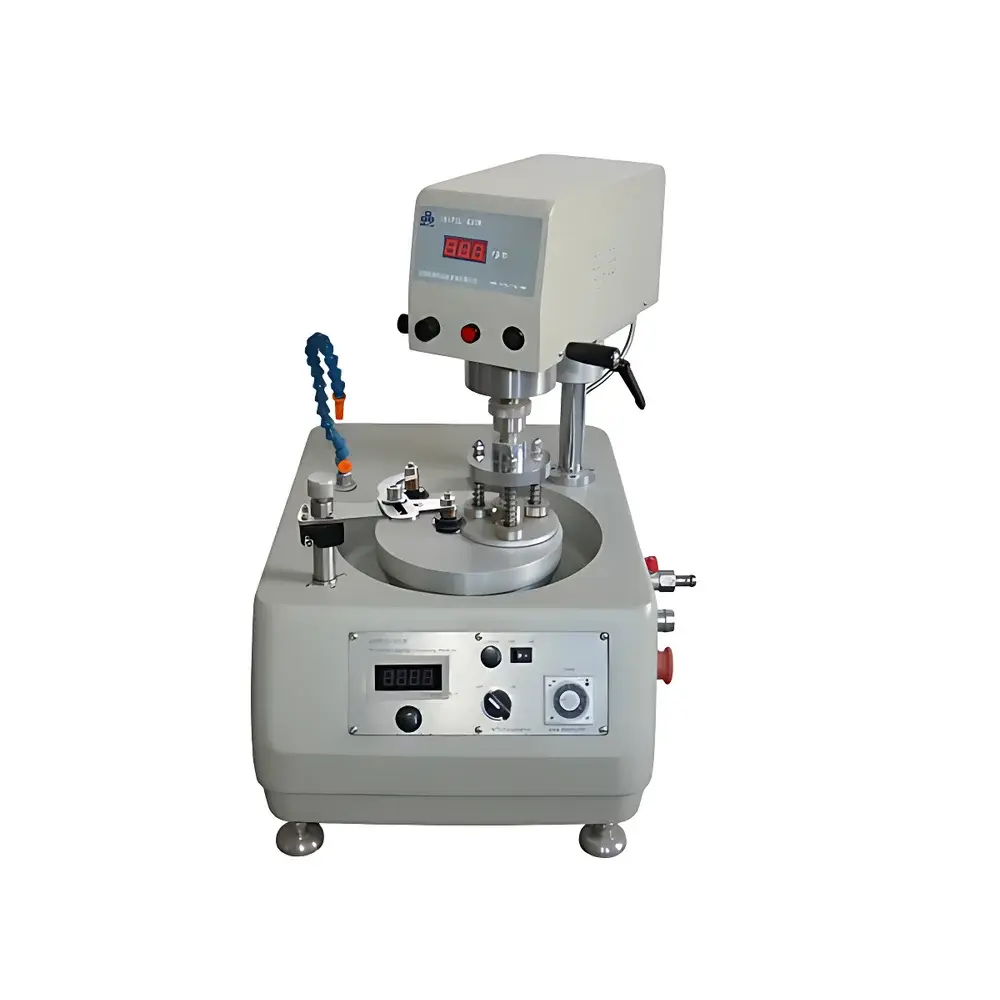
KJ GROUP UNIPOL-800M Multi-Point Mechanical Pressure Grinding and Polishing Machine
| Brand | KJ GROUP |
|---|---|
| Origin | Liaoning, China |
| Manufacturer Type | Authorized Distributor |
| Country of Origin | China |
| Model | UNIPOL-800M |
| Dimensions (L×W×D) | 580 mm × 420 mm × 630 mm |
| Number of Grinding/Polishing Plates | 1 |
| Plate Diameter | 203 mm |
| Lower Plate Speed | 0–400 rpm |
| Upper Carrier Plate Speed | 1–60 rpm |
| Carrier Plate Diameter (Standard) | Ø110 mm |
| Gravity Carrier Plate Diameter | Ø80 mm |
| Sample Holder Capacity | Ø25 mm & Ø30 mm |
| Timer Range | 0–300 h |
| Operating Environment | ≤1000 m altitude, 10–40 °C ambient, 45–65 %RH |
| Power Supply | AC 220 V, 50 Hz |
| Water Interface | Inlet & Drain Required |
| Ventilation | Mandatory |
Overview
The KJ GROUP UNIPOL-800M Multi-Point Mechanical Pressure Grinding and Polishing Machine is a precision-engineered laboratory instrument designed for controlled, reproducible material surface preparation in metallurgical, ceramic, geological, optical, and advanced composite research. It operates on a dual-motion mechanical pressure principle: a spring-loaded three-point loading system applies consistent, manually adjustable normal force to the specimen mounted on a rotating carrier plate, while the specimen simultaneously undergoes orbital motion relative to a motor-driven 203 mm grinding/polishing plate. This configuration ensures uniform material removal and minimizes edge rounding or topographic distortion—critical for subsequent microstructural analysis by optical microscopy, SEM, EBSD, or XRD. Unlike pneumatic or hydraulic systems, the UNIPOL-800M’s purely mechanical pressure architecture eliminates variability from air supply fluctuations or fluid compressibility, delivering high run-to-run repeatability across diverse hardness regimes—from soft polymers (Shore A 30) to hard ceramics (Vickers HV 1500+) and brittle infrared optical crystals (e.g., ZnS, ZnSe, Si, Ge).
Key Features
- Mechanically regulated multi-point spring loading: Three calibrated compression springs enable precise, stable, and operator-tunable normal force application via external lock-nut adjustment—no calibration drift over time.
- Dual-motion carrier plate design: Standard Ø110 mm carrier plate rotates at 1–60 rpm while orbiting eccentrically above the stationary lower plate axis, ensuring isotropic abrasion distribution and eliminating directional scratch bias.
- Dedicated gravity-swing arm station: A secondary mechanical pendulum arm accommodates fragile or cleavage-prone specimens (e.g., layered perovskites, mica, single-crystal wafers), where gravitational torque couples with slow oscillation (±15°, 0.5 rpm) and independent carrier rotation to minimize fracture risk during initial grinding.
- Independent speed control: Lower plate (0–400 rpm) and upper carrier plate (1–60 rpm) operate via separate AC inverters, enabling optimization of shear rate vs. contact dwell time for specific abrasive slurries (e.g., diamond suspension, alumina, colloidal silica).
- Extended timer functionality: Programmable digital timer supports durations from 1 minute to 300 hours (12.5 days), facilitating unattended multi-stage protocols—including coarse grinding (120 µm diamond), intermediate lapping (9 µm), and final polishing (0.05 µm colloidal silica)—with automatic shutdown and audible alert.
- Robust stainless-steel chassis with integrated water management: Front-mounted inlet and rear-mounted drain ports support continuous coolant flow; splash guard and corrosion-resistant housing meet ISO 13857 safety clearance requirements for lab environments.
Sample Compatibility & Compliance
The UNIPOL-800M is validated for preparation of metallic alloys (Fe-, Al-, Ti-, Ni-based), oxide and non-oxide ceramics (Al2O3, SiC, YSZ), geological thin sections (granite, basalt, quartzite), IR-transmissive crystals (ZnS, ZnSe, CaF2, Ge), semiconductor wafers (Si, GaAs), and polymer composites (CFRP, GFRP). Its mechanical loading mechanism complies with ASTM E3-22 (Standard Guide for Preparation of Metallographic Specimens) and ISO 16337:2021 (Metallographic specimen preparation — Grinding and polishing equipment requirements). The unit’s electrical design conforms to IEC 61010-1:2010 (Safety requirements for electrical equipment for measurement, control, and laboratory use), including reinforced insulation and earth leakage protection. For GLP/GMP-regulated labs, optional audit-trail-enabled firmware (v2.1+) supports 21 CFR Part 11-compliant user authentication, parameter logging, and electronic signature capture.
Software & Data Management
While the base UNIPOL-800M operates via front-panel controls, optional KJ-PMControl v3.2 software (Windows 10/11 compatible) enables remote operation, protocol storage (up to 99 preconfigured methods), real-time RPM and timer monitoring, and CSV export of operational logs—including start/stop timestamps, speed profiles, and manual pressure settings. All data files are timestamped and digitally signed; version-controlled method libraries can be synchronized across networked instruments. Firmware updates are delivered via encrypted USB key with SHA-256 integrity verification, satisfying internal QA documentation requirements for equipment qualification (IQ/OQ/PQ).
Applications
This instrument serves as a core sample prep platform in academic materials science departments, national metrology institutes (e.g., NIM, NIST-affiliated labs), and R&D centers developing battery electrode architectures, thermal barrier coatings, or photonic crystal substrates. Typical workflows include: cross-sectional polishing of embedded PCBs for solder joint integrity analysis; planarization of sputtered thin-film stacks prior to TEM lamella extraction; preparation of geologic thin sections meeting ASTM D3282 standards; and surface conditioning of IR lens blanks to λ/10 surface flatness prior to coating. Its mechanical stability makes it particularly suited for labs lacking compressed air infrastructure or requiring long-term unattended operation in remote field stations.
FAQ
What types of abrasives are compatible with the UNIPOL-800M?
Standard aqueous and oil-based suspensions—including diamond (1–45 µm), silicon carbide (P80–P2500), aluminum oxide (0.3–30 µm), and colloidal silica (0.02–0.07 µm)—are supported. Non-corrosive, pH-neutral slurries are recommended to preserve stainless-steel components.
Can the machine accommodate custom-sized carrier plates?
Yes. KJ GROUP offers OEM-machined carrier plates (Ø75 mm to Ø150 mm) with standardized M6 threaded mounting; maximum load capacity remains limited to 1.2 kg per plate due to torque constraints.
Is vacuum chucking available for non-magnetic or low-density samples?
Not natively. However, third-party vacuum adapter kits (e.g., Struers VP-100 interface) can be retrofitted using the standard Ø110 mm mounting flange, provided vacuum line routing is integrated into the lab bench plumbing.
How often does the mechanical pressure system require recalibration?
None. Spring-based loading is inherently drift-free; periodic verification (annually) using certified dead-weight test loads (NIST-traceable) is sufficient per ISO/IEC 17025 internal calibration procedures.
Does the unit support automated slurry dispensing?
No. Slurry delivery is manual or via external peristaltic pumps (e.g., Watson-Marlow 323U); KJ GROUP provides mounting brackets and flow-rate synchronization guidelines in Application Note AN-UNIPOL-07.



