
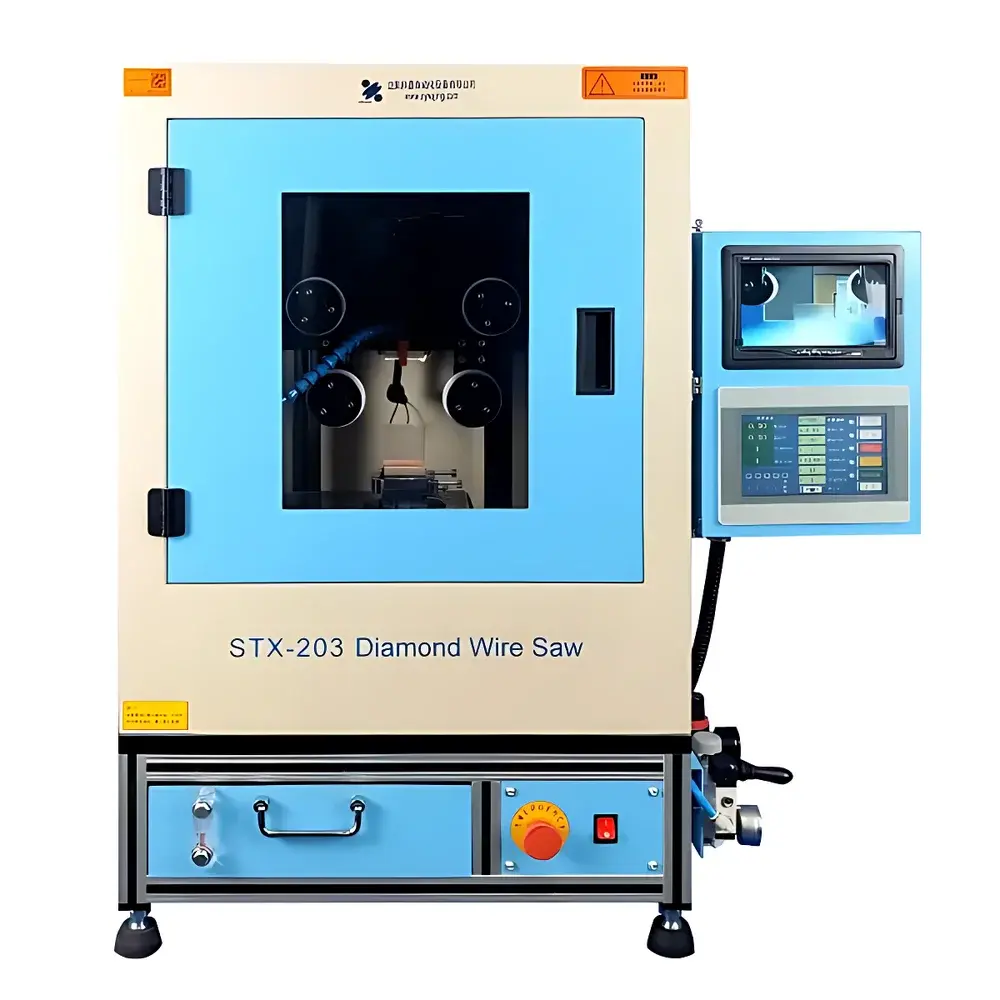
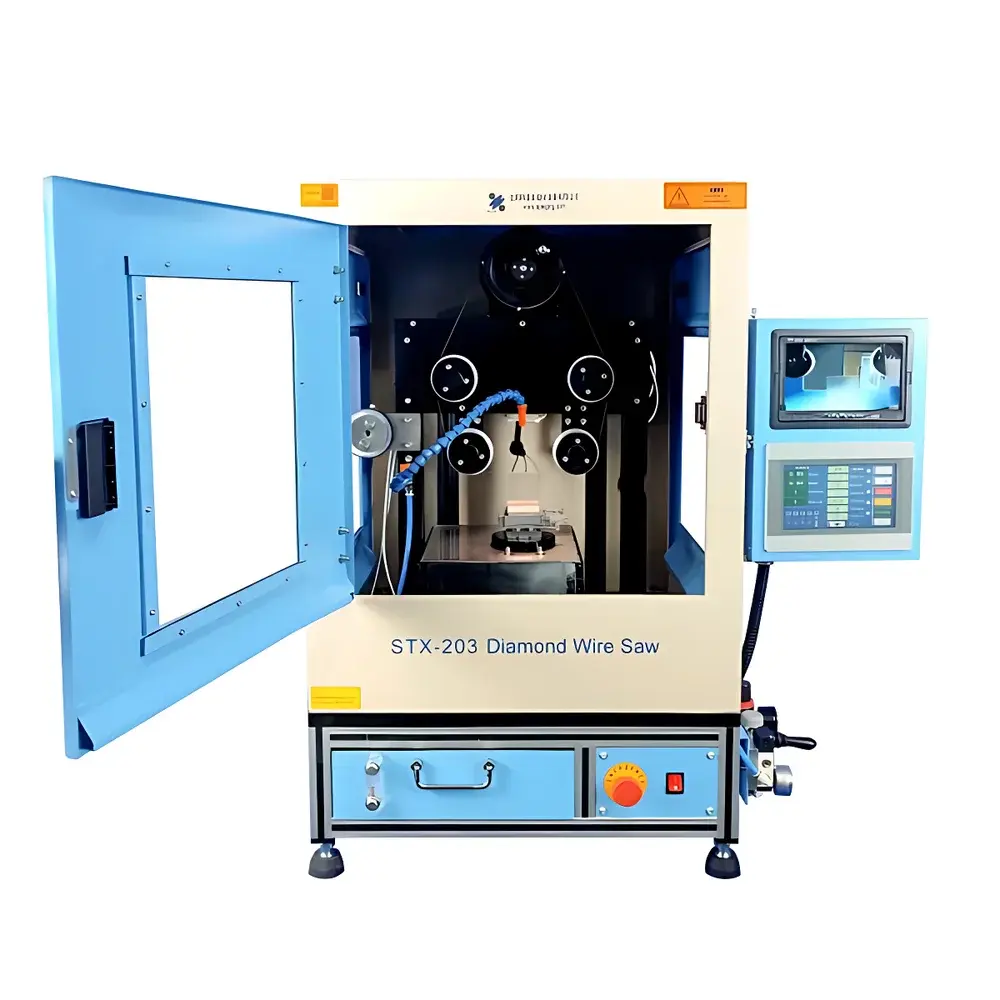
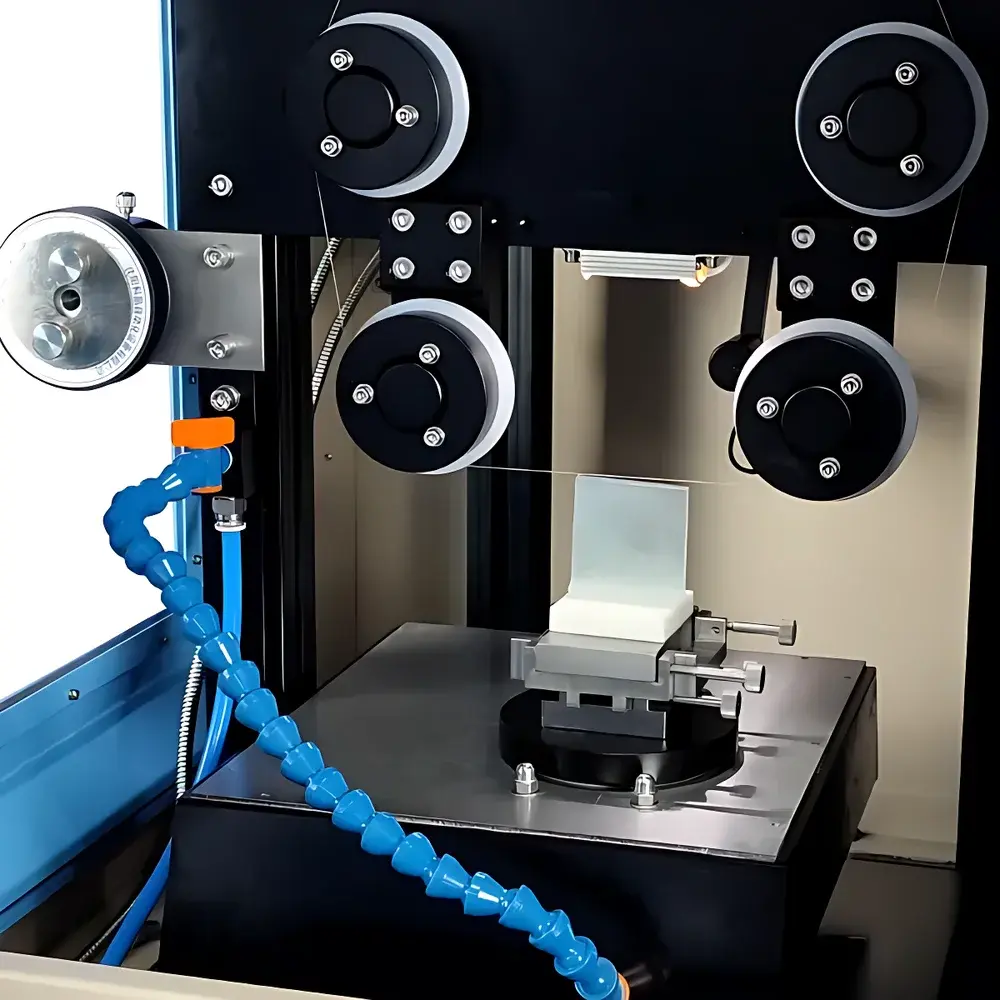
KJ GROUP STX-203 Fully Automated Diamond Wire Saw
| Brand | KJ GROUP |
|---|---|
| Origin | Liaoning, China |
| Model | STX-203 |
| Power Supply | AC 220 V, 50 Hz, 10 A |
| Total Power Consumption | 120 W (excl. air compressor) |
| Diamond Wire Length | ≤45 m |
| Wire Diameter | ≤0.45 mm |
| Wire Tensioning | Pneumatically adjustable |
| Main Spindle Rotation | Reciprocating |
| Spindle Speed | 2–300 rpm (adjustable) |
| Cutting Feed Rate | 0.05–40 mm/min |
| Return Speed | 1–40 mm/min |
| Z-axis Stroke | ≤60 mm |
| Y-axis Stroke | 0.01–50 mm |
| Rotary Stage | 0–360° horizontal (motorized) |
| Tilt Stage | ±10° (motorized) |
| Maximum Workpiece Size | Φ50 × 50 mm |
| Sample Holder Dimensions | 80 × 51 × 12 mm |
| Max Cutting Depth | ≤50 mm |
| Control System | PLC + 7-inch HMI touchscreen |
| Integrated Video Monitoring | 7-inch display |
| Frame Material | Aluminum alloy with sheet metal enclosure |
| Machine Dimensions (L×W×H) | 730 × 680 × 970 mm |
| Net Weight | 130 kg |
| Operating Environment | 0–45 °C, 10–85% RH (non-condensing) |
| Required Utilities | Compressed air ≥0.6 MPa, cutting oil coolant, grounded AC supply, stable vibration-isolated bench (≥150 kg capacity) |
Overview
The KJ GROUP STX-203 Fully Automated Diamond Wire Saw is an industrial-grade precision cutting system engineered for laboratory and R&D environments where high-fidelity sectioning of brittle, hard, or heterogeneous materials is required. It operates on the principle of abrasive wire sawing—using a continuously circulating diamond-impregnated wire under controlled tension and kinematic feed to achieve low-stress, kerf-minimized material removal. Unlike rotary or abrasive wheel systems, the STX-203 eliminates mechanical shock and thermal damage, preserving microstructural integrity in delicate specimens such as single crystals, optical ceramics, geological thin sections, and bio-integrated implants. Its fully automated feed path—programmable via integrated PLC logic and a 7-inch HMI interface—enables unattended, repeatable slicing with positional reproducibility within ±1 µm per axis (dependent on mechanical calibration and environmental stability). The reciprocating spindle design ensures uniform wire wear distribution, while the pneumatically regulated tensioning system maintains consistent cutting force across extended operation cycles.
Key Features
- Fully programmable XYZ motion control with motorized rotary (0–360°) and tilt (±10°) stages for angled and oblique sectioning—critical for crystallographic plane alignment and anisotropic material analysis.
- Pneumatic wire tension regulation (≥0.6 MPa input) ensures stable line geometry during high-precision cuts, minimizing drift and improving slice thickness consistency.
- Extended diamond wire capacity (up to 45 m) supports uninterrupted multi-sample runs; compatible with wires ranging from Ø0.35 mm to Ø0.45 mm for balancing resolution and throughput.
- Integrated real-time video monitoring via a dedicated 7-inch display allows visual verification of wire position, sample alignment, and cut progression without opening the enclosure.
- Modular coolant delivery system designed for compatibility with mineral-based cutting oils—reducing frictional heating and extending wire life during prolonged ceramic or carbide processing.
- Robust aluminum-alloy frame with full sheet-metal shielding provides EMI resilience and operator safety compliance (IEC 61000-6-2/6-4), meeting general lab equipment electromagnetic compatibility requirements.
Sample Compatibility & Compliance
The STX-203 accommodates a broad spectrum of materials with Vickers hardness below that of diamond (~10,000 HV), including but not limited to oxide and non-oxide ceramics (Al2O3, ZrO2, SiC), semiconductor ingots (Si, Ge, GaAs), infrared-transmissive crystals (ZnS, ZnSe, CaF2), geological specimens (granite, basalt, meteorites), composite laminates (CFRP, GFRP), and hydrated biological composites (calcified tissue, dental prostheses, vascular stent–tissue interfaces). For standardized thin-section preparation, it supports ASTM D7022 (Standard Practice for Preparing Rock Thin Sections) and ISO 14688-1 (Geotechnical investigation—Identification and classification of soil) workflows when paired with optional geological夹具 and resin-embedding protocols. While not certified to FDA 21 CFR Part 11 out-of-the-box, its PLC-based control architecture permits audit-trail logging integration via external SCADA systems compliant with GLP/GMP documentation frameworks.
Software & Data Management
Operation is managed through a deterministic real-time PLC controller interfaced with a 7-inch resistive touchscreen HMI. All motion parameters—including feed rate, spindle speed, Z/Y stroke limits, rotational angle offsets, and dwell times—are stored as named program files (.PRG) on internal flash memory. No proprietary PC software is required; however, parameter exports (CSV-formatted motion logs) can be retrieved via USB port for traceability and post-processing correlation with microscopy or XRD data. The system does not feature network connectivity or remote access by default, aligning with secure lab infrastructure policies. Firmware updates are performed offline using FAT32-formatted USB drives, ensuring version control integrity during validation-critical applications.
Applications
- Preparation of TEM-ready lamellae from thermoelectric alloys (Bi2Te3, PbTe) and layered chalcogenides—minimizing ion-beam damage during final polishing.
- Cutting of IR optics blanks (e.g., Ge lenses, ZnS windows) prior to CNC grinding, preserving stoichiometric homogeneity at subsurface layers.
- Sectioning of undecalcified bone–implant interfaces for histomorphometric quantification under backscattered electron imaging.
- Production of geologic thin sections (30 µm target thickness) from metamorphic rock cores, enabling petrographic analysis without preferential mineral dissolution.
- Isolation of functional domains from large-area polycrystalline perovskite films for carrier lifetime mapping and defect spectroscopy.
- Serial sectioning of calcified cardiovascular tissues containing metallic stents for corrosion–tissue interaction studies under SEM-EDS.
FAQ
What types of diamond wire are compatible with the STX-203?
The system accepts standard electroplated or resin-bonded diamond wires with diameters between 0.35 mm and 0.45 mm. Wire length must not exceed 45 meters to maintain optimal tension dynamics and spool clearance.
Is compressed air mandatory for operation?
Yes—pneumatic tensioning requires a clean, dry, oil-free air supply at ≥0.6 MPa. An optional silent oil-free air compressor (KJ-AC-100) is available to meet ISO 8573-1 Class 1 purity requirements.
Can the STX-203 perform serial sectioning for 3D reconstruction?
While not equipped with auto-loader or Z-stack scripting, repeatable manual reloading combined with sub-micron Y-axis repeatability enables sequential sectioning for correlative light-electron microscopy (CLEM) workflows when used with fiducial markers.
What cooling medium is recommended?
A low-viscosity, sulfur-free mineral cutting oil (e.g., Blaser Swisslube Vasco 700 series) is strongly advised to prevent wire glazing and thermal cracking in quartz or sapphire substrates.
Does the system support vacuum or inert atmosphere operation?
No—the enclosure is not sealed or rated for vacuum or gas purging. For oxygen-sensitive materials (e.g., Li-ion cathode slices), users must integrate external glovebox-compatible mounting fixtures separately.



