
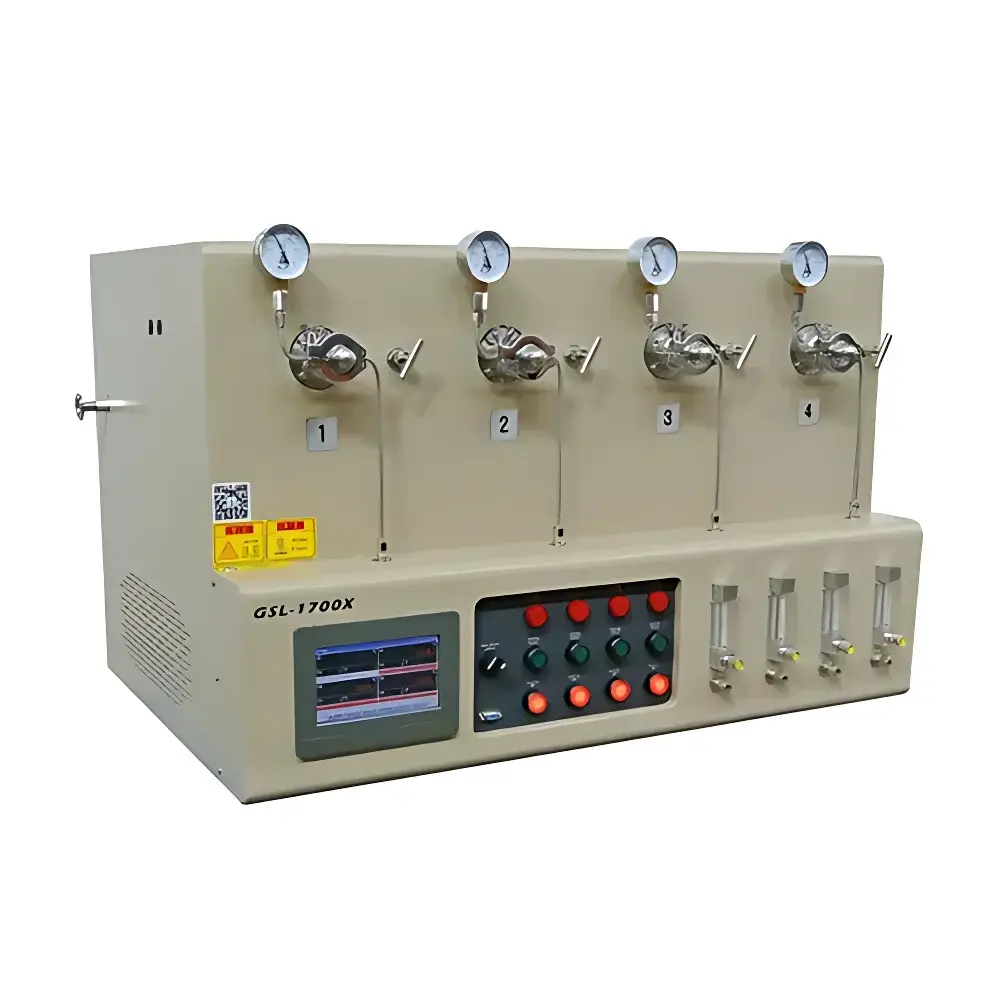
KJ GROUP GSL-1700X-MGI-4 Four-Zone High-Temperature Tube Furnace
| Brand | KJ GROUP |
|---|---|
| Origin | Liaoning, China |
| Manufacturer Type | Authorized Distributor |
| Country of Origin | China |
| Model | GSL-1700X-MGI-4 |
| Quotation | Upon Request |
| Tube OD/ID/L | 25 mm / 22 mm / 460 mm |
| Max Temp | 1700 °C (≤1 h) |
| Continuous Operating Temp | 1600 °C |
| Uniform Zone | 30 mm (±1 °C), 60 mm (±5 °C) |
| Heating Rate | Up to 10 °C/min |
| Temp Control Accuracy | ±1 °C |
| Vacuum Level | 1×10⁻⁵ Torr (with turbomolecular pump) |
| Input Power | 6 kW, 208–240 V AC, 50/60 Hz |
| Certifications | UL / MET / CSA / CE compliant (>24 V components) |
| Dimensions (L×W×H) | 1000 × 650 × 640 mm |
| Weight | Approx. 120 kg |
| Gas Flow Capacity | ≤200 SCCM |
| Max Internal Gauge Pressure | 0.02 MPa |
| Thermocouple Type | B-type (Pt/Rh) |
| Vacuum Interface | KF25 |
| Atmosphere Options | Vacuum, inert gas (N₂, Ar), reducing (H₂/N₂), or reactive (e.g., for CVD) |
Overview
The KJ GROUP GSL-1700X-MGI-4 is a precision-engineered, four-zone high-temperature tube furnace designed for parallel thermal processing under controlled atmospheric or vacuum conditions. Based on resistive heating via high-purity silicon molybdenum (MoSi₂) heating elements and alumina ceramic insulation, it operates on the principle of radial heat conduction through a high-purity α-alumina tube (99.8% Al₂O₃), enabling stable, repeatable thermal profiles up to 1700 °C. Its modular architecture—comprising four physically independent heating zones, each with dedicated B-type thermocouples and PID-controlled solid-state relays—supports true multi-sample, multi-temperature experiments in a single run. This capability is especially critical in combinatorial materials synthesis, phase diagram mapping, and accelerated thermal screening within Materials Genome Initiative (MGI) workflows. The furnace is not rated for pressurized operation; all thermal treatments must be conducted at ambient pressure or under vacuum (≤0.02 MPa gauge), ensuring compatibility with standard laboratory gas delivery and vacuum infrastructure.
Key Features
- Four independent heating zones with individual touch-screen controllers, enabling simultaneous yet distinct temperature programs across four samples
- High-purity α-alumina tubes (Φ25 × 460 mm, ID 22 mm) offering excellent thermal stability, low alkali content, and resistance to thermal shock up to 1700 °C
- Precision vacuum integration: KF25 flanges, mechanical vacuum gauge, and turbomolecular pump interface supporting ultimate vacuum down to 1×10⁻⁵ Torr
- Gas handling system: Four calibrated rotameters (0–200 SCCM range), dual-stage pressure regulators required upstream, KF25 inlet ports compatible with inert, reducing, or reactive atmospheres
- Safety architecture: Over-temperature cutoff, thermocouple break detection, automatic power cutoff on fault, and UL/MET/CSA/CE-compliant low-voltage control circuitry
- Modular upgrade path: Optional vertical quenching configuration with motorized sample rotation and liquid quench reservoir for rapid thermal arrest studies
Sample Compatibility & Compliance
The GSL-1700X-MGI-4 accommodates standard cylindrical or crucible-loaded specimens up to 20 mm in diameter and 40 mm in length per zone. It supports powder, pellet, thin-film, and fiber samples—common in ceramic sintering, alloy homogenization, oxide reduction, and precursor decomposition (e.g., for CVD seed layer formation). All structural and electrical components exceeding 24 V are certified to UL 61010-1, CSA C22.2 No. 61010-1, and EN 61010-1 standards. Upon customer request and associated fee, individual units can be submitted for full TÜV Rheinland or CSA Group certification—including traceable calibration records, wiring diagrams, and risk assessment documentation—ensuring readiness for GLP/GMP-regulated labs or EU-based academic infrastructure procurement.
Software & Data Management
Temperature programming is executed via an integrated 7-inch resistive touch HMI with intuitive drag-and-drop profile builder, supporting up to 30 segments per zone. Real-time data logging (sampled at 1 Hz) is stored internally and exportable via USB to CSV. Optional PC connectivity (RS485/Modbus RTU or Ethernet/IP) enables remote monitoring, synchronized multi-zone scripting, and integration into LabArchives or Electronic Lab Notebook (ELN) systems. All temperature logs include timestamps, zone identifiers, setpoint/actual deviation, and alarm event flags—fully compliant with FDA 21 CFR Part 11 requirements when paired with validated user access controls and audit trail software (available as add-on module).
Applications
- Combinatorial phase diagram exploration: Simultaneous annealing of compositionally graded libraries at discrete isotherms (e.g., Ni–Co–Fe–O spinel systems)
- Ceramic densification kinetics: Multi-point sintering studies with identical dwell times but varying peak temperatures to extract activation energy
- Pre-ceramic polymer pyrolysis: Controlled inert-atmosphere conversion of polycarbosilane fibers into SiC ceramics
- Thin-film crystallization: Rapid thermal processing of sol-gel-derived TiO₂ or LiCoO₂ precursors under N₂/H₂ mixtures
- CVD precursor decomposition screening: Evaluating decomposition onset temperatures and gaseous byproduct evolution across four metalorganic precursors
- Thermal stability benchmarking: ISO 11357-1 compliant heat resistance testing of advanced refractory composites
FAQ
Can this furnace operate under positive pressure?
No. The GSL-1700X-MGI-4 is engineered exclusively for vacuum or ambient-pressure gas flow applications. Internal gauge pressure must not exceed 0.02 MPa to maintain structural integrity and seal reliability.
Is the vacuum level of 1×10⁻⁵ Torr achievable with the base configuration?
That ultimate vacuum requires optional turbomolecular pumping; the standard package includes only a mechanical vacuum gauge and KF25 interface—pump selection and installation are customer-responsible.
Are B-type thermocouples included and calibrated?
Yes, four factory-installed, ungrounded B-type thermocouples are provided, each with NIST-traceable calibration certificate (as-shipped). Recalibration services are available annually.
What gas purity is recommended for CVD-compatible operation?
For reproducible film growth, carrier and reactant gases should meet ASTM D7525 specifications (≥99.999% purity, H₂O ≤ 1 ppm, O₂ ≤ 0.5 ppm). Dual-stage regulators are mandatory to prevent backstreaming.
Does the one-year warranty cover consumables?
No. The warranty excludes furnace tubes, silicone O-rings, MoSi₂ heating elements, and thermocouple sheaths—these are classified as normal-wear items per IEC 60068-2-66 maintenance guidelines.



