
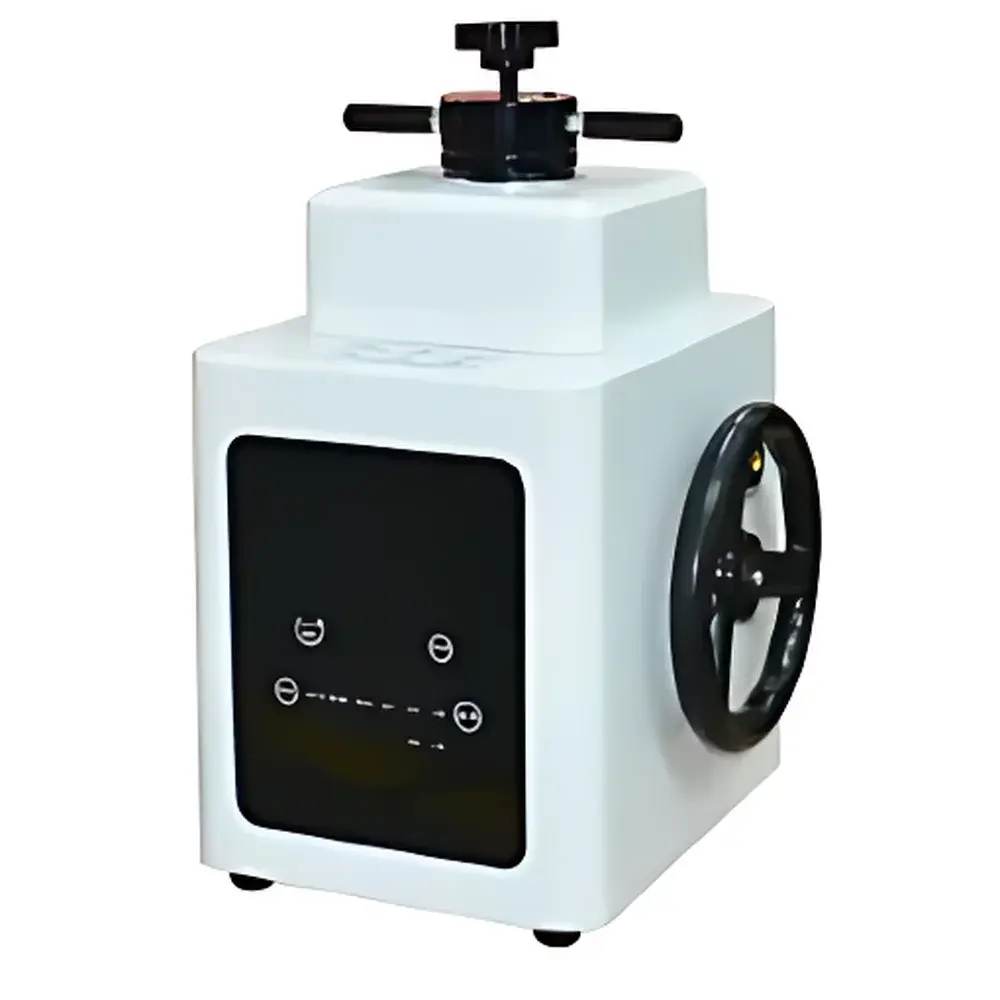
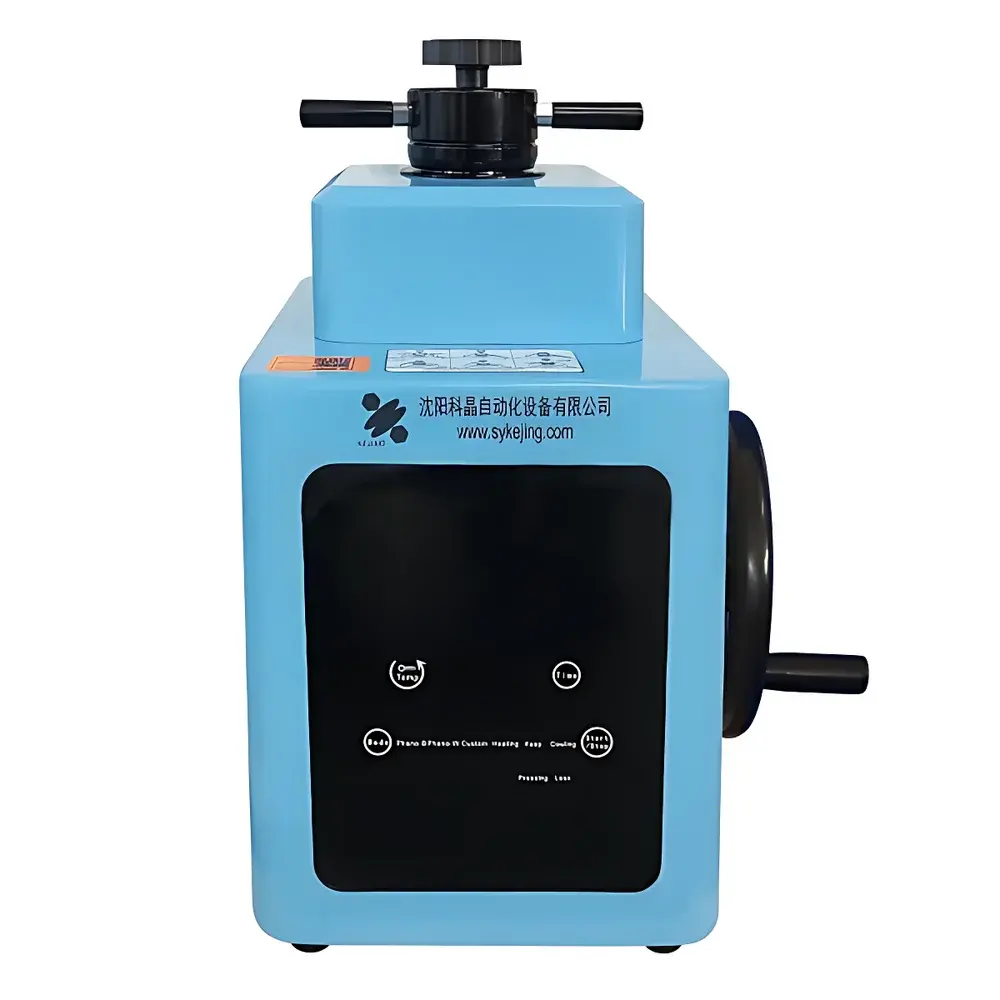
KJ GROUP XQ-2B Metallographic Hot Mounting Press
| Brand | KJ GROUP |
|---|---|
| Origin | Liaoning, China |
| Model | XQ-2B |
| Type | Hot Mounting Press |
| Power Supply | AC 220 V, 50 Hz, 10 A |
| Rated Power | 800 W |
| Temperature Range | Ambient to 200 °C |
| Mold Diameters | Φ22 mm, Φ30 mm, Φ45 mm (one standard configuration selected at order) |
| Dimensions | 310 × 300 × 480 mm (L×W×H) |
| Weight | ≈33 kg |
| Operating Environment | 10–30 °C, <85% RH (non-condensing), vibration-free, corrosion-free, grounded power supply |
Overview
The KJ GROUP XQ-2B Metallographic Hot Mounting Press is a manually operated, thermally activated specimen mounting system engineered for reproducible preparation of metallographic samples prior to grinding, polishing, and microscopic analysis. It operates on the principle of hot compression molding: thermosetting resins—such as phenolic, epoxy, or acrylic—soften under controlled heat and flow under axial pressure into a mold cavity, encapsulating irregular, fragile, or dimensionally unstable specimens. The XQ-2B employs a mechanical gear-and-screw actuation mechanism driven by an external handwheel; this rotates a pair of bevel gears that translate rotational input into precise vertical displacement of the lower die within a fixed mold sleeve. A calibrated spring-based force compensation system ensures consistent compaction pressure across cycles, while an integrated status indicator light activates when nominal pressure is reached—providing real-time tactile and visual feedback during consolidation. Unlike hydraulic or programmable systems, the XQ-2B delivers deterministic, operator-controlled process repeatability suited for routine lab environments where thermal stability, mechanical robustness, and procedural transparency are prioritized over automation.
Key Features
- Mechanically actuated compression system with bevel-gear-driven lead screw—eliminates reliance on hydraulic fluids or electronic actuators, enhancing long-term reliability and serviceability.
- Adjustable temperature control from ambient to 200 °C, enabling compatibility with a broad spectrum of thermosetting embedding media (e.g., phenolic resins requiring ~150–180 °C, acrylics at ~120–160 °C).
- Interchangeable mold sets supporting three standardized diameters (Φ22 mm, Φ30 mm, Φ45 mm), facilitating adaptation to diverse sample geometries—from microelectronic interconnects to turbine blade cross-sections—without tooling reconfiguration.
- Integrated pressure-indicating LED: illuminates when the preset spring-compression threshold is attained, confirming initiation of effective resin flow and specimen confinement.
- Compact footprint (310 × 300 × 480 mm) and lightweight construction (~33 kg) allow flexible benchtop integration in QC labs, university teaching facilities, or field-deployable metallurgical stations.
- No external cooling water, compressed air, or exhaust ducting required—compliant with ISO 14644-1 Class 8 cleanroom-adjacent installation and compatible with standard laboratory electrical infrastructure (AC 220 V, 50 Hz, 10 A grounded outlet).
Sample Compatibility & Compliance
The XQ-2B accommodates heterogeneous specimen types including brittle ceramics, soft alloys, multi-layered composites, and irregularly shaped components unsuitable for clamping or manual handling during subsequent preparation steps. Its hot-mounting methodology conforms to ASTM E3-22 (Standard Guide for Preparation of Metallographic Specimens) and ISO 15510:2021 (Metallic materials — Metallographic specimen preparation). While the unit itself does not incorporate digital audit trails or user authentication, its mechanical operation supports GLP-compliant documentation workflows: operators may record batch-specific parameters—including set temperature, dwell time, mold ID, and resin lot number—in laboratory notebooks or LIMS-integrated forms. The absence of firmware or network connectivity renders it inherently compliant with FDA 21 CFR Part 11 requirements for non-electronic records, provided procedural controls are defined in SOPs.
Software & Data Management
The XQ-2B is a fully manual, analog-operated instrument with no embedded microprocessor, display interface, or data logging capability. All operational parameters—including temperature setpoint, compression timing, and mold selection—are established and verified externally via calibrated dial thermometers, stopwatch measurement, and physical mold identification. This architecture eliminates software validation burdens and aligns with laboratories maintaining legacy compliance frameworks where deterministic mechanical processes are preferred over digital control. Users may integrate the XQ-2B into broader digital workflows by pairing it with external thermal data loggers (e.g., certified thermocouple-based recorders meeting ASTM E740) or documenting cycle parameters in validated ELN platforms such as LabArchives or Benchling.
Applications
- Routine metallographic sample preparation in foundry QA labs for cast iron, aluminum, and stainless steel microstructure evaluation per ASTM E112 (grain size) and ASTM E384 (microhardness).
- Encapsulation of fracture surfaces, weld zones, and corrosion-damaged coupons for cross-sectional SEM/EDS analysis.
- Mounting of small-dimension electronics packages (e.g., solder joints, PCB traces) prior to precision sectioning using diamond wafering blades.
- Academic instruction in materials science laboratories—where transparent mechanical operation aids pedagogical demonstration of thermoset curing kinetics and pressure-assisted resin infiltration.
- Preparation of reference standards for hardness calibration blocks and wear-test specimens requiring geometric stabilization before abrasion testing (ASTM G65, G132).
FAQ
Is the XQ-2B suitable for cold mounting applications?
No—the XQ-2B is designed exclusively for hot compression mounting using thermosetting resins. Cold mounting requires separate vacuum-impregnation equipment or hydraulic cold presses with ambient-temperature dies.
Does the unit include temperature calibration certification?
The XQ-2B ships with factory-set thermal controls but does not include NIST-traceable calibration documentation. Users should perform periodic verification using a calibrated immersion thermometer or contact thermocouple probe per ISO/IEC 17025 procedures.
Can multiple molds be used simultaneously?
No—only one mold assembly (with matching upper/lower dies and collar) is installed per cycle. Sequential mounting with different diameters is supported via manual die exchange.
What safety certifications does the XQ-2B carry?
The device complies with GB 4793.1–2019 (Chinese national standard for electrical safety in laboratory equipment) and meets CE marking requirements for low-voltage directive (2014/35/EU) and electromagnetic compatibility (2014/30/EU) when supplied with appropriate regional power cords.
Is technical support available outside mainland China?
Yes—KJ GROUP maintains authorized service partners in North America, Europe, and Southeast Asia. Spare parts including heating elements, thermocouples, and mold sets are stocked regionally and shipped with documented traceability.
Related Products



