
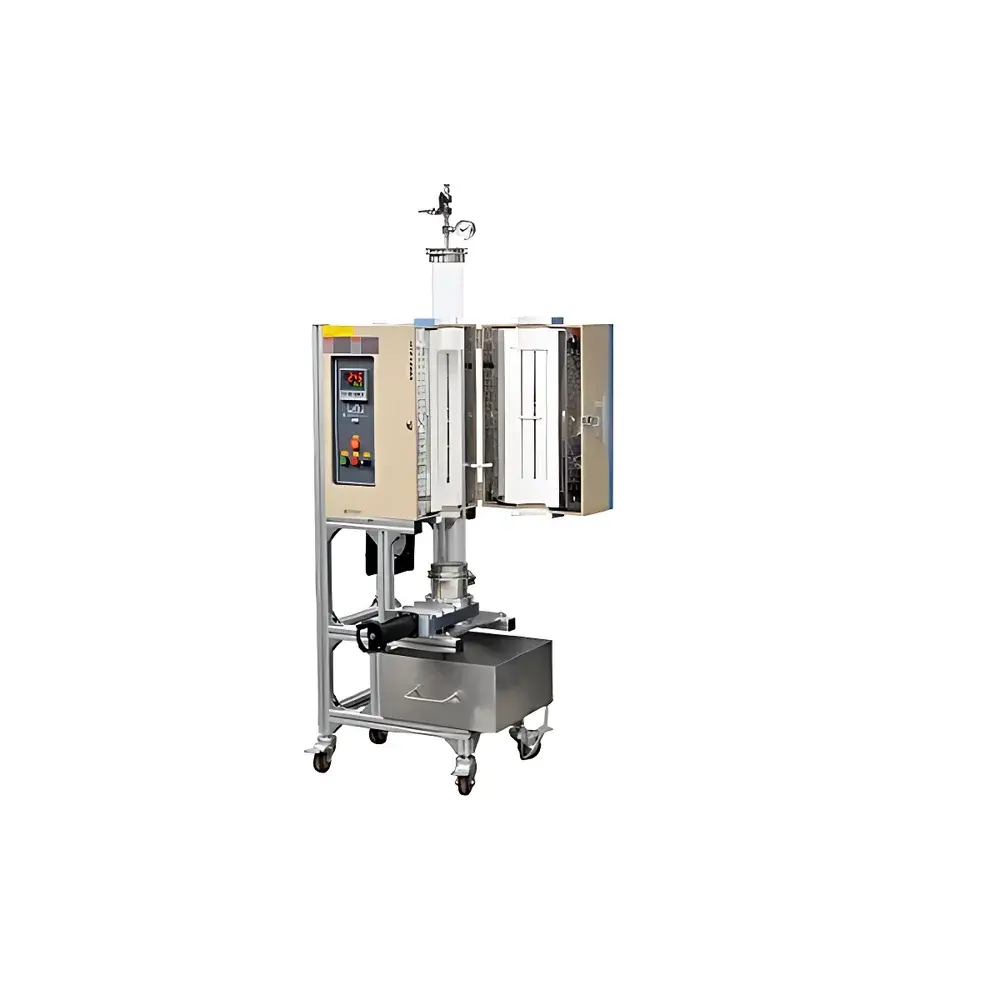
KJ GROUP OTF-1200X-4-VTQ Vertical Vacuum Tube Quenching Furnace
| Brand | KJ GROUP |
|---|---|
| Origin | Liaoning, China |
| Manufacturer Type | Authorized Distributor |
| Country of Origin | China |
| Model | OTF-1200X-4-VTQ |
| Voltage | AC 208–240 V, 50/60 Hz |
| Power | 3 kW |
| Maximum Operating Temperature | 1200 °C (<1 h), Continuous at 1100 °C |
| Heating Rate | ≤20 °C/min (recommended ≤10 °C/min) |
| Temperature Uniformity | ±1 °C over 150 mm zone |
| Control Accuracy | ±1 °C |
| Thermocouple | Type K |
| Vacuum Flange | 4" stainless steel CF-100 compatible |
| Base Vacuum | 0.05 torr (pump-dependent) |
| Quartz Tube | OD 100 mm, ID 94 mm, L 1450 mm |
| Heating Zone Length | 440 mm |
| Quenching Chamber | 400 × 400 × 200 mm |
| Dimensions (W×D×H) | 660 × 400 × 1450 mm |
| Weight | ~85 kg |
| Cooling Medium Compatibility | Ice water or chilled oil |
| Safety Certifications | CE |
| Communication Interface | RS485 |
Overview
The KJ GROUP OTF-1200X-4-VTQ is a vertically oriented, vacuum-capable tube furnace engineered specifically for controlled rapid quenching experiments under inert, reducing, or vacuum atmospheres. It integrates a high-temperature resistance-heated quartz tube system with a pneumatically actuated or manually operated 4-inch gate valve and sealed quenching chamber—enabling reproducible phase transformation studies via precise thermal cycling from up to 1200 °C directly into cryogenic or thermally conductive liquid media. The furnace operates on the principle of resistive heating using Mo-doped Fe–Cr–Al alloy elements, delivering stable thermal profiles across a 440 mm heating zone. Its vertical architecture minimizes gravitational distortion during sample suspension and ensures unobstructed drop-path geometry between the hot zone and quench medium—critical for achieving consistent microstructural arrest in metallurgical, ceramic, and functional material research.
Key Features
- Double-walled air-cooled housing maintains external surface temperature below 65 °C during continuous operation at 1100 °C—enhancing operator safety and lab ambient stability.
- Vertically opening top-loading design simplifies sample insertion, crucible mounting, and post-quench retrieval without horizontal repositioning or tube removal.
- CF-100 compatible 4-inch stainless steel vacuum flange includes integrated vacuum gauge and isolation valve, supporting base pressures down to 0.05 torr when paired with appropriate rotary vane or turbomolecular pumping systems.
- PID-based temperature controller supports up to 30 programmable segments, enabling precise ramp/soak/cool sequences—including independent control of heating rate, dwell time, and cooling initiation timing.
- Dual-stage thermal protection: Over-temperature cutoff (hardware-based) and thermocouple break detection prevent uncontrolled excursions during extended无人值守 operation.
- Al2O3-ceramic furnace plug with integrated hook ring allows secure suspension of samples or crucibles via high-purity metal wire—ensuring centric positioning within the 150 mm ±1 °C uniformity zone.
- Quench chamber (400 × 400 × 200 mm) is isolated by gate valve and sealed against contamination; compatible with deionized ice water, silicone oil, or paraffin-based quenchants per ASTM D2140 and ISO 9950 standards.
Sample Compatibility & Compliance
The OTF-1200X-4-VTQ accommodates cylindrical specimens up to Ø25 mm × 100 mm, powders in quartz or alumina crucibles, and thin-film substrates mounted on refractory holders. Quartz tube specifications (OD 100 mm, ID 94 mm, L 1450 mm) comply with ASTM F1721 for fused silica dimensional stability under thermal cycling. All electrical subsystems exceeding 24 V DC/AC are certified to UL 61010-1, MET 61010-1, and CSA C22.2 No. 61010-1. The unit carries CE marking per EU Machinery Directive 2006/42/EC and Electromagnetic Compatibility Directive 2014/30/EU. Upon request and client-funded assessment, individual units may be submitted for TÜV Rheinland certification (EN 61000-6-2/-6-4) and additional CSA validation.
Software & Data Management
Optional RS485 interface enables integration with third-party SCADA platforms or custom LabVIEW/Python acquisition scripts for real-time temperature logging, alarm event capture, and remote program execution. While the standard PID controller does not include built-in audit trail functionality, data export via Modbus RTU permits traceable record generation compliant with GLP and ISO/IEC 17025 documentation requirements. When used with validated PC control software (sold separately), full electronic records—including user ID, timestamped setpoints, actual PV curves, and fault logs—can be generated to support FDA 21 CFR Part 11 readiness where local IT infrastructure permits digital signature implementation.
Applications
- Phase transformation kinetics in Fe–C, Ni–Ti, and Zr–based alloys via interrupted quenching followed by TEM/XRD analysis.
- Thermal shock resistance evaluation of oxide dispersion strengthened (ODS) steels and SiC fiber-reinforced composites.
- Controlled martensitic/austenitic fraction tuning in shape memory alloys through variable quench-rate protocols.
- Grain boundary engineering in polycrystalline ceramics (e.g., Al2O3, YSZ) under dynamic thermal gradients.
- Decomposition behavior of metastable precursors in battery cathode materials (e.g., NMC, LFP) under inert vacuum conditions.
- Calibration reference for high-speed pyrometry and contact thermometry validation at temperatures up to 1100 °C.
FAQ
What is the maximum safe internal pressure for the quartz tube during operation?
The quartz tube must not exceed 0.02 MPa (2 bar gauge) at any time. Exceeding this limit risks catastrophic failure due to thermal stress amplification.
Can the furnace operate under vacuum at temperatures above 1000 °C?
No. Above 1000 °C, the quartz tube must be maintained at atmospheric pressure to prevent devitrification and structural weakening. Vacuum operation is restricted to ≤1000 °C per manufacturer guidelines.
Is the quenching chamber compatible with organic solvents such as ethanol or acetone?
Only non-volatile, thermally stable media with flash points >150 °C are recommended (e.g., polyalkylene glycols, mineral oils). Flammable liquids introduce explosion hazards under vacuum and are strictly prohibited.
What is the minimum achievable quench rate using ice water?
Empirical testing shows average cooling rates of 150–300 °C/s for 3-mm-diameter steel coupons, depending on initial temperature, immersion depth, and agitation—consistent with ISO 18265 Annex B benchmarking procedures.
Does the system support automated quench triggering based on real-time temperature feedback?
Yes—via optional RS485 integration and external PLC logic, the gate valve can be triggered at user-defined setpoints (e.g., “open valve when TC reads 1150 °C”) to synchronize quench onset with thermal history.



