
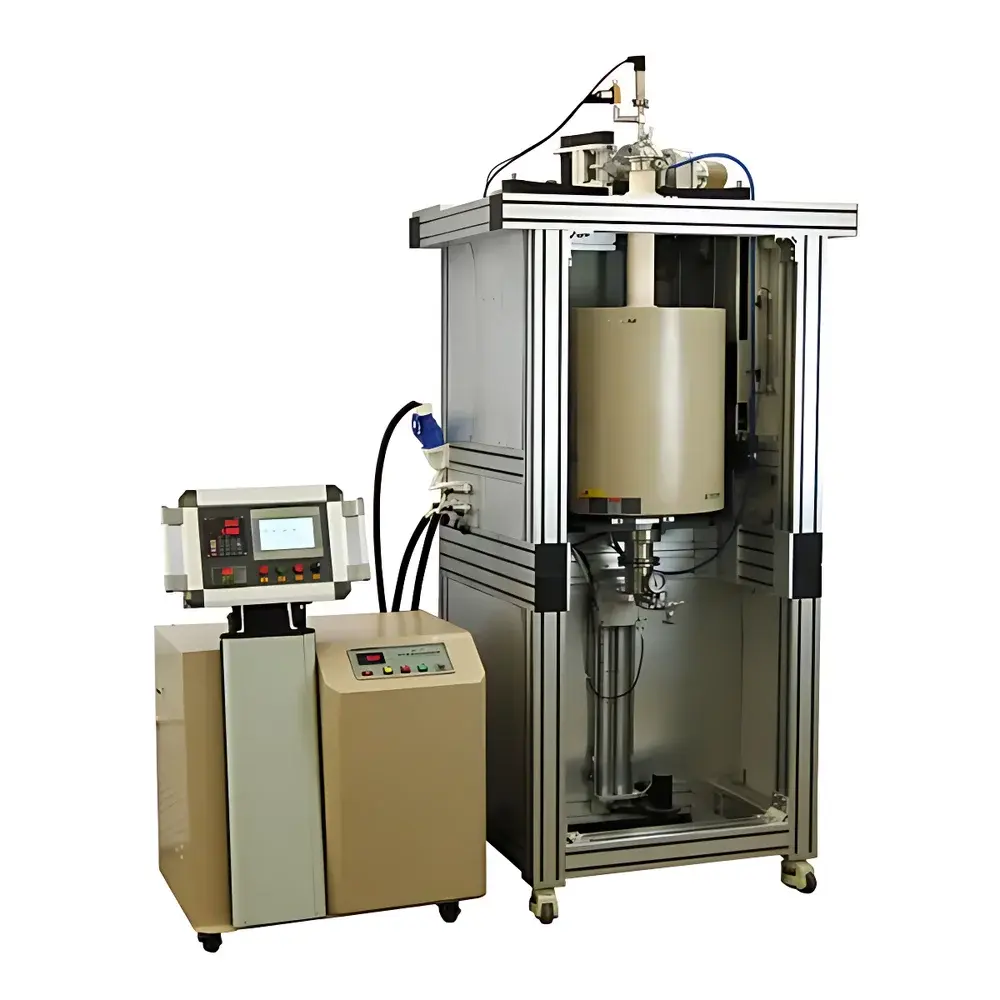
KJ GROUP SKJ-BG1650 Bridgman Single-Crystal Growth Furnace
| Brand | KJ GROUP |
|---|---|
| Origin | Liaoning, China |
| Manufacturer Type | Authorized Distributor |
| Country of Origin | China |
| Model | SKJ-BG1650 |
| Price | Upon Request |
| Power Supply | AC 220 V, 50/60 Hz, Single Phase, Max. 9.5 kW |
| Max. Operating Temperature | 1650 °C (<1 h), Continuous Operation: 1600 °C |
| Heating Element | Silicon Molybdenum (MoSi₂) Rods |
| Furnace Tube | High-Purity Alumina (Al₂O₃), Φ80 × 1000 mm |
| Sealing | Stainless Steel Flanged Vacuum/Atmosphere-Compatible Chamber |
| Sample Stage | Al₂O₃, Φ42 × 40 mm |
| Thermocouples | Dual B-Type — One Embedded at Stage Base (Crucible Bottom Temp), One Inserted Vertically into Crucible (Sample Core Temp) |
| Temperature Control | Eurotherm PID Controller, 24-Stage Ramp/Soak Program, ±0.1 °C Stability, Over-Temp & Broken-Thermocouple Protection |
| Heating Zone | Standard Single Zone (200 mm) |
| Stage Motion | Motorized Vertical Lift, 700 mm Stroke, Precise Crucible Loading/Retrieval |
| Furnace Translation | Linear Drive, 200 mm Travel Range, Adjustable Speed: 0.03–3 mm/h |
| Vacuum Options | Mechanical Pump (10⁻³ Torr), Turbo-Molecular Pump (10⁻⁵ Torr) |
| Dimensions (L×W×H) | 1155 × 930 × 2300 mm |
Overview
The KJ GROUP SKJ-BG1650 Bridgman Single-Crystal Growth Furnace is an engineered thermal system designed for controlled vertical solidification of high-melting-point crystalline materials via the modified Bridgman technique. It operates on the principle of directional solidification—where a polycrystalline charge is melted in a sealed crucible and slowly withdrawn from a high-temperature zone across a precisely defined axial temperature gradient. This enables nucleation at a single point followed by unidirectional crystal growth along the [001] or other preferred orientation, minimizing grain boundary formation and maximizing structural homogeneity. Optimized for oxides (e.g., YAG, sapphire, LiNbO₃), fluorides (CaF₂, BaF₂), and intermetallic compounds, the furnace supports both vacuum and inert-gas (Ar, N₂) atmospheres—critical for stoichiometry preservation and defect suppression in optoelectronic and laser-grade crystals.
Key Features
- High-stability dual B-type thermocouple monitoring: one embedded in the alumina sample stage base to record crucible bottom temperature, and a second vertically inserted into the melt for real-time core sample profiling—enabling empirical calibration of thermal gradient profiles.
- Motor-driven vertical sample stage with 700 mm stroke, facilitating safe, repeatable crucible loading and post-growth extraction without manual handling or thermal exposure risk.
- Modular furnace architecture: standard single-zone configuration (200 mm heating length) with optional triple-zone upgrade (3 × 100 mm independent zones) using mullite-insulated MoSi₂ heating elements—capable of sustaining axial gradients exceeding 50 °C/cm under steady-state conditions.
- Eurotherm 3500-series PID controller with 24-segment programmable ramp/soak capability, integrated over-temperature cutoff, broken thermocouple detection, and ±0.1 °C long-term thermal stability at 1600 °C.
- Vacuum- and atmosphere-compatible chamber: high-purity alumina tube (Φ80 × 1000 mm) sealed with stainless steel flanges rated for ≤10⁻⁵ Torr (with turbomolecular pump) or ≤10⁻³ Torr (with two-stage rotary vane pump).
- Programmable furnace translation system: linear motion drive with 200 mm travel range and continuously adjustable withdrawal speed (0.03–3 mm/h), synchronized with temperature profile execution for precise solidification velocity control.
Sample Compatibility & Compliance
The SKJ-BG1650 accommodates standard cylindrical crucibles up to Φ35 mm (e.g., iridium, molybdenum, graphite, or alumina-lined quartz), with compatibility verified for oxide, fluoride, and chalcogenide feedstock materials. All wetted components—including furnace tube, stage, and insulation—are non-reactive above 1600 °C and chemically inert under reducing or inert atmospheres. The system meets mechanical and electrical safety requirements per IEC 61000-6-2 (EMC Immunity) and IEC 61000-6-4 (EMC Emission). While not certified to ISO/IEC 17025, its control architecture supports GLP-compliant documentation when paired with external data logging systems compliant with FDA 21 CFR Part 11 (audit trail, electronic signature, and data integrity protocols).
Software & Data Management
Control and monitoring are executed via a 7-inch industrial touchscreen HMI interface. All operational parameters—including setpoint temperature, ramp rate, dwell time, stage position, translation speed, and real-time thermocouple readings—are logged internally at user-defined intervals (1–60 s resolution) and exportable via USB to CSV format. Optional Ethernet connectivity enables integration with LabVIEW™ or MATLAB® environments for closed-loop feedback control. Raw thermal and positional data are timestamped and structured to support traceable process validation per ASTM F2658 (Standard Practice for Crystal Growth Process Documentation) and internal quality assurance workflows.
Applications
- Growth of laser host crystals (Y₃Al₅O₁₂, GdVO₄, LuAG) for diode-pumped solid-state lasers.
- Production of scintillator single crystals (Ce:LuAG, Eu:Strontium Iodide) for radiation detection and medical imaging.
- Research-scale synthesis of thermoelectric oxides (Ca₃Co₄O₉, NaₓCoO₂) requiring controlled oxygen partial pressure and slow-cooling kinetics.
- Development of piezoelectric substrates (LiTaO₃, LiNbO₃) with minimized domain twinning through gradient-tuned nucleation.
- Process optimization studies for melt-textured growth of high-temperature superconductors (e.g., YBCO) in reduced-oxygen atmospheres.
FAQ
What crucible materials are compatible with the SKJ-BG1650 at 1600 °C?
Iridium, molybdenum, tungsten, and high-density graphite crucibles have been validated; alumina crucibles are suitable only for non-reducing atmospheres and short-duration runs.
Can the furnace operate under reactive gas atmospheres such as CO or H₂?
Yes—provided appropriate gas flow controllers, leak-tested fittings, and exhaust scrubbing are implemented externally; the furnace chamber itself is rated for inert and mildly reducing environments.
Is remote monitoring supported out-of-the-box?
The standard HMI does not include native remote access; however, Modbus TCP support is available via optional communication module for integration with SCADA or building management systems.
How is temperature gradient quantified and verified during operation?
Gradient is inferred from dual B-type thermocouple outputs and calibrated using reference thermography or embedded micro-thermocouple arrays; users are advised to perform pre-run gradient mapping using empty crucibles under identical thermal and motion conditions.
Does the system include cryogenic cooling capability for rapid quenching?
No—quenching is not supported; the furnace is optimized for controlled, low-velocity solidification. Rapid cooling requires external post-growth transfer to a separate quench station.



