
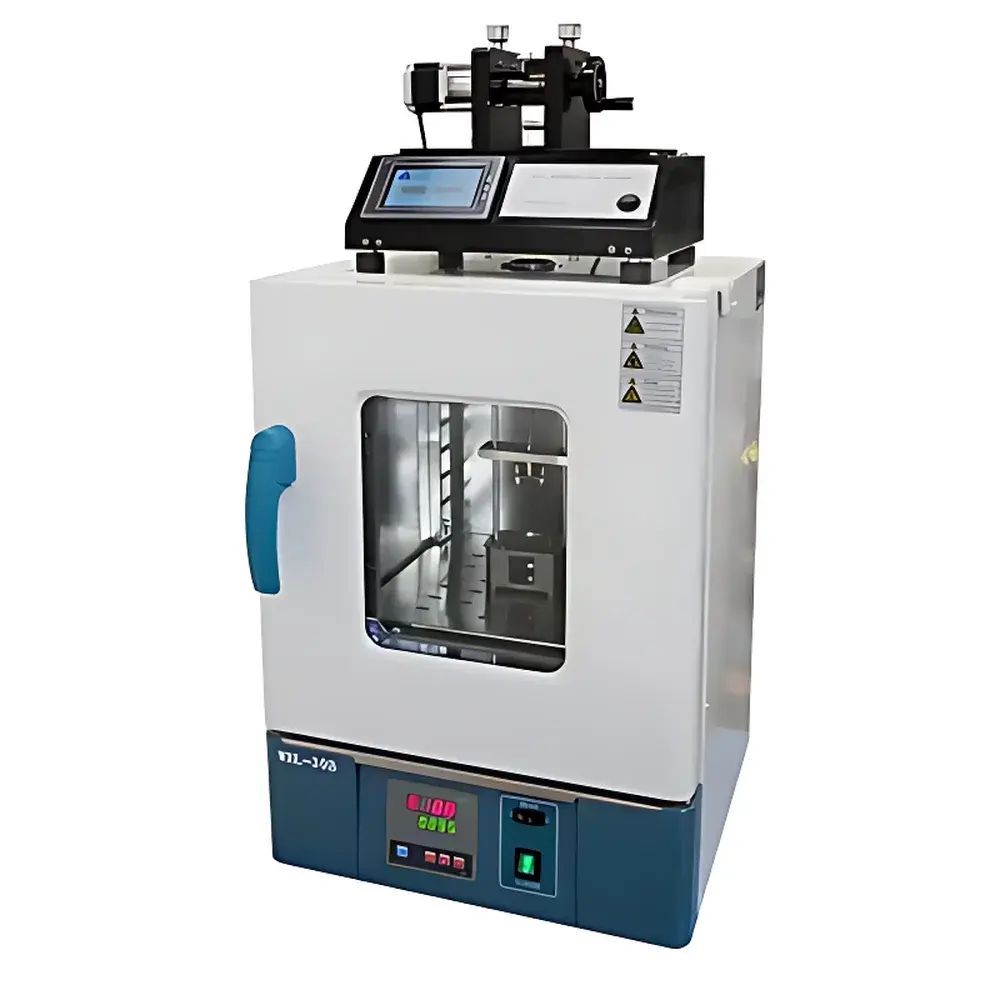
KJ GROUP PTL-NMB Nanoscale Precision Dip Coater with Integrated恒温 Chamber
| Brand | KJ GROUP |
|---|---|
| Origin | Liaoning, China |
| Manufacturer Type | Authorized Distributor |
| Country of Origin | China |
| Model | PTL-NMB |
| Price | Upon Request |
| Power Supply | AC 220 V, 50 Hz, 850 W |
| Dip Speed Range | 1–500 nm/s |
| Effective Immersion Length | 60 mm |
| Immersion/Drying Time Setting | 1–999 s |
| Cycles per Run | 1–20 |
| Temperature Control Range (Chamber) | RT+5°C to 100°C |
| Temperature Stability | ±1.5°C |
| Sample Holder Dimensions | 75 × 25 × 2.5 mm |
| Chamber External Dimensions | 460 × 510 × 695 mm |
| Overall Instrument Dimensions | 450 × 500 × 970 mm |
| Weight Capacity of Workbench | ≥200 kg |
| Required Bench Footprint | 800 × 600 × 700 mm |
Overview
The KJ GROUP PTL-NMB Nanoscale Precision Dip Coater with Integrated恒温 Chamber is an engineered solution for controlled, reproducible thin-film fabrication via vertical immersion and withdrawal (dip-coating) in liquid-phase precursors. Operating on the principle of meniscus-controlled deposition, the system enables precise nanometer-scale velocity control during substrate withdrawal—critical for achieving uniform thickness, graded architectures, and stoichiometric fidelity in sol-gel, nanoparticle, polymer, and metal-organic framework (MOF) films. Unlike conventional dip coaters, the PTL-NMB integrates a thermostatically regulated drying chamber that maintains a stable thermal environment throughout both immersion and post-dip solvent evaporation phases. This eliminates convective disturbances and minimizes Marangoni-driven non-uniformities, directly supporting ISO 20507-compliant thin-film process standardization. Designed for low-footprint integration into academic and industrial R&D laboratories, the instrument meets CE marking requirements under Directive 2014/30/EU (EMC) and 2014/35/EU (LVD), and supports GLP-aligned operational traceability through parameter logging.
Key Features
- Sub-nanometer-per-second speed resolution: Programmable withdrawal rates from 1 nm/s to 500 nm/s, enabled by closed-loop high-torque stepper motor drive and anti-vibration suspended motor mounting.
- Integrated恒温 chamber: Maintains temperature between RT+5°C and 100°C with ±1.5°C stability over time, ensuring consistent solvent evaporation kinetics and film densification across repeated runs.
- Intuitive HMI interface: 7-inch color TFT touchscreen with real-time display and editable fields for dip speed, immersion depth (60 mm effective length), dwell time (1–999 s), drying duration (1–999 s), and cycle count (1–20).
- Modular sample handling: Standardized fixture accommodates substrates up to 75 × 25 × 2.5 mm; compatible with glass slides, silicon wafers, ITO-coated PET, and flexible metallized foils.
- Robust mechanical architecture: Aluminum alloy frame with vibration-damped base; no compressed air or water connections required; grounded 220 V / 850 W single-phase supply only.
- Compliance-ready design: CE-certified; conforms to IEC 61000-6-2 (immunity) and IEC 61000-6-3 (emission); supports audit-trail-capable operation when paired with external data acquisition systems.
Sample Compatibility & Compliance
The PTL-NMB accommodates rigid and semi-rigid planar substrates within defined dimensional limits (max. 75 mm × 25 mm × 2.5 mm), including fused silica, borosilicate glass, silicon (100/111), quartz, stainless steel coupons, and conductive polymer films. It is routinely deployed in ASTM C1436-22 (sol-gel coating procedures) and ISO 15486:2021 (nanomaterial thin-film characterization) workflows. While not intrinsically 21 CFR Part 11 compliant, its parameter logging capability—when interfaced via RS-232 or optional USB-to-serial adapter—enables integration into validated GMP/GLP environments requiring electronic record retention. The absence of pneumatic or hydraulic subsystems simplifies qualification (IQ/OQ) and reduces maintenance overhead in regulated settings.
Software & Data Management
The embedded PLC-based controller stores all user-defined parameters and runtime logs internally, including timestamped start/stop events, actual vs. setpoint speed profiles, and chamber temperature history. Export is supported via USB flash drive (FAT32 formatted) in CSV format for post-processing in MATLAB, Python (pandas), or JMP. No proprietary software installation is required. Optional LabVIEW-compatible drivers (available upon request) allow remote triggering and synchronization with in-situ characterization tools such as ellipsometers or environmental SEM stages. All firmware updates are delivered as signed binary packages verified via SHA-256 checksum to ensure integrity.
Applications
- Sol-gel derived oxide films (SiO₂, TiO₂, ZrO₂) for antireflective, photocatalytic, and dielectric applications.
- Nanoparticle monolayer assembly (e.g., Au, Ag, Fe₃O₄ colloids) for plasmonic sensor platforms.
- Layer-by-layer (LbL) polyelectrolyte deposition with controlled interfacial hydration states.
- Perovskite precursor films for optoelectronic device prototyping (e.g., solar cells, LEDs).
- Hydrophobic/hydrophilic gradient coatings via speed-modulated withdrawal protocols.
- Teaching laboratories: Demonstrating colloidal stability, capillary rise, and evaporation-driven self-assembly phenomena.
FAQ
What is the minimum achievable film thickness resolution using the PTL-NMB?
Film thickness is governed by withdrawal speed, precursor concentration, and solvent volatility—not instrument resolution alone. At 1 nm/s withdrawal under optimized sol-gel conditions, sub-5 nm average thicknesses have been reported in peer-reviewed literature (e.g., Langmuir 2021, 37, 10223–10232), assuming calibrated ellipsometric validation.
Can the恒温 chamber be operated independently of the dip cycle?
Yes—the chamber temperature can be set and stabilized without initiating motion, enabling pre-conditioning of substrates or post-deposition annealing protocols.
Is third-party calibration certification available?
KJ GROUP provides factory calibration reports traceable to NIM (National Institute of Metrology, China). ISO/IEC 17025-accredited calibration services are available through authorized metrology partners upon request.
Does the system support custom substrate fixtures?
Standard mounting uses spring-loaded clamps compatible with 2.5 mm thickness. Custom machined fixtures (e.g., for curved or oversized samples) can be fabricated under NRE agreement—contact technical support for dimensional specifications and lead time.
What maintenance intervals are recommended?
No scheduled lubrication or alignment is required. Monthly visual inspection of guide rails and cleaning of immersion cup with IPA is advised. Stepper motor and PLC firmware retain full functionality beyond 10,000 operational hours under typical lab use.
Related Products



