
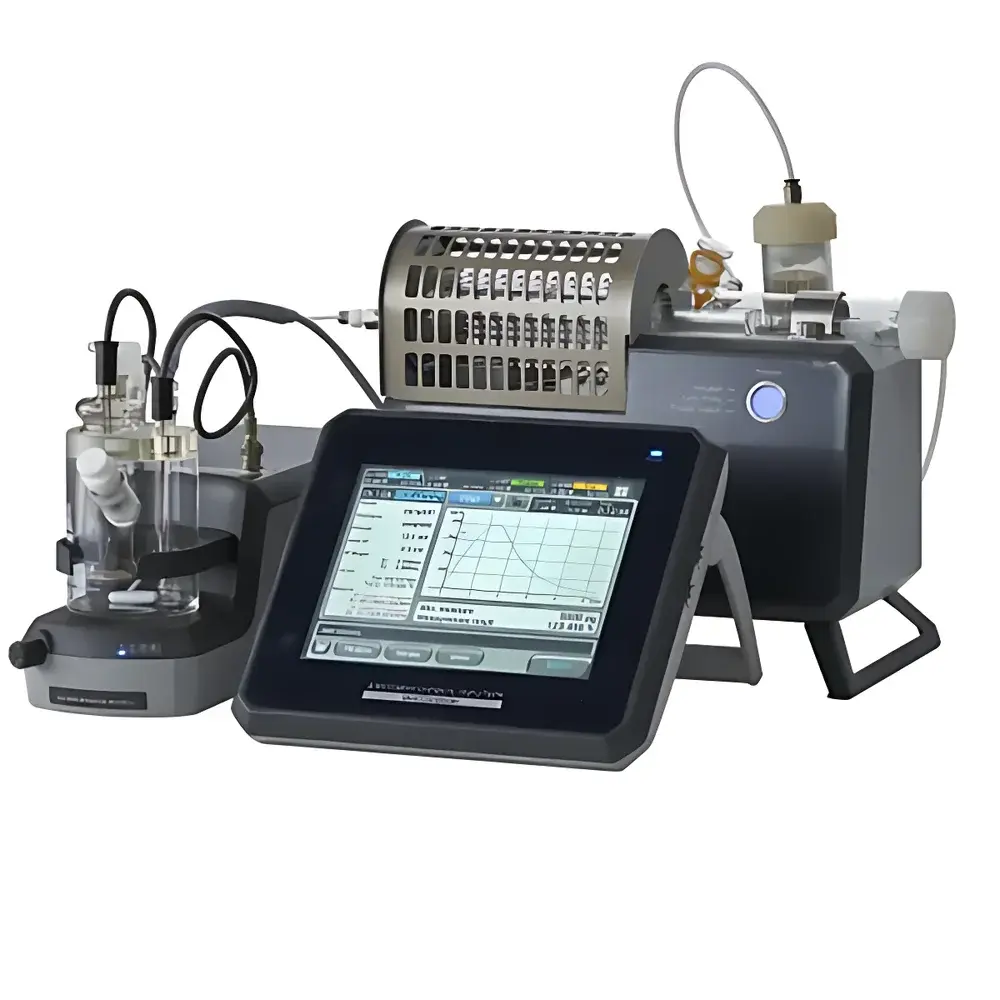
Mitsubishi Chemical CA-310 Coulometric Karl Fischer Moisture Analyzer
| Brand | Mitsubishi Chemical |
|---|---|
| Origin | Japan |
| Model | CA-310 |
| Electrolysis Current | 400 mA |
| Titration Speed | 2.1 mg H₂O/min |
| Measurement Range | 10 µg – 100 mg H₂O |
| Detection Limit | 0.1 µg H₂O |
| Accuracy | ±3 µg (for 10 µg – 1 mg H₂O) |
| Precision | RSD ≤ 0.3% (for ≥1 mg H₂O) |
| Printer | 21-character dot-matrix thermal printer (58 mm paper width) |
| Channel Configuration | Single or dual-channel (Coulometric/Coulometric, Coulometric/Volumetric single-cell, Coulometric/Volumetric dual-cell) |
Overview
The Mitsubishi Chemical CA-310 Coulometric Karl Fischer Moisture Analyzer is a high-precision, laboratory-grade instrument engineered for trace-level water quantification in demanding analytical environments. Based on the electrochemical coulometric titration principle—where iodine is generated *in situ* via controlled electrolysis of iodide ions—the CA-310 delivers exceptional sensitivity and reproducibility for samples containing ultra-low moisture content. Unlike volumetric KF systems, the coulometric mode eliminates reagent standardization and syringe calibration dependencies, making it ideal for applications requiring sub-microgram detection limits and minimal sample consumption. The analyzer supports both standalone operation and integration with external vaporization units, enabling reliable moisture determination in thermally labile, viscous, or non-soluble matrices—including pharmaceutical actives, polymer resins, lithium battery electrolytes, and high-purity solvents.
Key Features
- Coulometric detection architecture with 400 mA maximum electrolysis current, optimized for rapid iodine generation and short analysis cycle times.
- Dual-channel configuration flexibility: users may select from three operational modes—Coulometric/Coulometric (dual independent cells), Coulometric/Volumetric (single-cell), or Coulometric/Volumetric (dual-cell)—to accommodate parallel sample testing or hybrid method validation.
- Sub-microgram resolution: 0.1 µg water detection limit ensures compliance with stringent pharmacopeial requirements for low-moisture APIs and excipients.
- Calibration traceability: built-in drift compensation and automatic background correction minimize baseline drift effects during extended analyses.
- Integrated 21-character thermal dot-matrix printer (58 mm paper width) provides real-time, tamper-evident hardcopy output of sample ID, result, date/time stamp, and method parameters—supporting GLP documentation integrity.
- Robust cell design with platinum working electrode and double-junction reference system enhances long-term stability and resistance to contamination in aggressive solvents.
Sample Compatibility & Compliance
The CA-310 accommodates a broad spectrum of sample types through direct injection, oven-vaporization coupling, or headspace sampling. Its compatibility extends to solids (e.g., hygroscopic powders, tablet granules), liquids (e.g., acetonitrile, DMF, ethylene carbonate), and gases (via gas-tight syringe or flow-through cell). When paired with Mitsubishi’s optional AH-310 or AH-610 automated vaporizers, the system achieves quantitative recovery of water bound in crystalline lattices or adsorbed on surfaces—critical for USP <921>, EP 2.5.12, and ASTM E203 validation protocols. Instrument firmware adheres to data integrity principles aligned with FDA 21 CFR Part 11 (when used with compliant LIMS interfaces), including electronic signature support, audit trail logging, and user-access level management.
Software & Data Management
While the CA-310 operates autonomously via front-panel controls, it supports RS-232 serial communication for bidirectional data exchange with external PCs or laboratory information management systems (LIMS). Raw titration curves, endpoint detection logic, and integrated water mass calculations are exportable in ASCII format for secondary statistical review. All printed reports include full metadata: operator ID, method name, cell status flags (e.g., over-titration, electrode saturation), and environmental conditions logged at time of analysis. The system retains up to 100 test records internally, with overwrite protection enabled by default to prevent accidental data loss.
Applications
- Pharmaceutical quality control: residual solvent moisture in lyophilized products, water content in hygroscopic APIs per ICH Q5C guidelines.
- Electrochemical materials: moisture quantification in Li-ion battery cathode precursors, separator films, and electrolyte formulations—where ppm-level H₂O directly impacts cell cycle life and safety.
- Polymer science: hydrolytic stability assessment of polyesters, polyamides, and polycarbonates during processing and storage.
- Chemical manufacturing: specification release testing of anhydrous reagents (e.g., thionyl chloride, aluminum alkyls) and catalysts.
- Food & flavor chemistry: water activity correlation studies in low-moisture confectionery and powdered dairy systems.
FAQ
What is the minimum detectable water mass using the CA-310?
The instrument achieves a detection limit of 0.1 µg H₂O under optimal operating conditions, verified via repeated analysis of certified water standards.
Can the CA-310 be used for samples that decompose below 100°C?
Yes—when interfaced with the AH-310 programmable vaporizer, temperature ramp profiles as low as 30°C enable gentle thermal release of water without matrix degradation.
Is method validation support available for regulatory submissions?
Mitsubishi Chemical provides application notes aligned with USP <921>, EP 2.5.12, and ASTM E203, including linearity, accuracy, precision, LOD/LOQ, and robustness data templates.
How does the dual-channel configuration improve workflow efficiency?
Dual-channel operation allows simultaneous analysis of two dissimilar samples (e.g., one solid via vaporizer, one liquid via direct injection), reducing total turnaround time without compromising measurement integrity.
Does the CA-310 require daily recalibration?
No—coulometric systems do not require volumetric reagent standardization; however, periodic verification using certified water standards (e.g., 1.00 mg H₂O ampoules) is recommended before critical batch releases.






