
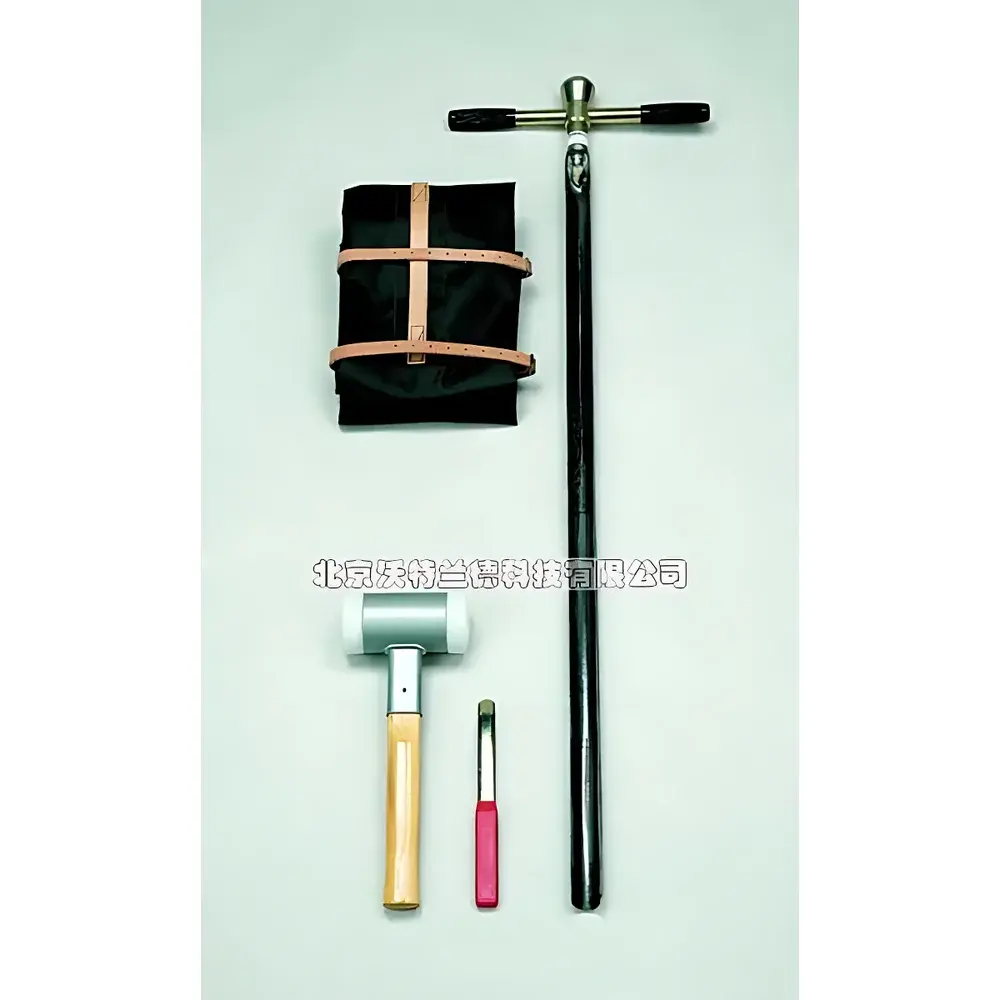
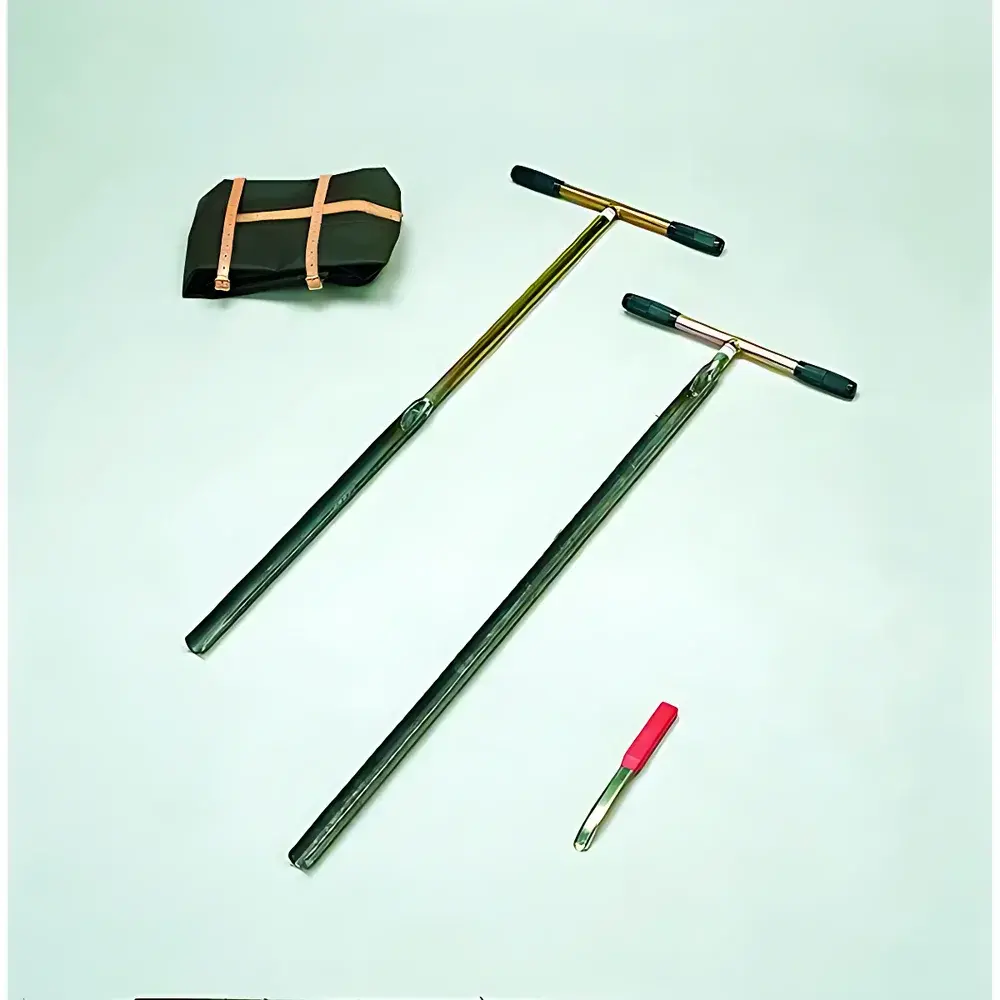
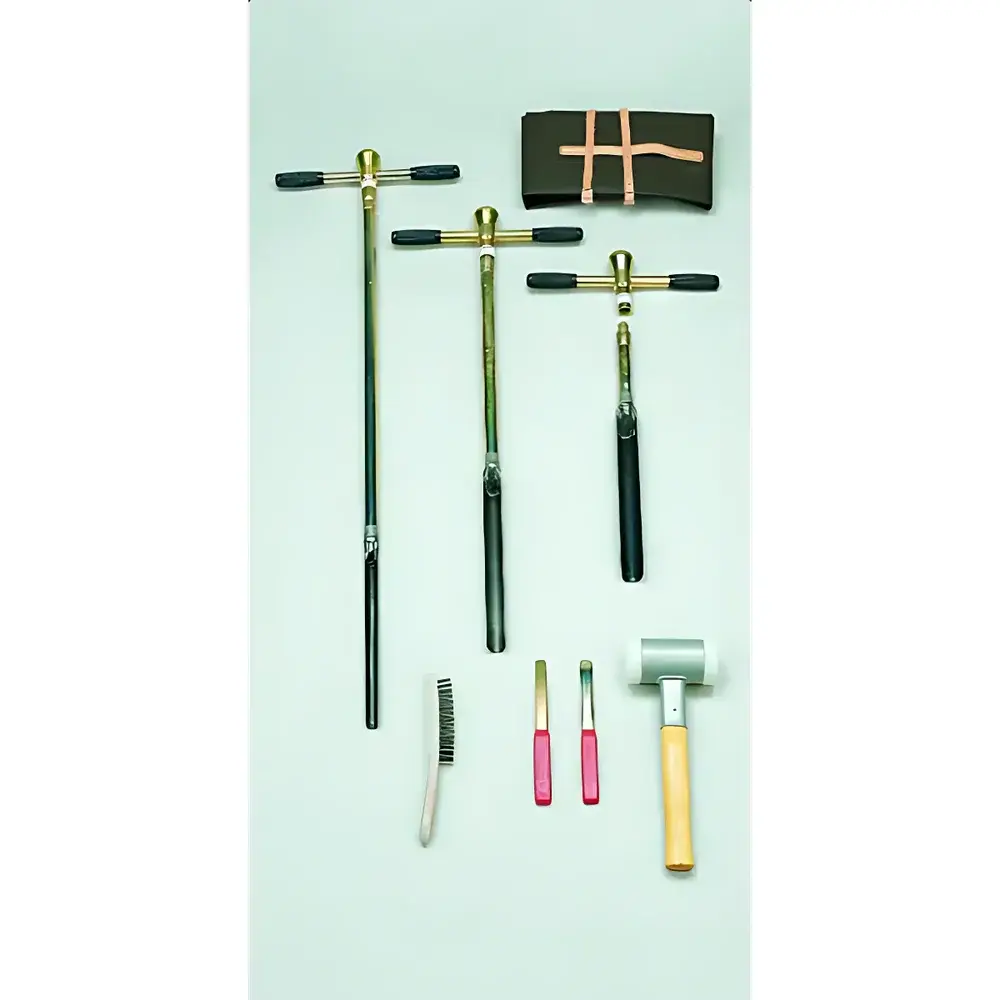
Eijkelkamp 04.02.SC Manual Single-Tube Soil Sampler
| Brand | Eijkelkamp |
|---|---|
| Origin | Netherlands |
| Model | 04.02.SC |
| Weight | 15 kg |
| Maximum Sampling Depth | 5 m |
| Core Diameter | 3 cm |
| Sample Length per Insertion | 100 cm |
| Sampling Type | Intact Cylindrical Soil Core |
| Connection Type | Threaded Coupling |
| Configuration | Single-tube, manual operation |
Overview
The Eijkelkamp 04.02.SC Manual Single-Tube Soil Sampler is a precision-engineered field instrument designed for the retrieval of undisturbed cylindrical soil cores in environmental site assessments, agricultural research, and geological surveys. Based on the proven semi-circular auger (also known as the “Dutch auger”) principle, this sampler operates via vertical percussion-driven insertion—leveraging controlled impact force to advance the cutting edge into the ground while preserving structural integrity of the soil profile. Unlike rotary or hollow-stem augers that induce shear disturbance, the 04.02.SC employs a split-tube geometry with a sharpened semi-circular leading edge and internal core retention mechanism, enabling high-fidelity sampling of cohesive and moderately dense soils—including loam, silt, clay, and weathered till—up to 5 meters depth. Its design complies with internationally recognized field sampling protocols for intact core recovery, including ASTM D1586 (Standard Test Method for Penetration Resistance and Classification of Soils) and ISO 22475-1:2017 (Geotechnical investigation and testing — Sampling methods and equipment — Part 1: Technical principles for soil and rock).
Key Features
- Heavy-duty semi-circular auger body constructed from hardened carbon steel, optimized for repeated percussion loading with nylon mallets without deformation or edge blunting.
- Threaded coupling system enables rapid assembly and disassembly of extension rods—four 1-meter galvanized steel rods included—allowing incremental depth progression while maintaining axial alignment and minimizing lateral deviation.
- Integrated core retention sleeve and tapered internal profile ensure minimal slippage and high recovery ratio (>95% in non-gravelly soils), critical for stratigraphic interpretation and horizon-specific analysis.
- Ergonomic push-pull handle and dedicated striking handle provide dual-mode actuation: controlled downward pressure for soft layers and percussive driving for compacted strata.
- Compatible with Eijkelkamp Edelman-type composite sampling rods (included), supporting simultaneous collection of disturbed and undisturbed samples at discrete depths within a single borehole.
- Energy-dissipating nylon mallet reduces operator fatigue and mitigates shock transmission to both user and sampling apparatus during repetitive hammering cycles.
Sample Compatibility & Compliance
The 04.02.SC is validated for sampling fine- to medium-textured soils with low to moderate gravel content (<10% by volume). It is not recommended for use in highly cemented, rocky, or frozen ground without pre-augering. The 3 cm diameter core supports standard laboratory sub-sampling protocols for physical property analysis (e.g., bulk density, porosity, water retention), chemical assays (nutrient profiling, heavy metal screening), and biological assessment (microbial community mapping, enzyme activity). All components conform to EU Machinery Directive 2006/42/EC for portable hand-held tools and carry CE marking. Field deployment aligns with EPA Method 5035A (Soil Core Collection for Volatile Organic Analysis) and ISO 10381-2 (Soil quality — Sampling — Part 2: Guidance on techniques of sampling soils) when used with appropriate chain-of-custody documentation and cold-chain transport provisions.
Software & Data Management
As a purely mechanical, non-electronic sampling tool, the 04.02.SC does not incorporate onboard sensors or digital interfaces. However, it integrates seamlessly into structured field data workflows: core depth, location (via GNSS-enabled tablet or handheld GIS device), lithological notes, and photographic documentation can be recorded using compliant electronic field notebooks (e.g., ESRI Field Maps, Fulcrum, or OpenDataKit). When paired with Eijkelkamp’s optional CoreLog software suite (sold separately), users may digitally annotate core photographs, assign horizon boundaries, generate stratigraphic logs, and export metadata in ISO 19115-compliant XML for inclusion in geospatial databases or regulatory reporting packages. Audit trails remain fully traceable under GLP-compliant data governance frameworks.
Applications
- Agricultural land evaluation: mapping soil horizons, assessing compaction layers, and quantifying organic matter distribution across management zones.
- Environmental site characterization: delineating contaminant plumes in vadose and saturated zones, collecting representative matrices for leaching studies (e.g., ASTM D4827).
- Ecological restoration monitoring: tracking root-zone development, mycorrhizal colonization, and bioturbation effects over multi-year chronosequences.
- Geomorphological and paleopedological research: recovering pedogenic features such as clay films, iron nodules, and carbonate coatings for micromorphological thin-section analysis.
- Regulatory compliance sampling: supporting Phase I/II ESA reports, landfill closure verification, and brownfield redevelopment due diligence per ASTM E1527 and E1903 standards.
FAQ
What soil types are suitable for sampling with the 04.02.SC?
It performs optimally in cohesive, non-gravelly soils—such as silty clays, loams, and peats—with moisture content between plastic and liquid limits. Performance diminishes in coarse sands with >20% gravel or in desiccated, highly indurated clays.
Can the 04.02.SC be used for groundwater sampling?
No—it is not designed for direct porewater extraction. For saturated zone sampling, pair it with Eijkelkamp’s 04.21.W piezometer-compatible samplers or install dedicated monitoring wells first.
Is calibration required prior to use?
No formal calibration is needed; however, periodic visual inspection of auger edge sharpness, thread integrity, and sleeve alignment is recommended per manufacturer’s maintenance schedule.
How is sample depth accuracy ensured?
Depth is measured using engraved metric graduations on each extension rod and verified via calibrated tape measurement from surface datum to core top after extraction.
Does the 04.02.SC meet FDA or ISO 17025 requirements for accredited labs?
While the tool itself is not certified, its documented use—combined with SOPs, operator training records, and traceable field logs—supports ISO/IEC 17025:2017 clause 7.5.2 (Sampling) when embedded in an accredited laboratory’s quality management system.
Related Products







