Solinst Model 101 Groundwater Water Level Tape
| Brand | Solinst |
|---|---|
| Origin | Canada |
| Manufacturer Type | Authorized Distributor |
| Product Origin | Imported |
| Model | 101 |
| Category | Fiber-Optic Water Level Sensor |
| Accuracy | ±1 mm (±0.01 ft) |
| Probe Options | P2 Standard (surface use), P7 Submersible (up to 300 m) |
| Tape Material | UV-stabilized polyethylene with embedded stainless-steel conductors |
| Tape Width | 9.5 mm (3/8 in) |
| Max Tape Length | 1800 m (6000 ft) |
| Power | 9 V alkaline battery |
| Output Indication | Audible buzzer + LED flash |
| Sensitivity Adjustment | Continuously variable conductivity threshold |
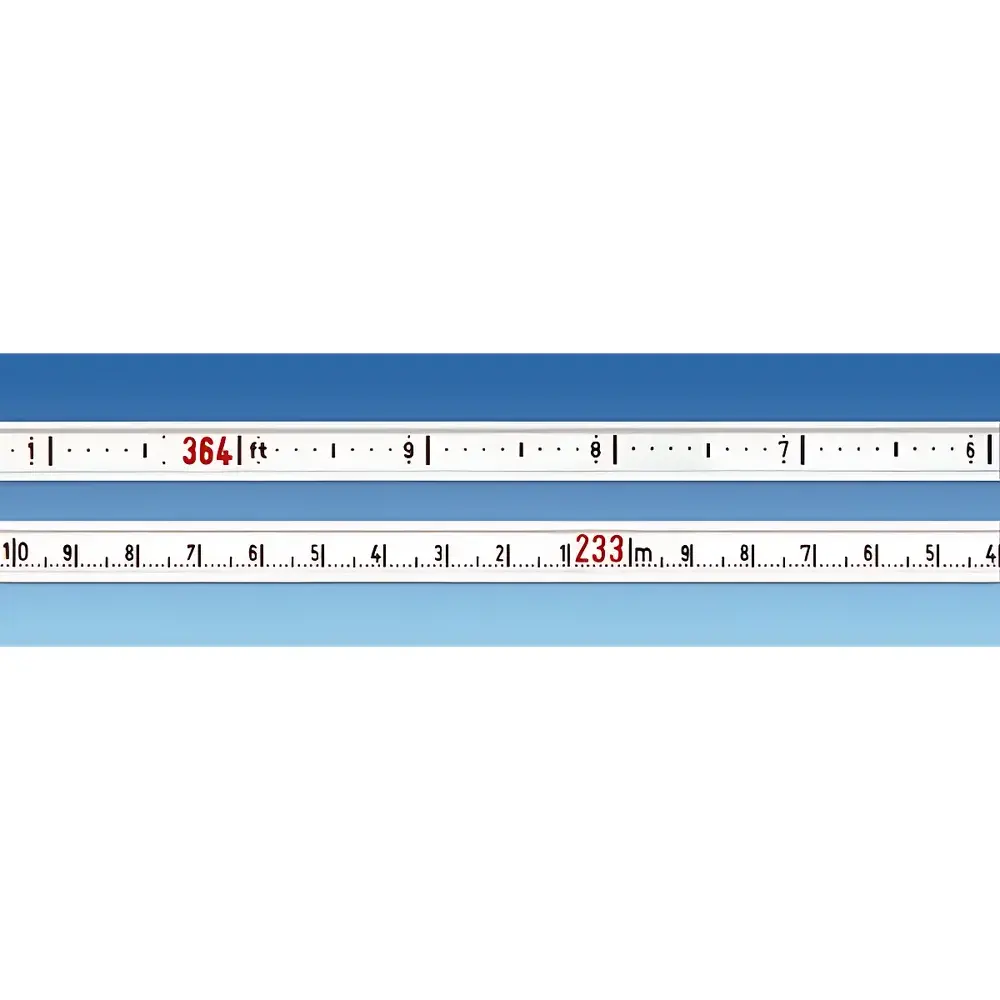
| Scale Marking | Permanent heat-embossed dual-side markings (mm & 0.01 ft) |
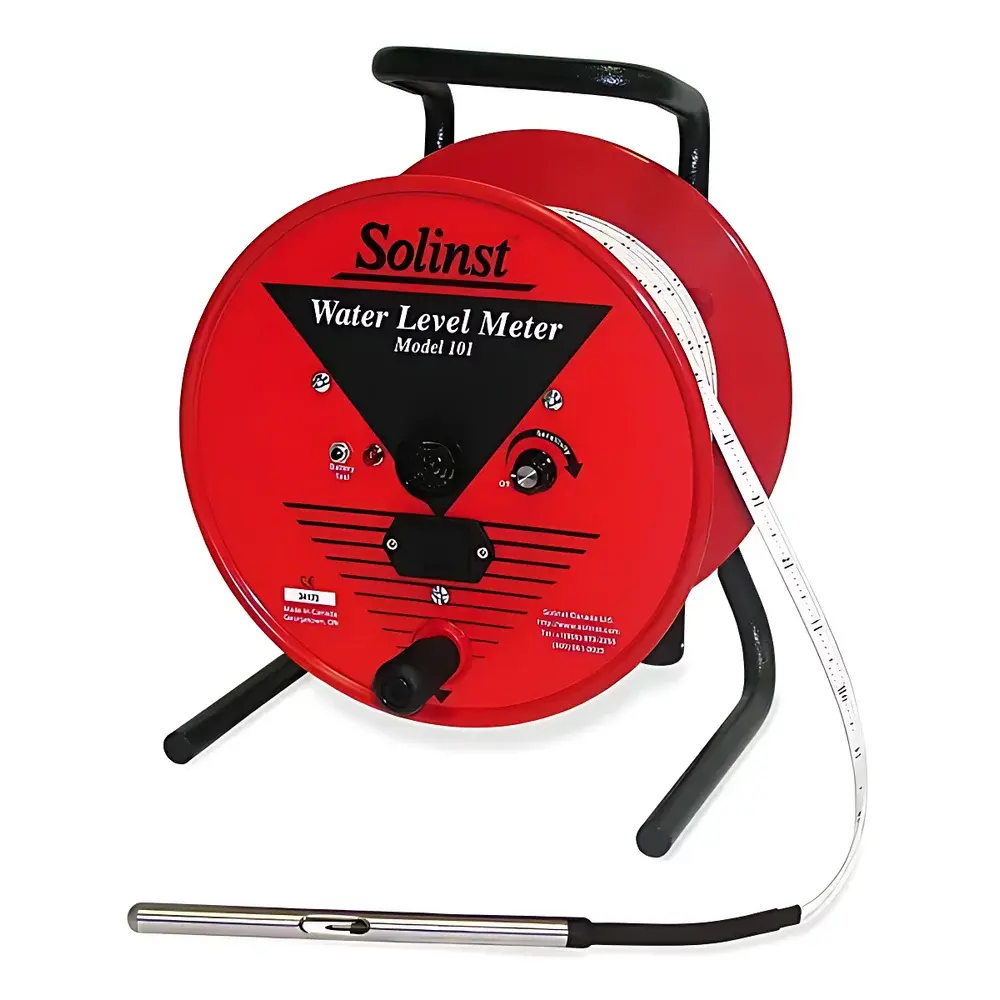
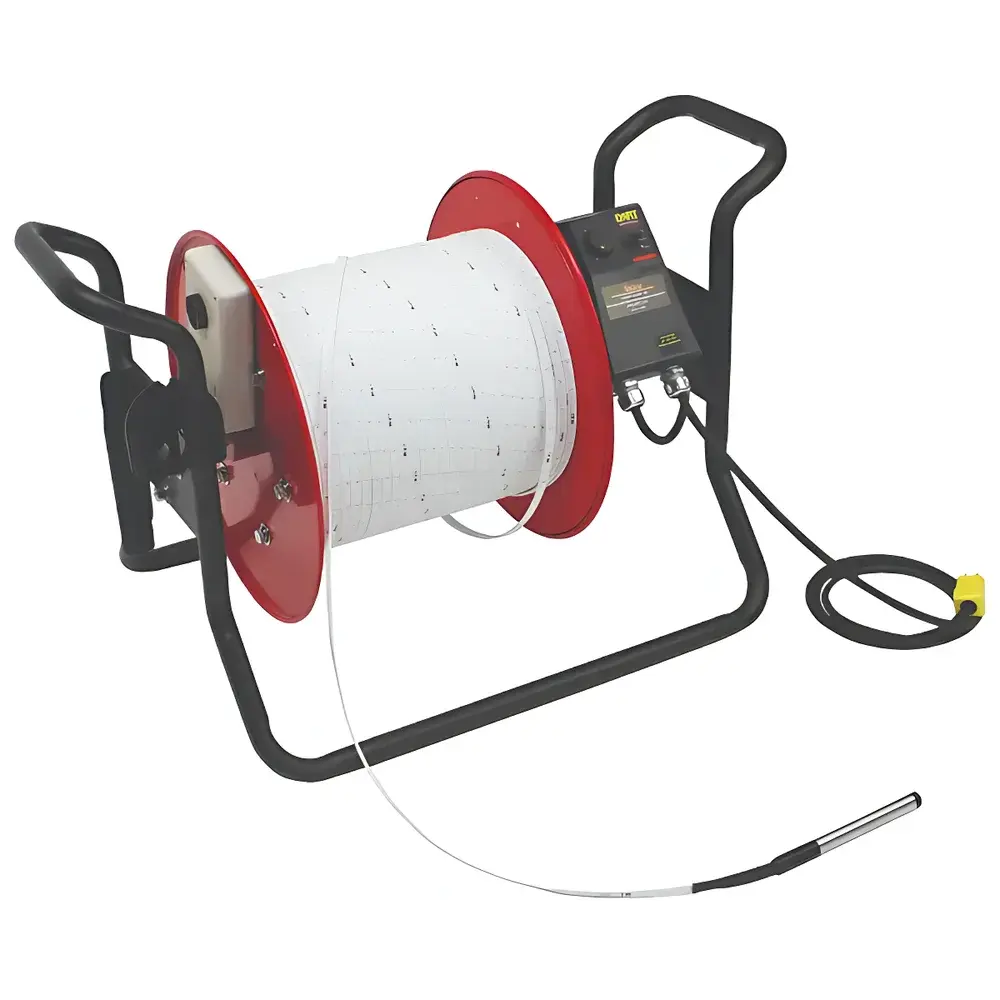
| Reel Design | Ergonomic hand-crank reel with mechanical brake, on/off switch, battery test button, and integrated probe holder |
Overview
The Solinst Model 101 Groundwater Water Level Tape is a field-proven, direct-reading electrical contact water level measurement instrument engineered for precision, durability, and long-term reliability in hydrogeological monitoring applications. It operates on the principle of electrical conductivity detection: when the probe’s insulated electrodes contact water—regardless of its ionic concentration—a closed circuit is formed, triggering an audible buzzer and visual LED indicator. This binary signal enables unambiguous identification of the water surface elevation relative to a fixed datum (e.g., well casing top or land surface). Unlike pressure transducers or ultrasonic sensors, the Model 101 delivers absolute depth-to-water measurements without drift, temperature compensation artifacts, or calibration dependency—making it a primary reference standard for well validation, aquifer testing, and regulatory compliance monitoring across environmental, geotechnical, and water resource management sectors.
Key Features
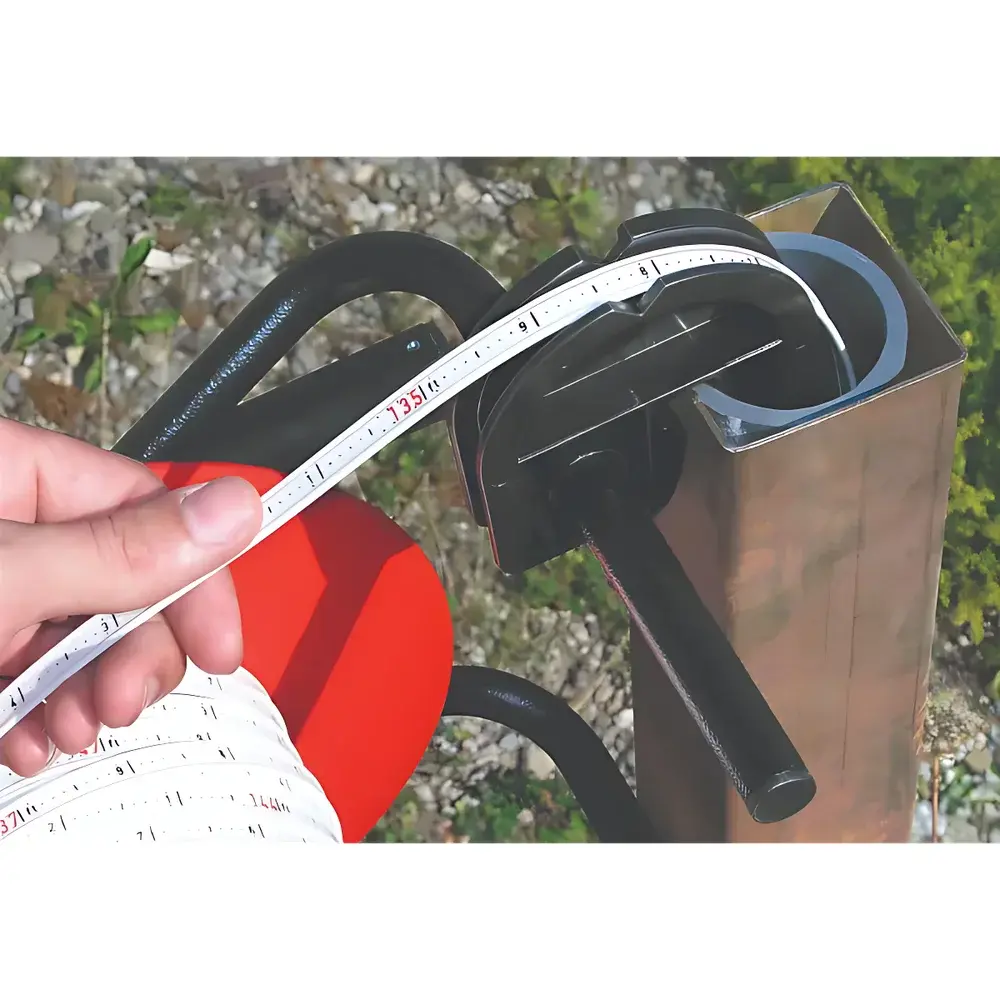
- High-resolution scale marking: Permanently heat-embossed graduations at 1 mm (0.01 ft) intervals on both sides of the tape, ensuring readability under low-light or wet conditions.
- Dual-probe compatibility: Interchangeable P2 standard probe (for shallow, non-submerged use; max 190 mm length, 14 mm diameter) and P7 submersible probe (O-ring sealed, rated to 300 m depth; 12.7 mm diameter, 190 mm length).
- Corrosion-resistant tape construction: Reinforced polyethylene tape with seven embedded stainless-steel conductors providing tensile strength >220 N, UV resistance, and dimensional stability across -40°C to +60°C ambient ranges.
- Adjustable conductivity sensitivity: Continuously variable threshold control allows reliable operation in low-conductivity groundwater (5000 µS/cm), while suppressing false triggers from turbulent or aerated flow.
- Ergonomic reel system: Precision-machined aluminum reel with integrated mechanical brake, tactile on/off switch, battery test function, and dedicated probe retention clip—designed for one-handed operation and repeatable tape deployment/retrieval.
- Dog-bone tape profile: Minimizes adhesion to wet or biofouled well casings, reducing drag and improving vertical alignment during measurement.
Sample Compatibility & Compliance
The Model 101 is compatible with standard PVC, steel, and fiberglass well casings (ID ≥ 50 mm), as well as open boreholes and piezometers. Its physical contact methodology eliminates electromagnetic interference concerns and ensures consistent performance in electrically noisy environments (e.g., near pumps or power lines). The device meets ASTM D4043–22 “Standard Guide for Selection of Instruments for Measuring Ground-Water Levels” and supports adherence to ISO 555–2:1987 (Part 2: Electrical contact methods) and USGS Techniques and Methods Book 4, Chapter D2. While not a digital data logger, its measurements are traceable to NIST-traceable tape calibration standards and serve as primary field verification for automated sensor networks. All components comply with RoHS Directive 2011/65/EU and CE marking requirements for portable electrical equipment.
Software & Data Management
The Model 101 is a manual, analog field instrument and does not incorporate onboard data logging or wireless transmission. However, its measurement output is fully compatible with structured field data capture workflows. Users record depth-to-water values directly into paper logbooks, digital forms (e.g., PDF or Excel templates), or mobile GIS applications (e.g., ESRI Field Maps, QField) using standardized metadata fields—including date/time, well ID, casing elevation, observer name, and probe type. For QA/QC traceability, Solinst provides optional calibration certificates (NIST-traceable tape length verification) and maintains full service documentation per GLP-aligned maintenance records. Battery voltage is monitored via the built-in test button, ensuring consistent signal integrity across multi-year deployments.
Applications
- Aquifer characterization and long-term groundwater level trend analysis in monitoring wells (e.g., USGS NWIS, EPA UCMR programs)
- Construction dewatering and excavation support monitoring per ASTM D5088–21
- Landfill leachate collection system performance verification
- Mine dewatering and pit lake level surveillance
- Validation of pressure transducer or bubbler-based continuous level systems
- Academic hydrogeology field instruction and student research projects
- Regulatory compliance reporting under state groundwater protection statutes (e.g., CA GWPA, NY Part 613)
FAQ
What is the maximum recommended depth for the P7 submersible probe?
The P7 probe is rated for continuous submersion up to 300 meters (1000 feet) static head pressure. It must be deployed vertically and allowed to stabilize for ≥30 seconds prior to reading in highly turbulent zones.
Can the tape be replaced independently of the reel?
Yes—Solinst supplies replacement tapes with pre-installed conductors and calibrated markings. Each tape includes a factory-certified length verification report and is compatible with all Model 101 reels.
Is the Model 101 suitable for saline or brackish groundwater?
Yes—the adjustable sensitivity control ensures robust detection across conductivity ranges from 10,000 µS/cm (coastal aquifers), without requiring probe modification.
How often should the 9 V battery be replaced?
Under typical field use (50–100 measurements/week), battery life exceeds 12 months. The integrated test button confirms operational voltage (>7.2 V) before each use.
Does Solinst provide calibration services for used units?
Yes—authorized service centers perform full functional verification, tape length recalibration (per ISO 6988), and probe insulation resistance testing, issuing GLP-compliant service reports with uncertainty budgets.