
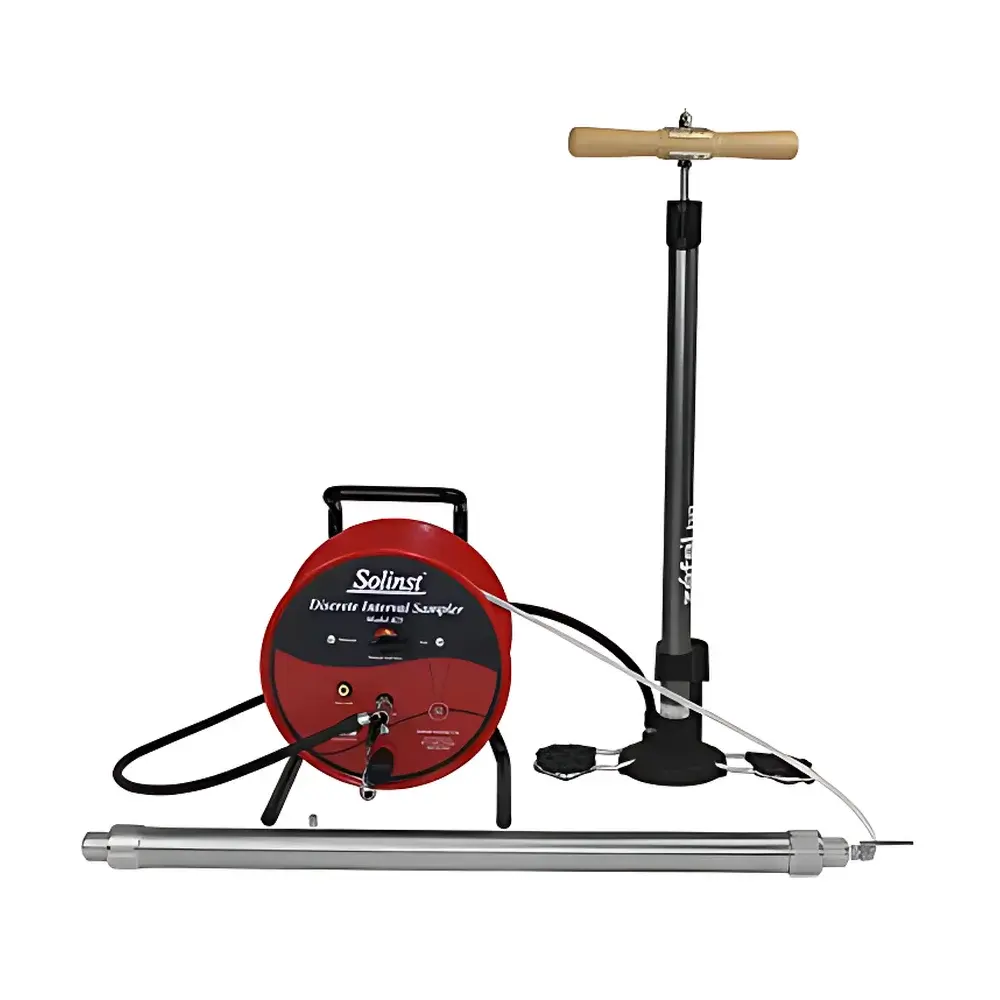
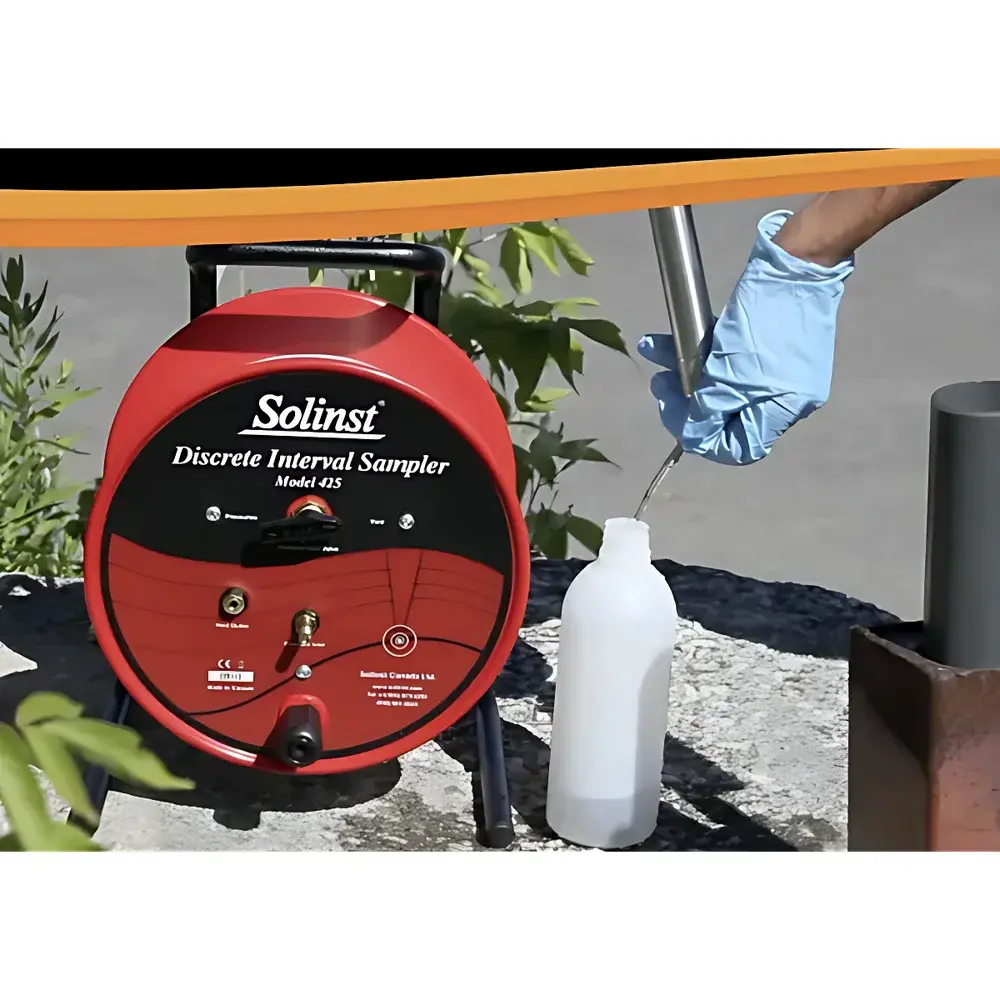
Solinst Model 425 Discrete-Interval Groundwater Sampler
| Brand | Solinst |
|---|---|
| Origin | Canada |
| Model | 425 |
| Sampling Depth | 150 m |
| Sample Volume per Cycle | 1800 mL |
| Volume Accuracy | ±1% |
| Fill Rate | 1800 mL/min |
| Minimum Sampling Interval | 5 min |
| Sampler Type | Manual, Portable, Discrete-Depth |
| Sampling Method | Pressure-actuated, Hydrostatic-fill |
| Construction Materials | Stainless Steel Body, Viton O-rings, PTFE Components, LDPE Tubing (standard), Optional FEP-lined PE Tubing |
| Compliance | ASTM D6771, ASTM D7929, ISO 5667-3, US EPA Method 502.2, US EPA Method 8260D (VOCs), GLP-Compatible Operation |
Overview
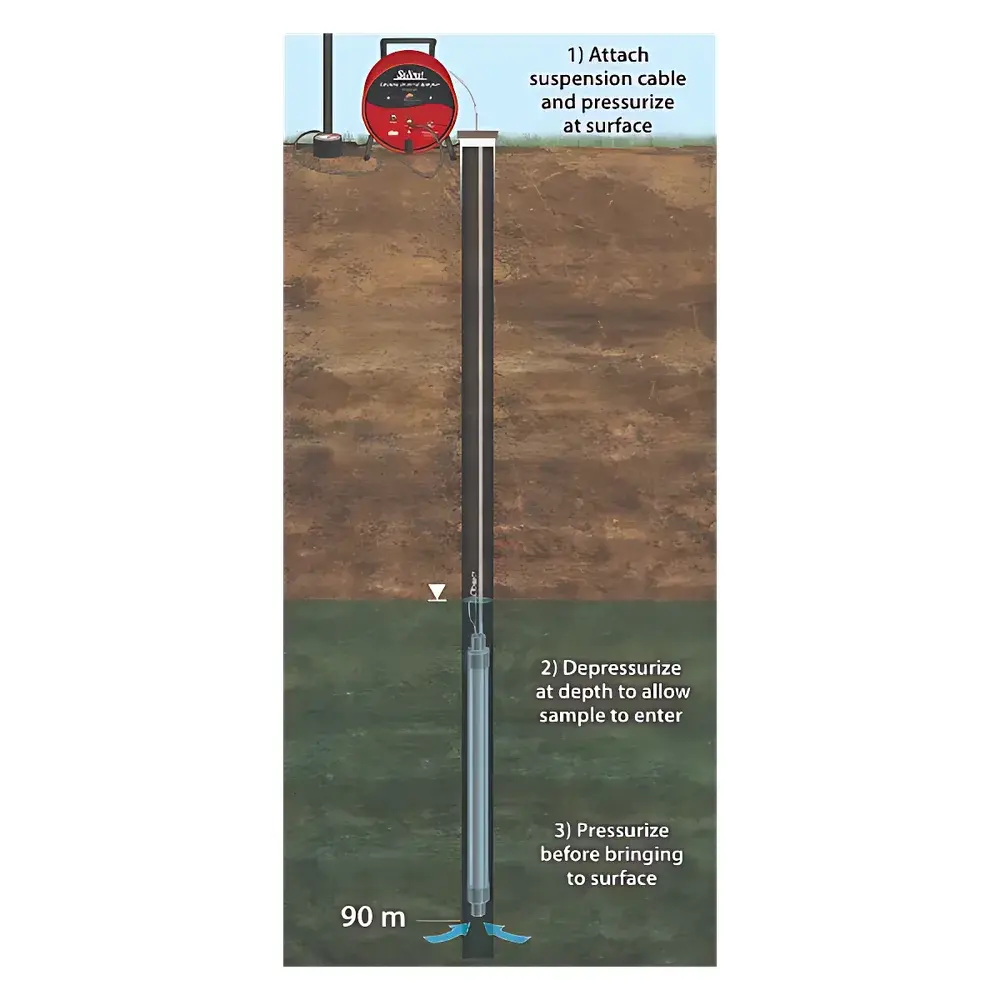
The Solinst Model 425 Discrete-Interval Groundwater Sampler is a precision-engineered, pressure-actuated field instrument designed for high-fidelity, depth-specific groundwater sampling in monitoring wells, boreholes, and surface water bodies. Operating on the principle of hydrostatic fill under controlled pressure release, the 425 sampler eliminates vertical mixing and minimizes sample disturbance by isolating discrete aquifer intervals without pumping-induced cross-contamination. Its stainless steel housing, Viton-sealed valving, and chemically inert internal components ensure compatibility with volatile organic compounds (VOCs), semi-volatile organics (SVOCs), metals, and redox-sensitive analytes. Unlike continuous pump-sampling systems, the Model 425 acquires representative samples directly at target depth—leveraging ambient formation pressure to fill the chamber upon actuation—thereby preserving in-situ chemical speciation, dissolved gas content, and oxidation-reduction potential.
Key Features
- Stainless steel main body with precision-machined ports and Viton O-ring seals for long-term corrosion resistance and leak-tight integrity up to 150 m depth (500 ft)
- Integrated float-activated check ball (polyethylene/PTFE) that prevents backflow during retrieval and eliminates tubing rinse requirements
- LDPE sampling tubing wound on a calibrated Solinst reel with optional metric or imperial depth markings for accurate depth registration
- Dual-function pressure manifold with high-pressure hand pump interface and dedicated pressurize/vent toggle valve for field-controlled actuation
- Modular design enables rapid disassembly, solvent-rinse decontamination, and component replacement—fully compliant with EPA SW-846 Chapter 5 decontamination protocols
- Optional 425T transport variant available with zero-headspace, crimp-sealable configuration for VOC preservation during transit per EPA Method 502.2 and ASTM D6771
Sample Compatibility & Compliance
The Model 425 is validated for use across a broad range of environmental matrices including anoxic groundwater, LNAPL- and DNAPL-impacted zones, fractured bedrock intervals, and stratified lake/river sediments. It meets critical regulatory requirements for low-level VOC analysis—including US EPA Methods 502.2, 8260D, and 8270E—as well as ASTM D6771 (Standard Test Method for Determination of Volatile Organic Compounds in Groundwater Using Field Portable Gas Chromatography) and ASTM D7929 (Standard Guide for Selection of Groundwater Sampling Devices). Its non-pumping, passive-fill mechanism satisfies ISO 5667-3:2018 (Water quality — Sampling — Part 3: Guidance on the preservation and handling of water samples) criteria for minimizing volatilization loss and atmospheric exposure. The device supports GLP-compliant workflows through traceable depth logging, pressure-actuation event documentation, and operator-auditable handling records.
Software & Data Management
While the Model 425 operates as a manual, hardware-only system—ensuring reliability in remote, power-constrained environments—it integrates seamlessly into digital data capture ecosystems. Depth logs from the calibrated reel can be recorded in field tablets using Solinst’s free WellData™ mobile app (iOS/Android), which supports structured metadata entry (date, time, well ID, operator, depth, pressure setting, sample ID). Exported CSV files are compatible with LIMS platforms (e.g., LabWare, Thermo Fisher SampleManager) and GIS-based groundwater management systems (ArcGIS Pro, QGIS). For audit readiness, all sampling events—including pre-deployment pressurization, depth verification, actuation timing, and post-retrieval release—are manually documented in accordance with 21 CFR Part 11–aligned field logbooks, supporting FDA, EPA, and provincial regulatory inspections.
Applications
- Discrete-depth profiling of geochemical gradients (e.g., nitrate, sulfate, Fe²⁺/Fe³⁺, methane, ethane) in multi-level monitoring wells
- VOC sampling beneath floating product layers (LNAPL/DNAPL) without interfacial mixing or air entrainment
- Point-source characterization at well inflow zones, fracture intersections, or sediment–water interfaces
- Time-series sampling for attenuation studies, plume migration tracking, and remediation performance monitoring
- Low-flow purging avoidance in ultra-low-permeability formations where traditional pump sampling induces drawdown artifacts
- Regulatory compliance sampling for RCRA, CERCLA, and provincial environmental protection acts requiring depth-specific representativeness
FAQ
How does the Model 425 prevent cross-contamination between sampling depths?
It uses a sealed, pressure-isolated chamber that only opens at the target depth via controlled venting—no fluid movement occurs during descent or ascent.
Can the 425 be used for metals analysis without acid-wash contamination risk?
Yes—its stainless steel body and Viton/PTFE wetted parts allow full ASTM D1691-compliant acid cleaning; LDPE tubing is single-use or replaceable.
What is the maximum recommended static water column for reliable actuation?
Rated for hydrostatic pressures up to 15 bar (equivalent to 150 m depth), with consistent fill performance verified per ASTM D7929 Annex A2.
Is tubing purge required before sampling?
No—the integrated float check ball blocks flow until actuation, eliminating pre-sample tubing volume and associated purge waste.
How is depth accuracy ensured during deployment?
Calibrated depth markings on the Solinst reel—traceable to NIST-certified tape standards—enable ±0.1 m depth resolution when used with a certified survey-grade winch encoder.







