
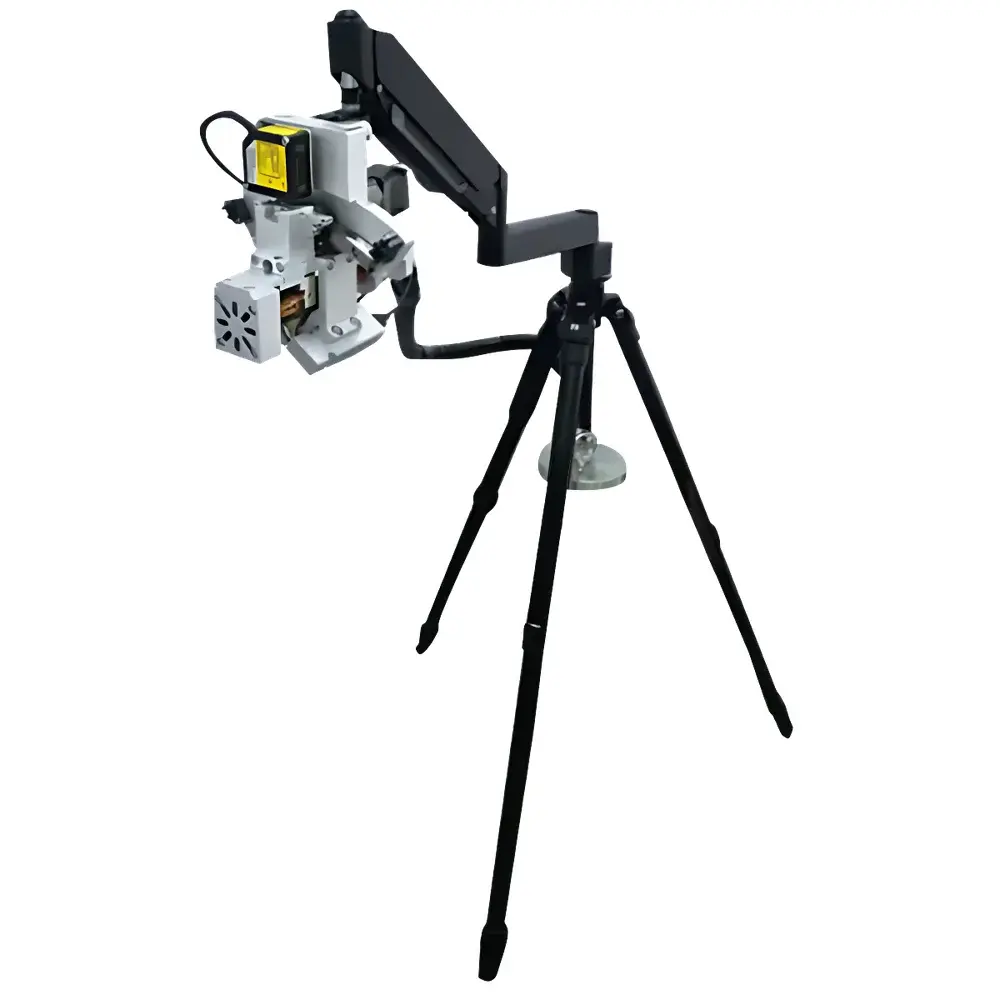
TD-Mini Portable X-Ray Residual Stress Analyzer
| Brand | Tongda |
|---|---|
| Origin | Liaoning, China |
| Manufacturer Type | Authorized Distributor |
| Product Origin | Domestic (China) |
| Model | TD-Mini |
| Price Range | USD 70,000 – 140,000 |
| X-ray Tube Power | 60 W |
| 2θ Angular Range | 45°–170° (continuously adjustable) |
| ψ Tilt Angle Range | 0° to ±45° |
| Anode Target Material | Chromium (Cr) |
| X-ray Source | Fine-focus Ceramic Tube with Integrated Closed-loop Self-circulating Cooling System |
| Detector | High-speed Silicon Strip Photon-counting Area Detector (640-channel linear array), Total Count Rate > 1×10⁹ cps |
Overview
The TD-Mini Portable X-Ray Residual Stress Analyzer is a compact, field-deployable instrument engineered for non-destructive determination of near-surface residual stress in crystalline metallic and polymeric materials. It operates on the principle of X-ray diffraction (XRD) using the sin²ψ method — a standardized technique defined in ASTM E915, ISO 21948, and EN 15305 — to quantify lattice strain via precise measurement of interplanar spacing (d-spacing) shifts in diffracted Bragg peaks. Unlike benchtop systems requiring sample removal or vacuum environments, the TD-Mini employs an air-path geometry with optimized beam collimation and real-time angular positioning, enabling in-situ stress mapping directly on machined components, welds, heat-treated parts, and additive-manufactured structures without surface preparation beyond standard polishing.
Key Features
- Portable architecture: Weighing under 18 kg with integrated ergonomic handle and shock-absorbing chassis, designed for repeated transport between production floors, hangars, and field sites.
- Robust X-ray source: 60 W fine-focus ceramic X-ray tube with Cr anode (Kα = 2.29 Å), delivering high-intensity monochromatic radiation; equipped with closed-loop self-circulating cooling for uninterrupted 24-hour operation and thermal cut-off protection at >65°C.
- Precision goniometry: Motorized dual-axis stage supporting continuous 2θ adjustment from 45° to 170° and ψ tilt from –45° to +45°, calibrated to ±0.02° angular accuracy per axis.
- High-throughput detection: Silicon strip photon-counting detector with 640 parallel channels, enabling direct X-ray conversion without scintillator loss; achieves >1×10⁹ counts per second total throughput and sub-millisecond dead-time response.
- Modular target compatibility: Interchangeable anode targets (Cr, Cu, Mn, Co, V, Ti, Fe, Mo) allow optimization of penetration depth and peak separation based on material composition and thickness.
Sample Compatibility & Compliance
The TD-Mini accommodates flat, curved, and irregularly shaped samples up to 300 mm in diameter and 100 mm in height. Surface roughness ≤ Ra 0.8 µm is recommended for optimal diffraction signal integrity. It complies with IEC 61000-6-3 (EMC emission standards) and IEC 61000-6-2 (immunity). Radiation safety conforms to GBZ 138–2002 (Chinese national standard for portable X-ray devices) and aligns with ALARA principles through built-in shutter control, dose monitoring, and automatic beam cutoff during idle motion. Data acquisition workflows support audit trails compliant with GLP and GMP documentation requirements.
Software & Data Management
The proprietary StressView™ software (v3.2+) provides real-time diffraction pattern visualization, automated peak search and profile fitting (Pseudo-Voigt convolution), d-spacing calculation, and stress tensor derivation using elastic constants input by user or selected from an embedded materials database (e.g., Al 6061, Ti-6Al-4V, Inconel 718, AISI 4340). All raw frames, calibration logs, and processed reports are stored in vendor-neutral HDF5 format. Export options include CSV, XML, and PDF with embedded metadata (operator ID, timestamp, location GPS tag, instrument serial number). Software supports 21 CFR Part 11-compliant electronic signatures and role-based access control when deployed on networked Windows Server environments.
Applications
- Aerospace: Residual stress profiling across turbine blade roots, landing gear weldments, and cold-sprayed coatings prior to fatigue testing.
- Automotive: Validation of shot-peening efficacy on crankshafts and gear teeth; post-machining stress verification in aluminum chassis components.
- Energy: Monitoring stress relaxation in nuclear reactor piping welds after PWHT; assessing thermal stress gradients in solar receiver tubes.
- Additive Manufacturing: Layer-by-layer stress evolution analysis in laser powder bed fusion (LPBF) builds to inform support structure design and HIP parameter optimization.
- Academic Research: Teaching crystallographic strain analysis principles; correlating process parameters with near-surface lattice distortion in novel alloys and composites.
FAQ
What is the minimum detectable stress resolution of the TD-Mini?
Typical stress resolution is ±15 MPa for steel using Cr Kα radiation under optimal surface conditions (polished, low texture, no oxidation).
Can the TD-Mini measure stresses in non-ferrous alloys such as aluminum or titanium?
Yes — appropriate anode selection (e.g., Cu for Al, Cr for Ti-6Al-4V) and proper d₀ reference value input ensure accurate results per ASTM E915 Annex A3.
Is vacuum or helium purging required for measurements?
No — the system operates in ambient air; optional He-flush kit available for enhanced low-angle (<60° 2θ) sensitivity in light-element alloys.
How is calibration traceability maintained?
Factory calibration uses NIST-traceable Si and α-Fe reference powders; users may perform daily drift checks with included calibration standard.
Does the system support automated scanning over large areas?
Yes — optional motorized XYZ translation stage (up to 200 × 200 mm travel) integrates seamlessly with StressView™ for programmable grid mapping and contour stress visualization.
Related Products




