
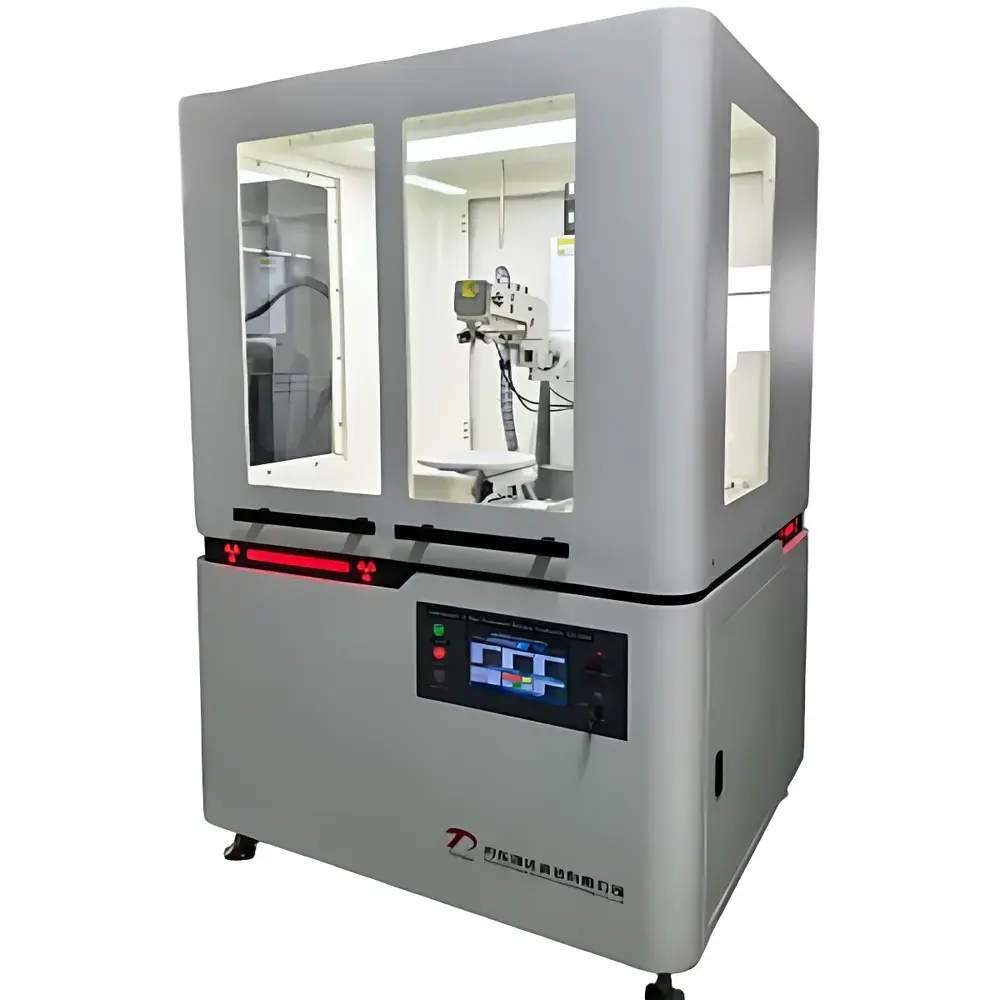
TD-RSD X-Ray Residual Stress Analyzer by Tongda
| Brand | Tongda |
|---|---|
| Model | TD-RSD |
| X-Ray Tube Anode Material | Cr |
| Maximum Power | 3 kW |
| Detector Type | Photon-Counting Area Detector (Dual Symmetric Configuration) |
| Angular Positioning Accuracy | ≤ 0.01° (2θ) |
| Stress Measurement Repeatability (Stress-Free Iron Powder) | σ < ±7 MPa (n = 5) |
| Sample Stage | Motorized XYZ + Φ Tilt Stage |
| Cooling System | Integrated Closed-Loop Ceramic X-Ray Tube Cooling |
| Compliance | ASTM E915, ISO 21432, EN 15305 |
| Dimensions (W×D×H) | 1300 × 1200 × ~1800 mm |
| Target Options | Cr, Cu, Mn, Co, V, Ti, Fe, Mo |
Overview
The TD-RSD X-Ray Residual Stress Analyzer is a high-precision, laboratory-grade instrument engineered for non-destructive determination of near-surface residual stress states in polycrystalline metallic materials using the sin²ψ method. Based on Bragg’s law and lattice strain measurement via X-ray diffraction (XRD), the system quantifies elastic lattice distortion induced by residual stress through precise angular measurement of diffraction peak shifts. Designed for metrological rigor in industrial QA/QC, R&D, and failure analysis labs, the TD-RSD implements dual-detector geometries—including symmetric tilt (ψ-split), side-inclination, and ω-rocking modes—to accommodate complex component geometries and multi-axial stress fields. Its 3 kW fine-focus ceramic X-ray tube ensures stable beam intensity and thermal management for uninterrupted 24-hour operation, while the integrated closed-loop cooling system eliminates external chiller dependency and enhances long-term reproducibility.
Key Features
- Dual high-speed photon-counting area detectors with symmetric configuration—total counting rate >1 × 10⁹ cps—eliminating pulse pile-up and enabling rapid, saturation-free data acquisition.
- Motorized three-axis sample stage (X, Y, Φ) supporting automated mapping of residual stress distributions; enables generation of 2D/3D stress contour maps and principal stress vector visualization.
- Precision goniometric system with angular resolution ≤ 0.01° (2θ), calibrated against NIST-traceable reference standards and validated per ISO 21432 Annex B.
- Modular anode target selection (Cr, Cu, Mn, Co, V, Ti, Fe, Mo) optimized for phase-specific diffraction and minimized fluorescence interference across alloy systems (e.g., Cr for ferritic steels, Co for nickel-based superalloys).
- Robust mechanical architecture featuring vertical X-ray beam orientation and motorized ψ-tilt adjustment mechanism for precise incident angle control—critical for thin-layer or gradient stress profiling.
- Comprehensive safety interlock system compliant with IEC 61010-1 and national radiation protection regulations; includes real-time dose monitoring and automatic beam shutter activation.
Sample Compatibility & Compliance
The TD-RSD accommodates flat, curved, and irregularly shaped metallic specimens up to Ø200 mm × 50 mm thick, including weldments, machined components, shot-peened surfaces, and additive-manufactured parts. It supports stress evaluation in ferrous and non-ferrous alloys (e.g., AISI 4140, Inconel 718, Ti-6Al-4V, Al 6061-T6) without destructive sectioning. All measurement protocols adhere to ASTM E915–22 (“Standard Test Method for Verifying the Alignment of X-Ray Diffraction Equipment for Residual Stress Measurement”), ISO 21432:2020 (“Non-destructive testing — Standard test method for determining residual stresses by X-ray diffraction”), and EN 15305:2007. Full audit trail logging, electronic signature support, and user-access-level controls meet GLP/GMP documentation requirements and align with FDA 21 CFR Part 11 principles for regulated environments.
Software & Data Management
The proprietary TD-RSD Analysis Suite provides a unified platform for instrument control, real-time diffraction imaging, and advanced stress tensor computation. Core modules include: (1) Automated peak search and elliptical/linear profile fitting algorithms for accurate centroid determination; (2) Full 3D stress tensor reconstruction from multi-ψ datasets; (3) Strain-free reference library integration for calibration traceability; (4) Batch processing with customizable report templates (PDF/CSV/XLSX export); and (5) Built-in uncertainty estimation per GUM (JCGM 100:2008) incorporating angular error propagation, peak fitting residuals, and material elastic constant sensitivity. Software architecture supports Windows 10/11 (64-bit), network deployment, and optional LIMS integration via OPC UA.
Applications
- Verification of stress relief effectiveness post-welding, heat treatment, or machining operations.
- Quantitative assessment of surface integrity in gear teeth, bearing races, and turbine blades subjected to rolling contact fatigue.
- Residual stress mapping across selective laser melted (SLM) or electron beam melted (EBM) additively manufactured parts to guide post-processing strategy.
- Root cause analysis of premature cracking or distortion in high-value aerospace and power-generation components.
- Calibration validation of numerical models (e.g., FEA-based residual stress prediction) using experimental benchmark data.
- Quality gate inspection for critical suppliers under AS9100 or ISO/TS 16949 automotive requirements.
FAQ
What X-ray tube anodes are supported, and how does target selection affect measurement?
The TD-RSD accepts interchangeable anodes including Cr, Cu, Mn, Co, V, Ti, Fe, and Mo. Cr Kα radiation (λ = 2.2909 Å) is optimal for ferritic/martensitic steels due to strong (211) or (310) reflections and low fluorescence yield; Cu is preferred for aluminum alloys and austenitic stainless steels.
Is the system capable of measuring through-thickness stress gradients?
While primarily designed for near-surface stress (typically 10–50 µm depth depending on material and radiation), controlled electrolytic layer removal or incremental grinding—per ASTM E915 Annex A—can be combined with TD-RSD measurements to reconstruct depth profiles.
Does the software support automated compliance reporting for ISO or ASTM standards?
Yes—preconfigured report templates include all mandatory parameters defined in ISO 21432 and ASTM E915, with embedded metadata (operator ID, calibration date, environmental conditions) and digital signature fields.
Can the system be integrated into an automated production line environment?
The TD-RSD supports Ethernet-based remote control (TCP/IP), PLC handshake signals, and programmable macro scripting via Python API, enabling synchronization with robotic part handling and MES data exchange.
What maintenance intervals are recommended for long-term measurement stability?
Annual recalibration of goniometer axes and detector alignment is recommended; X-ray tube lifetime exceeds 5,000 hours under continuous 3 kW operation, with predictive diagnostics logged in system health dashboard.





