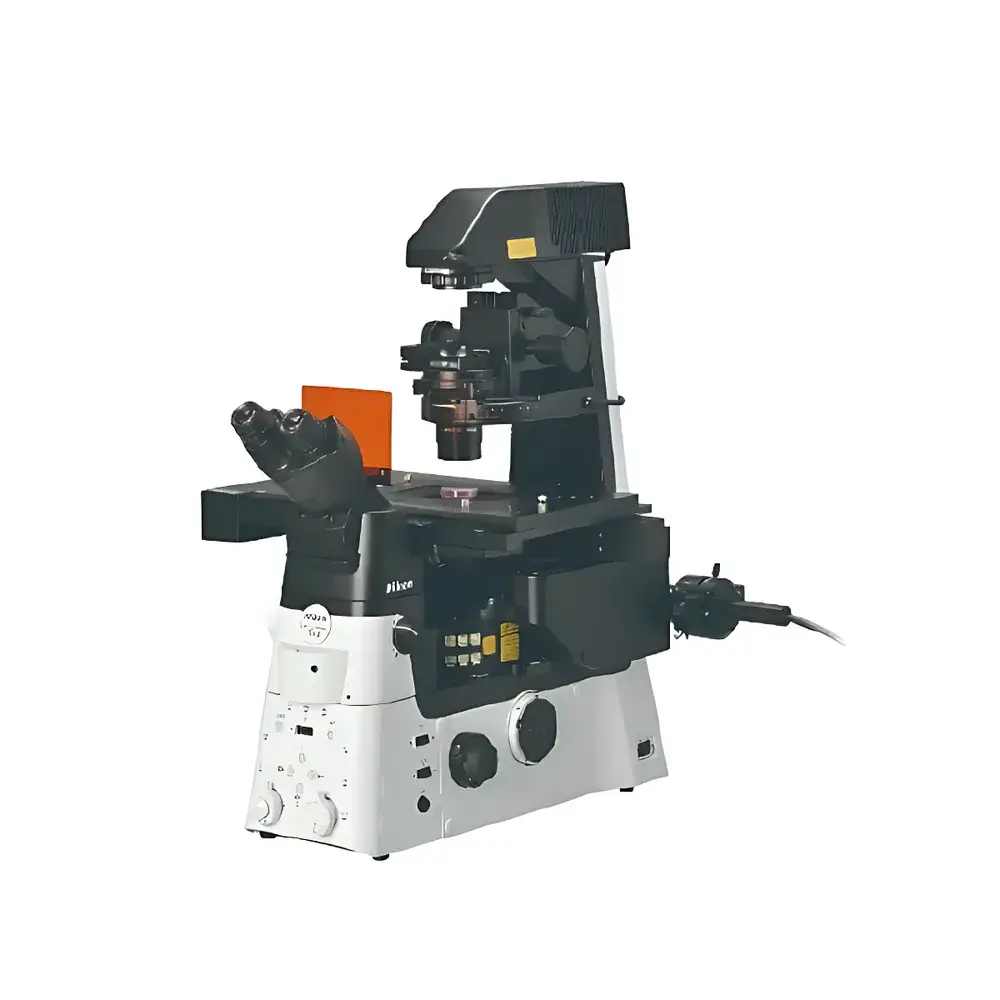
Nikon ECLIPSE Ti2-A Inverted Research-Grade Fluorescence Microscope
| Brand | Nikon |
|---|---|
| Origin | Japan |
| Model | ECLIPSE Ti2-A |
| Optical System | CFI60 Infinity-Corrected |
| Intermediate Magnification | 1.0× / 1.5× (field-replaceable to 2.0×) |
| Focus Mechanism | Motorized coarse/fine focus with 10 mm travel, minimum step size: 0.01 µm (encoder-controlled) |
| Condenser | Motorized turret (TI2-C-TC-E) supporting 7 positions (ø37 mm × 4, ø39 mm × 3), including LWD, ELWD, CLWD, HNA dry/oil, and NAMC objectives |
| Stage | Motorized XY stage (TI2-S-SE-E): ±57 mm X, ±36.5 mm Y, max speed 25 mm/s |
| Objective Turret | 6-position motorized nosepiece with Perfect Focus System (PFS) and DIC compatibility |
| Epi-Fluorescence Filter Turret | 6-position motorized filter cube turret (TI2-F-FLT-E) with integrated shutter |
| Illumination | LED-based transmitted illumination (TI2-D-LHLED), optional 100 W halogen or pre-centered D-LH/LC lamp housing |
| Software Integration | Compatible with NIS-Elements AR/VR/CV platforms |
| Environmental Rating | Indoor use only |
Overview
The Nikon ECLIPSE Ti2-A is a high-precision inverted research-grade fluorescence microscope engineered for demanding live-cell imaging, time-lapse microscopy, and quantitative multimodal analysis in academic, pharmaceutical, and biotechnology laboratories. Built upon Nikon’s CFI60 optical architecture, the Ti2-A delivers diffraction-limited resolution across widefield, DIC, phase contrast, and epifluorescence modalities—optimized for compatibility with sCMOS, EMCCD, and scientific CMOS cameras. Its modular design centers on the Perfect Focus System (PFS), an infrared-based hardware autofocus mechanism that maintains focal plane stability over hours or days without software intervention—critical for long-term viability assays and developmental biology studies. Unlike conventional autofocus solutions reliant on image contrast or Z-stack interpolation, PFS operates independently of specimen fluorescence or contrast, ensuring robustness during phototoxicity-sensitive experiments. The system’s inverted configuration enables seamless integration with environmental chambers, micromanipulators, and perfusion systems, making it ideal for correlative live-cell imaging under physiologically relevant conditions.
Key Features
- Motorized 6-position objective nosepiece with integrated Perfect Focus System (PFS) for real-time, drift-free focus maintenance—compatible with oil, water, and dry objectives up to 100×.
- Motorized condenser turret (TI2-C-TC-E) supporting seven interchangeable condensers: LWD (NA 0.52), ELWD (NA 0.29), CLWD (NA 0.72), HNA dry (NA 0.85), HNA oil (NA 1.4), and NAMC (NA 0.4), enabling precise Köhler illumination optimization across magnifications and contrast techniques.
- High-speed 6-position motorized epi-fluorescence filter turret (TI2-F-FLT-E) with synchronized shutter actuation (12 ms open/close), minimizing exposure artifacts during multicolor acquisition.
- Large-travel motorized XY stage (±57 mm × ±36.5 mm) with 25 mm/s maximum velocity and magnetic sample holder compatibility—designed for automated multi-well plate scanning and tiled mosaic acquisition.
- Dedicated LED-based transmitted illumination (TI2-D-LHLED) with uniform intensity distribution and negligible thermal drift, eliminating the need for lamp alignment and reducing maintenance intervals compared to halogen sources.
- Fully encoded hardware architecture: all motorized components—including focus, stage, turret, and filter wheel—report positional status in real time, enabling deterministic experiment reproducibility and full hardware-level logging.
Sample Compatibility & Compliance
The Ti2-A accommodates standard culture formats including 35 mm dishes, multi-well plates (6–384-well), chambered coverslips, and microfluidic devices. Its low-profile stage and extended working distance optics support thick specimens up to 3 mm in height when using ELWD or CLWD condensers. All optical paths comply with ISO 10934-1 (microscope nomenclature) and ISO 9335 (objective labeling standards). The system meets IEC 61000-6-3 (EMC emission) and IEC 61000-6-2 (immunity) requirements for laboratory instrumentation. When operated with NIS-Elements software configured in compliance mode, the platform supports audit trail generation, electronic signatures, and user-access hierarchy per FDA 21 CFR Part 11 and EU Annex 11 guidelines—validated for use in GLP and GMP-regulated environments including QC release testing and preclinical imaging studies.
Software & Data Management
The Ti2-A integrates natively with Nikon’s NIS-Elements platform (AR, VR, and CV editions), providing unified control of hardware, acquisition, analysis, and metadata annotation. Acquisition modules support time-lapse scheduling, Z-stack capture with adaptive interval control, multi-channel synchronization, and hardware-triggered acquisition (TTL/USB). Quantitative analysis tools include particle tracking (with sub-pixel centroiding), colocalization (Pearson/Manders coefficients), intensity profiling, and morphometric segmentation. Raw data is saved in TIFF or NIS-Elements native .ND2 format—with embedded EXIF-style metadata including objective ID, filter set, exposure parameters, stage coordinates, and PFS calibration history. For enterprise deployment, NIS-Elements supports centralized license management, LDAP/Active Directory authentication, and secure DICOM export for PACS integration in translational imaging cores.
Applications
- Long-term live-cell imaging of mitotic progression, organelle dynamics, and intracellular trafficking under controlled CO₂/temperature/humidity.
- High-content screening (HCS) of phenotypic responses in adherent and suspension cultures using multi-well plate automation.
- Quantitative FRET and FLIM experiments leveraging precise filter positioning and stable illumination.
- Correlative light-electron microscopy (CLEM) workflows via coordinate-mapped stage navigation and fiducial marker registration.
- Developmental biology studies requiring extended observation of embryoid bodies, organoids, or zebrafish embryos in specialized culture chambers.
- Neuroscience applications including dendritic spine turnover analysis and calcium imaging with GCaMP or jRGECO reporters.
FAQ
Does the Ti2-A support oil immersion objectives?
Yes—the motorized condenser turret includes dedicated HNA oil condenser (NA 1.4) optimized for 60× and 100× oil objectives, with integrated correction collar adjustment and automatic recognition via status detection.
Is the Perfect Focus System compatible with thick tissue sections?
PFS operates effectively through coverslip thicknesses from 0.13–0.21 mm and media refractive indices ranging from 1.33–1.52; for thicker samples (>100 µm), PFS can be calibrated using internal reference layers or external IR reflectors.
Can the Ti2-A be upgraded to Ti2-E functionality?
Hardware upgrades—including additional camera ports, bottom-side illumination modules, and dual-camera configurations—require factory service and are subject to mechanical and firmware compatibility validation by Nikon Service Centers.
What illumination options are available for transmitted light?
Standard configuration includes the TI2-D-LHLED high-uniformity LED illuminator; optional 100 W halogen (D-LH/LC) and fiber-coupled xenon arc sources are supported via dedicated mounting interfaces.
How is data integrity ensured during regulatory submissions?
When deployed with NIS-Elements in 21 CFR Part 11 mode, all acquisitions generate immutable audit logs containing timestamped operator IDs, parameter changes, hardware state snapshots, and digital signatures—exportable as PDF/A or XML for submission to regulatory agencies.