
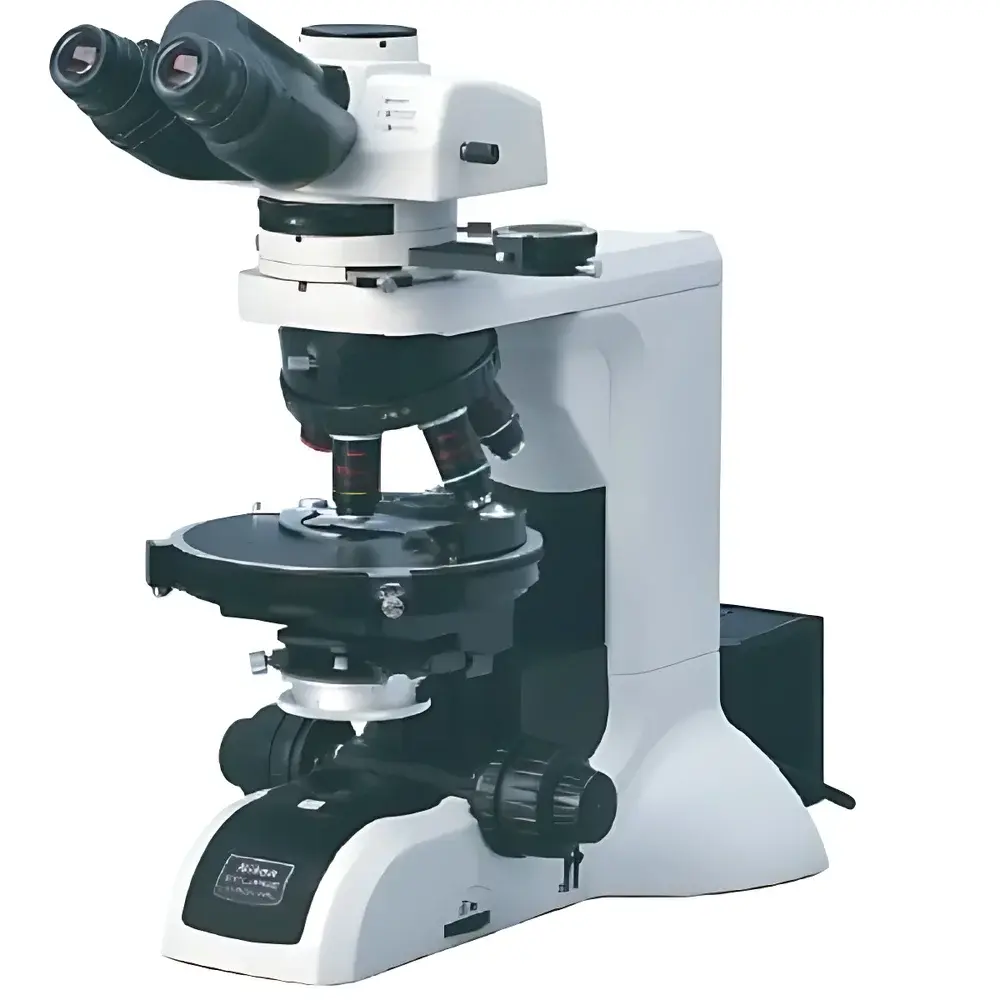
Nikon ECLIPSE LV100ND POL/DS Polarizing and Dispersion Microscope
| Brand | Nikon |
|---|---|
| Origin | Japan |
| Model | ECLIPSE LV100ND POL/DS |
| Optical System | CFI60 Infinity-Corrected |
| Illumination | 12 V–50 W Halogen Lamp (LV-HL50W) with Built-in DC Transformer |
| Brightness | >100 W Equivalent |
| Condenser | LV-CUD Universal Dry Condenser (NA 0.9), Optional Swing-Out Polarizing Condenser |
| Stage | Precision Rotatable Circular Stage (0–360°, 1° graduation, 0.1° vernier reading, 45° click-stop) |
| Focus Mechanism | Coaxial Coarse/Fine Adjustment (Coarse: 14 mm/rev |
| Fine | 0.1 mm/rev |
| Minimum Readout | 1 µm) |
| Eyepieces | CFI 10×, FOV 22 mm, CM-type with Crosshair & Micrometer Scale |
| Trinocular Tube | P-TT3 for Polarizing Microscopy, Equipped with Bertrand Lens (Focusable & Centerable), Removable Analyzer, Switchable Orthoscopic/Conoscopic Observation, λ/4 Plate & Compensator Slots |
| Analyzer | 360° Rotatable, 0.1° Graduation |
| Objective Turret | Centerable 5-Position Nosepiece with DIN Compensator Slot |
| Polarizers | C-SP Simple Polarizer, One-Touch Swing-Out Polarization Control |
| Objectives | CFI Achromat P 4×, P 10×, LWD P 20×, P 40×, P 100× Oil |
| Dispersion Objectives | CFI Achromat R-DS 10×, CFI Plan Achromat C-DS 10×, CFI Plan Fluor R-DS 40× |
| Compensators | P-CL1/4λ Plate, Quartz Wedge, or Sénarmont Compensator (Insertable into Intermediate Tube) |
| Filter Holder | IF546/12 Interference Filter (Ø45 mm) |
| Power Consumption | 75 W (1.2 A) |
Overview
The Nikon ECLIPSE LV100ND POL/DS is a high-precision, research-grade polarizing and dispersion microscope engineered for quantitative birefringence analysis, crystallographic characterization, and optical anisotropy assessment in geological, materials science, pharmaceutical, and polymer laboratories. Built upon Nikon’s CFI60 infinity-corrected optical platform, it delivers exceptional image fidelity, chromatic correction, and polarization purity across the visible spectrum. Its dual-mode architecture supports both standard orthoscopic polarized light observation and conoscopy—enabling simultaneous evaluation of interference figures and retardation patterns. The system integrates a thermally stable 12 V–50 W halogen illumination source (LV-HL50W), delivering uniform, high-intensity Köhler illumination (>100 W equivalent brightness) essential for reproducible extinction angle measurements and low-noise retardation quantification. Designed for compliance with ISO 9276-3 (particle shape analysis), ASTM D4125 (birefringence in polymers), and USP (microscopic identification of crystalline substances), the LV100ND POL/DS serves as a foundational instrument for GLP-regulated quality control and academic microstructural research.
Key Features
- CFI60 infinity-corrected optical path ensures optimal resolution, flatness of field, and compatibility with Nikon’s full suite of polarized and dispersion-corrected objectives.
- Dual-function trinocular tube (P-TT3) with integrated Bertrand lens, removable analyzer, and switchable orthoscopic/conoscopic viewing modes—enabling rapid transition between extinction-angle mapping and interference figure acquisition.
- Precision circular mechanical stage with 360° rotation, 1° engraved scale, 0.1° vernier readout, and 45° detent stops—critical for accurate crystallographic orientation determination and angular repeatability in multi-sample comparative studies.
- Centerable 5-position objective turret with DIN-standard compensator slot—supporting seamless insertion of λ/4 plates, quartz wedge, or Sénarmont compensators directly into the optical path without realignment.
- One-touch swing-out polarization mechanism (C-SP polarizer + synchronized objective-side polarization control)—minimizing mechanical drift during polarization state switching and preserving focus stability.
- LV-CUD universal dry condenser (NA 0.9) optimized for both high-resolution polarized imaging and dispersion staining applications, with optional swing-out polarizing condenser for enhanced contrast in weakly birefringent specimens.
Sample Compatibility & Compliance
The LV100ND POL/DS accommodates a broad range of anisotropic and dispersion-sensitive specimens—including mineral thin sections, liquid crystals, pharmaceutical polymorphs, fiber-reinforced composites, biological collagen arrays, and semiconductor thin films. Its modular design supports standardized sample formats: 24 × 50 mm glass slides, 30 mm diameter circular mounts, and custom metallurgical mounts up to 25 mm thickness. All optical components comply with ISO 8578 (microscope labeling), ISO 10934-1 (optical terms), and JIS B 7151 (Japanese industrial standards for polarizing microscopes). The system meets key requirements for FDA 21 CFR Part 11–ready documentation when paired with Nikon NIS-Elements software (audit trail, electronic signatures, and secure data export). It is routinely validated under GMP Annex 11 and ISO/IEC 17025 for use in method transfer protocols involving birefringence threshold testing and polymorphic identification.
Software & Data Management
While the LV100ND POL/DS operates as a standalone optical platform, it is fully compatible with Nikon NIS-Elements AR (Advanced Research) software for quantitative polarized light microscopy. NIS-Elements enables automated extinction angle measurement, retardation mapping via grayscale calibration against calibrated standards (e.g., quartz wedge reference), and interference figure analysis using built-in conoscopy templates. Software modules support GLP-compliant reporting with embedded metadata (objective ID, analyzer angle, filter configuration, stage position), time-stamped acquisition logs, and encrypted raw data storage (.nd2 format). Export options include TIFF (16-bit), CSV (angle/retardation tables), and PDF reports compliant with ISO/IEC 17025 clause 7.8.2 for result traceability.
Applications
- Geological petrography: Identification and orientation analysis of birefringent minerals (e.g., quartz, feldspar, mica) in thin section; determination of optic sign and axial angle via conoscopic observation.
- Pharmaceutical solid-state characterization: Detection of polymorphic transitions, hydrate/anhydrate differentiation, and stress-induced crystallinity changes in active pharmaceutical ingredients (APIs).
- Materials science: Evaluation of residual stress in transparent polymers (e.g., PMMA, PC), phase separation in block copolymers, and domain alignment in liquid crystal displays (LCDs).
- Forensic fiber analysis: Discrimination of synthetic fibers (nylon, polyester, acrylic) based on dispersion staining behavior and birefringence magnitude.
- Metallurgy: Assessment of grain boundary anisotropy and texture in annealed alloys using polarized light contrast enhancement.
FAQ
Does the LV100ND POL/DS support motorized stage or focus automation?
No—the base configuration is manually operated to maximize mechanical stability and polarization fidelity. Motorized components are available as factory-installed options (e.g., MS-LV100ND motorized stage) but require separate validation for regulated environments.
Can the system be used for quantitative retardation measurement?
Yes—when used with NIS-Elements AR and certified compensators (e.g., quartz wedge traceable to NIST SRM 2082), it achieves ±0.3 nm retardation accuracy under controlled environmental conditions (23 ± 1 °C, <50% RH).
Is the halogen lamp replaceable with LED illumination?
Not natively—the LV-HL50W halogen system is thermally and optically optimized for polarization purity and color temperature consistency (3200 K). Third-party LED retrofitting voids optical calibration and compromises extinction ratio performance.
What is the maximum specimen height clearance?
The working distance accommodates specimens up to 25 mm in height when using the standard LV-CUD condenser; clearance increases to 35 mm with the optional swing-out condenser removed.
Are objective lenses parfocal and parcentric across polarizing and dispersion configurations?
Yes—all CFI P-series and R-DS/C-DS objectives are factory-aligned to Nikon’s CFI60 parfocal standard (45 mm mechanical tube length equivalence) and maintain centration within ±0.02 mm across magnifications and polarization states.



