
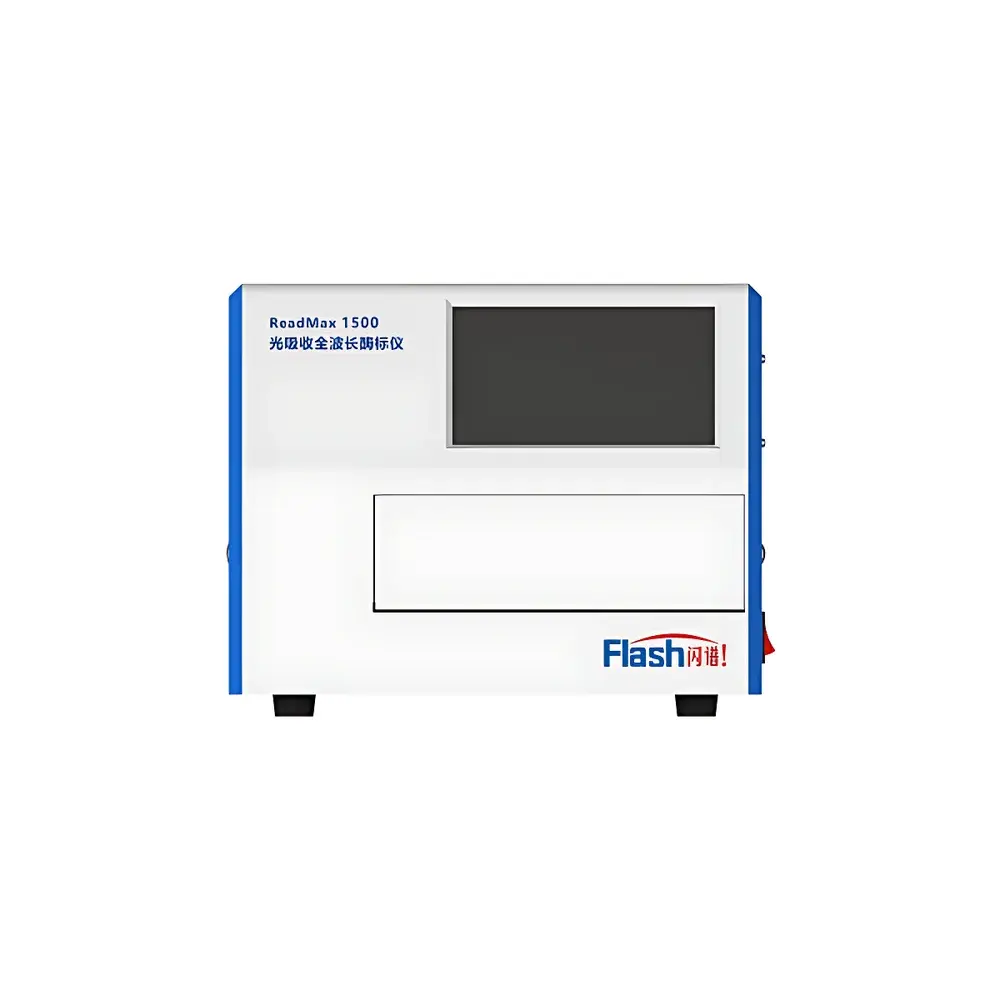
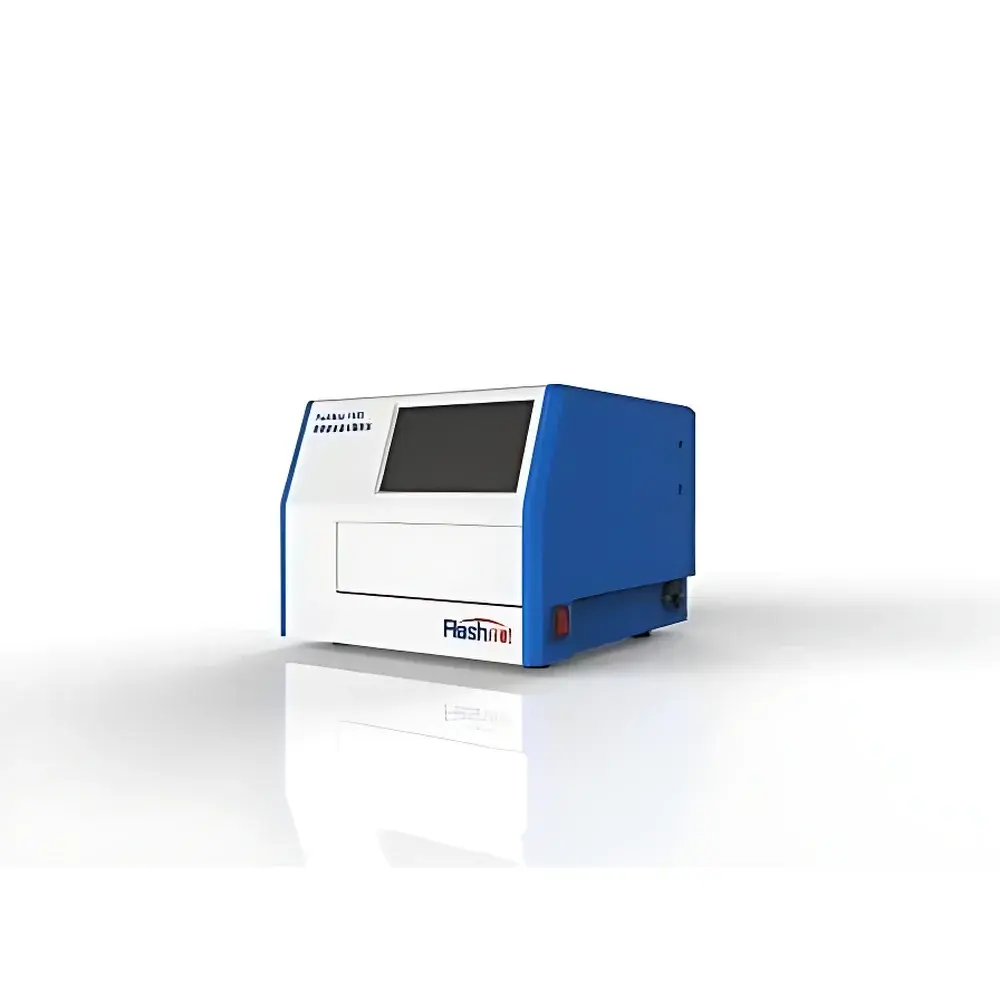
Flash Spectrum ReadMax 1500 UV-Vis Absorbance Microplate Reader
| Brand | Flash Spectrum |
|---|---|
| Origin | Shanghai, China |
| Model | ReadMax 1500 |
| Detection Principle | Monochromator-based UV-Vis Absorbance |
| Wavelength Range | 190–1000 nm (1 nm step) |
| Optical Density Range | 0–4.000 OD |
| OD Linearity | ±0.01% in 0–2.0 OD |
| Wavelength Accuracy | ±1.0 nm |
| Wavelength Repeatability | <0.2 nm |
| Spectral Bandwidth | 2.5 nm (2–10 nm customizable) |
| Stray Light | <0.01% (@230 nm) |
| OD Precision | CV <0.5% (@450 nm) |
| Read Time | 20 s per 96-well plate (dual-wavelength) |
| Plate Format | Standard and UV-transparent 96-well microplates |
| Detector Type | UV-Vis photodiode array |
| Light Source | Xenon flash lamp |
| Interface | 7-inch capacitive touchscreen + USB data export |
| Software | Onboard firmware with kinetic, endpoint, spectral scan, and curve-fitting modes (linear, point-to-point) |
| Compliance | Designed for GLP-compliant workflows |
Overview
The Flash Spectrum ReadMax 1500 is a monochromator-based UV-Vis absorbance microplate reader engineered for precision, reproducibility, and operational autonomy in life science laboratories. It employs a high-stability xenon flash lamp coupled with a precision Czerny-Turner grating monochromator to deliver continuous wavelength selection from 190 nm to 1000 nm in 1 nm increments—enabling full-spectrum acquisition without filter wheels or mechanical switching. This architecture supports quantitative measurement of nucleic acid concentration (A260/A280), protein quantification (UV280, Bradford, Lowry), end-point and kinetic ELISA/EIA, enzyme activity assays (e.g., phosphatase, kinase, protease), cytotoxicity (MTT/XTT), bacterial growth (OD600), and endotoxin detection (LAL). Its optical design minimizes stray light (<0.01% @230 nm) and ensures high photometric fidelity across the deep UV to near-IR range—critical for applications requiring accurate baseline correction and low-noise signal resolution.
Key Features
- Integrated 7-inch capacitive touchscreen interface—no external PC required for routine operation, calibration, or data export
- Onboard firmware supporting endpoint, kinetic, and spectral scanning modes with real-time curve fitting (linear, point-to-point, 4PL/5PL optional via export)
- Optimized optical path with 2.5 nm nominal bandwidth (customizable 2–10 nm) for balanced resolution and signal-to-noise ratio
- High photometric stability: OD repeatability <0.001 OD SD or CV <0.5% at 450 nm; linearity maintained to ±0.01% within 0–2.0 OD
- Full-wavelength scanning capability (190–1000 nm) with 1 nm resolution—enabling spectral fingerprinting of dyes, proteins, and nanoparticles
- Robust mechanical architecture designed for continuous use in QC labs and core facilities; validated for 96-well standard and UV-transmissive plates
- USB-native data export (CSV, XLSX) directly to thumb drive—supports traceable, timestamped file generation with plate map metadata
- Modular expandability: Compatible with optional MF-10 incubation-shaking module (temp range: ambient to 45°C, ±0.5°C accuracy) and ND-10 low-volume detection plates (2–30 µL)
Sample Compatibility & Compliance
The ReadMax 1500 accommodates all ANSI/SLAS-standard 96-well microplates—including clear, white, black, and UV-transparent polystyrene formats—without manual alignment or plate-type configuration. Its broad spectral coverage enables direct quantification of native biomolecules (DNA/RNA A260, proteins A280/A214) and chromogenic substrates (pNPP, ABTS, TMB) across clinical, pharmaceutical, and academic workflows. While the instrument itself does not carry CE IVD or FDA 510(k) certification, its measurement performance aligns with ISO 15197:2013 (for absorbance-based diagnostics), ASTM E2597-22 (microplate reader verification), and USP guidelines for spectrophotometric assay validation. Data integrity is preserved through deterministic timestamping, user-access logging, and export formats compatible with GLP/GMP audit trails when integrated into validated LIMS environments.
Software & Data Management
The embedded operating system provides intuitive workflow navigation with preconfigured assay templates (e.g., BCA, ELISA, MTT, OD600). All measurements include raw OD values, calculated concentrations, kinetic rate constants (ΔOD/min), and spectral profiles—with no proprietary binary formats. Exported CSV files contain column headers compliant with MIAME and MIAPE standards (e.g., “Well_ID”, “Wavelength_nm”, “OD_value”, “Timestamp”, “User_ID”). For regulated environments, the system supports external validation of firmware versioning, calibration certificate linkage (via QR-coded calibration plates), and post-acquisition reprocessing using exported spectral datasets in third-party tools (e.g., Python SciPy, GraphPad Prism, R). Audit trail functionality is implemented at the data export layer—ensuring ALCOA+ principles (Attributable, Legible, Contemporaneous, Original, Accurate) are upheld during method transfer and regulatory submission.
Applications
- Nucleic Acid & Protein Quantification: Direct A260/A280 ratio analysis; UV-based protein estimation; dye-binding assays (Bradford, BCA)
- Immunoassays: End-point and kinetic ELISA/EIA for cytokine, hormone, and antibody titer determination
- Enzyme Kinetics: Continuous monitoring of substrate depletion or product formation (e.g., alkaline phosphatase, β-galactosidase, caspase-3)
- Cell-Based Assays: Viability (MTT/XTT/WST-1), cytotoxicity (LDH release), proliferation (BrdU), and apoptosis (caspase activity)
- Microbiology & Bioprocessing: Bacterial/fungal growth curves (OD600), antibiotic susceptibility testing, fermentation monitoring
- Environmental & Food Safety: Detection of contaminants (nitrate, phosphate, heavy metals) via colorimetric reaction chemistries
- Material Science: Characterization of plasmonic nanoparticles, quantum dots, and conjugated polymers via UV-Vis extinction profiling
FAQ
Does the ReadMax 1500 support FDA 21 CFR Part 11 compliance?
The device does not include built-in electronic signature or role-based access control. However, its CSV/XLSX export architecture and deterministic timestamping enable integration into Part 11–compliant LIMS or ELN systems when deployed within a validated IT infrastructure.
Can it read low-volume samples in 384-well plates?
No—the ReadMax 1500 is optimized for 96-well format only. For higher-density formats, users should consider dedicated 384-well readers with enhanced optics and reduced pathlength correction algorithms.
Is spectral calibration traceable to NIST standards?
Yes—calibration is performed using NIST-traceable neutral density filters and holmium oxide reference standards. Certificate of Calibration (including wavelength and photometric verification) is provided with each unit.
What maintenance is required for long-term photometric stability?
Annual verification of wavelength accuracy and OD linearity is recommended using certified reference plates (e.g., OD450-96, Flash Spectrum P/N CAL-OD-96). The xenon flash lamp has a rated lifetime of >1×10⁹ flashes and requires no routine replacement under typical lab usage (≤200 plates/day).
How is temperature control handled during kinetic assays?
The base unit operates at ambient temperature. For temperature-sensitive kinetics, the optional MF-10 incubation-shaking module provides precise thermal regulation (±0.5°C) and orbital shaking (200–1000 rpm) synchronized with reading intervals.




