
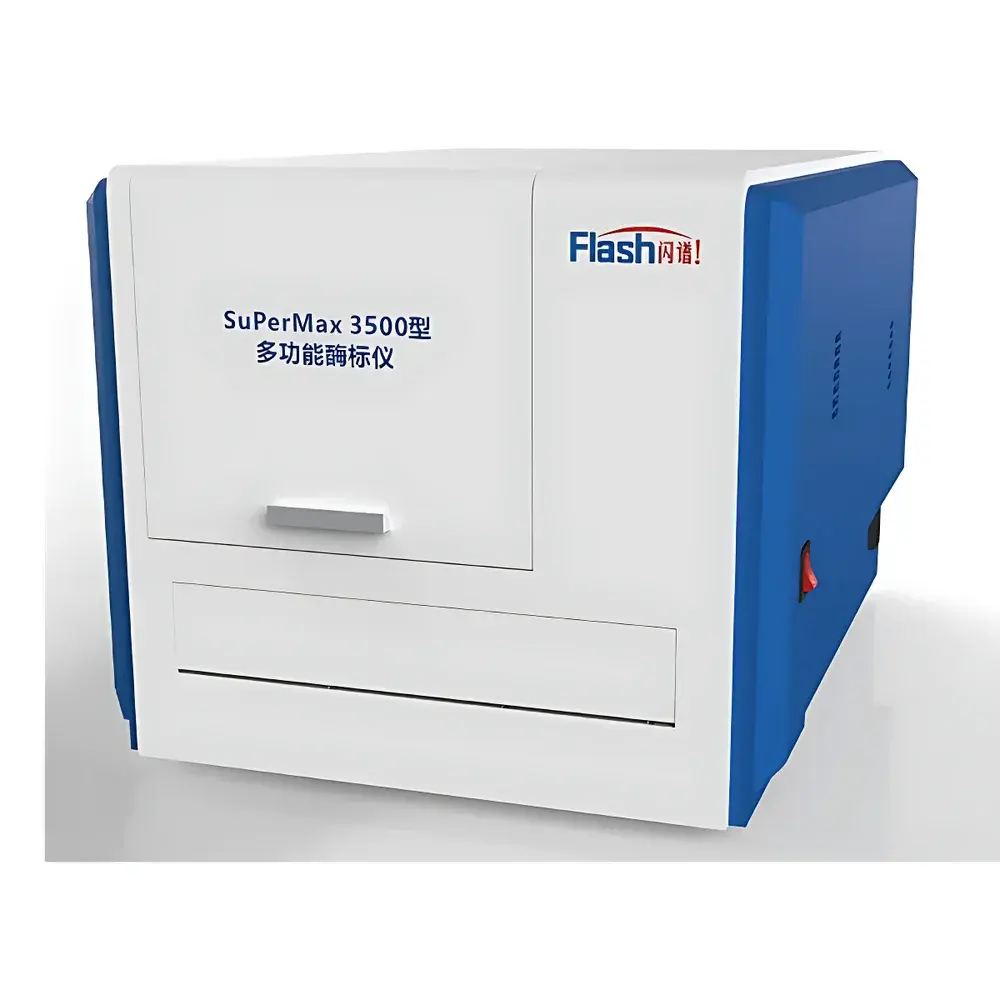
Flash Spectrum SuPerMax 3500 Multimode Microplate Reader
| Brand | Flash Spectrum |
|---|---|
| Origin | Shanghai, China |
| Model | SuPerMax 3500 |
| Automation Level | Fully Automated |
| Detection Modes | Absorbance (190–1000 nm, monochromator-based), Fluorescence (top/bottom reading, TRF, FP), Luminescence (photon-counting PMT) |
| Detectors | Photodiode, Standard PMT, Photon-Counting PMT |
| Excitation Sources | Tungsten-halogen lamp, Xenon flash lamp |
| Wavelength Selection | Dual-path — monochromator or filter-based |
| Curve Fitting | Linear, quadratic/cubic/quartic polynomial, 4PL/5PL, log, exponential, double-logarithmic |
| Incubation Range | Ambient to 65 °C (±0.2 °C uniformity at 37 °C) |
| Plate Formats | 6–1536-well microplates |
| Software | Integrated workstation with formula editor, audit trail, GLP-compliant data handling, and automation-ready API |
Overview
The Flash Spectrum SuPerMax 3500 Multimode Microplate Reader is an engineered platform for quantitative and kinetic analysis across life science laboratories. It integrates three core detection modalities—absorbance, fluorescence, and luminescence—within a single, compact architecture designed for reproducibility, flexibility, and regulatory readiness. Its absorbance module employs a high-resolution monochromator system covering 190–1000 nm, enabling spectral scanning, endpoint assays, and time-resolved kinetics for applications including protein quantification (e.g., Bradford, BCA), nucleic acid analysis (A260/A280), and enzyme activity monitoring. The fluorescence subsystem supports both top- and bottom-reading configurations, essential for adherent cell-based assays and suspension-based reporter systems. Time-resolved fluorescence (TRF) and fluorescence polarization (FP) are implemented with precise delay-gated detection and polarized excitation optics, facilitating low-background screening in GPCR and kinase assays. Chemiluminescence detection utilizes a photon-counting PMT with single-photon sensitivity and ultra-low dark current, critical for luciferase-based reporter gene assays—including dual-luciferase systems requiring stringent signal discrimination.
Key Features
- Fully automated operation with programmable incubation (ambient to 65 °C) and orbital shaking—temperature uniformity maintained at ±0.2 °C at 37 °C per ISO 20387 Annex C requirements.
- Dual excitation source architecture: tungsten-halogen lamp (optimized for repeatability in routine fluorescence assays) and xenon flash lamp (broad spectral output for UV-sensitive dyes and multiplexed detection).
- Hybrid wavelength selection: interchangeable monochromator (flexible scanning, full-spectrum acquisition) and filter-based paths (higher sensitivity, reduced stray light)—enabling four configurable excitation/emission combinations.
- Photon-counting PMT detector for luminescence, delivering <1 amol ATP detection limit under standard conditions and linear dynamic range exceeding 6 logs.
- Onboard microprocessor and embedded firmware support real-time plate mapping, multi-step protocol sequencing, and hardware-level error logging compliant with FDA 21 CFR Part 11 Annex 11 principles.
Sample Compatibility & Compliance
The SuPerMax 3500 accommodates standard microplate formats from 6- to 1536-well, including opaque, clear, and black-walled plates with or without lid compatibility. It supports assay chemistries aligned with CLSI EP17-A2 guidelines for limit of detection validation and ASTM E2554-21 for microplate reader performance verification. All optical modules are factory-aligned and traceable to NIST-calibrated reference standards. Data integrity controls include electronic signatures, immutable audit trails, and role-based user permissions—supporting GLP, GCP, and early-stage GMP workflows. The instrument meets IEC 61010-1 safety standards and electromagnetic compatibility per EN 61326-1.
Software & Data Management
The proprietary SuPerMax Control Suite provides a validated Windows-based interface supporting method development, plate layout definition, kinetic parameter extraction (e.g., Vmax, Km, EC50), and curve fitting using industry-standard algorithms—including four-parameter logistic (4PL), five-parameter logistic (5PL), and custom formula entry via built-in scripting engine. Raw data are stored in vendor-neutral .csv and .xlsx formats; metadata (instrument ID, operator, timestamp, calibration status) is embedded in each export. Audit trail records all user actions, parameter changes, and data exports with timestamps and digital signatures. An open API enables integration with LIMS (e.g., LabVantage, STARLIMS) and robotic liquid handlers (Hamilton, Tecan) via TCP/IP or RS-232.
Applications
- Quantitative ELISA and immunoassay development under ISO 13485 quality system frameworks.
- Cell viability/toxicity profiling using MTT, CellTiter-Glo®, and resazurin-based assays.
- Reporter gene assays—including dual-luciferase normalization workflows requiring sequential luminescent readouts with auto-reagent injection synchronization.
- Enzyme kinetics (e.g., caspase, protease, phosphatase) via continuous absorbance or fluorescence monitoring.
- High-throughput screening (HTS) of compound libraries using TRF-based binding assays or FP-based competitive displacement assays.
- Nucleic acid quantification and purity assessment (A260/A280, A260/A230) in genomic and transcriptomic sample QC pipelines.
FAQ
Does the SuPerMax 3500 support FDA 21 CFR Part 11 compliance?
Yes—the software includes electronic signature capability, audit trail generation, and secure user authentication aligned with Part 11 Subpart B requirements.
Can the instrument perform simultaneous dual-emission fluorescence measurements?
No; it performs sequential dual-wavelength detection with configurable dwell times, suitable for ratiometric dyes such as Fura-2 but not true simultaneous acquisition.
Is temperature calibration traceable to national standards?
Yes—incubation block calibration is performed using NIST-traceable platinum resistance thermometers and documented in the Certificate of Conformance supplied with each unit.
What is the minimum detectable luminescence signal?
Under optimized conditions (e.g., white 96-well plate, 1-second integration), the photon-counting PMT achieves ≤100 RLUs background and a signal-to-noise ratio ≥100:1 at 1 amol luciferin.
Are third-party microplate seals compatible with the top-read fluorescence mode?
Yes—optical-grade adhesive films (e.g., PerkinElmer TopSeal-A, Greiner Bio-One SealPlate) are validated for minimal autofluorescence and transmission loss at key excitation wavelengths (340–650 nm).
Related Products



