
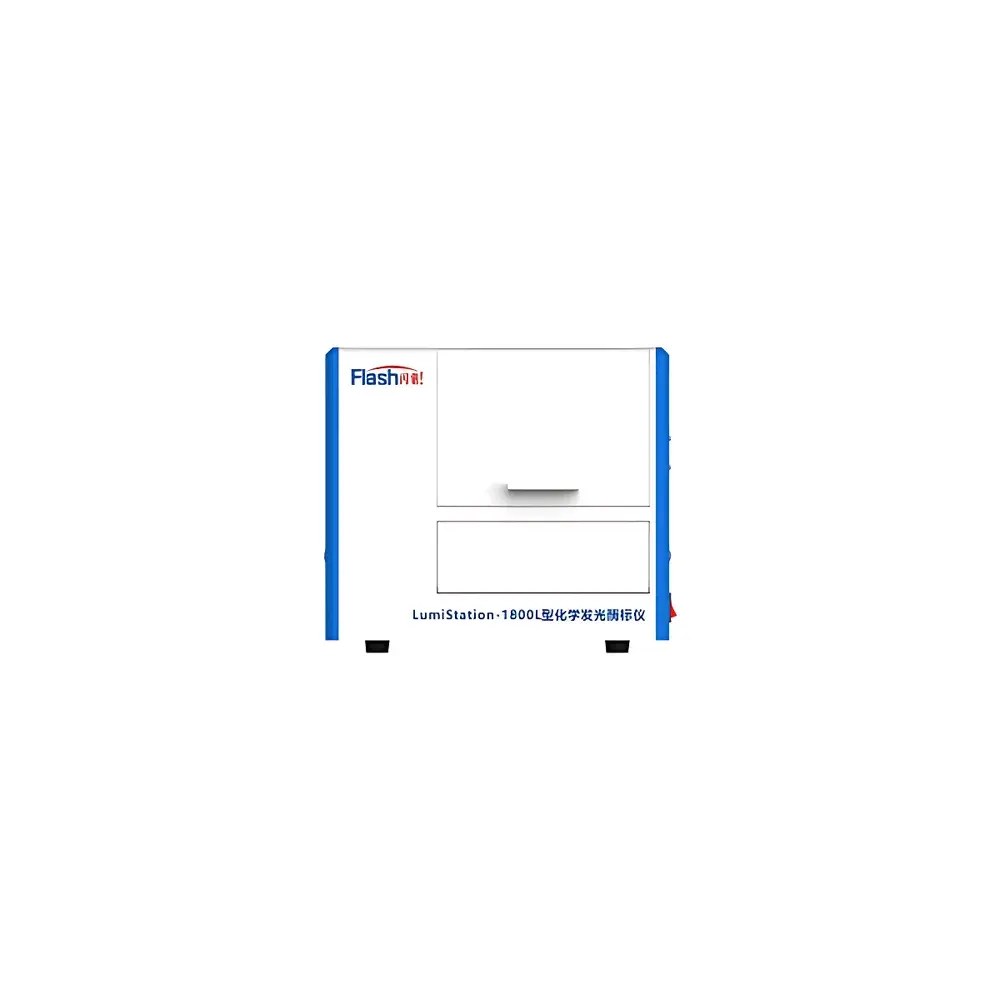
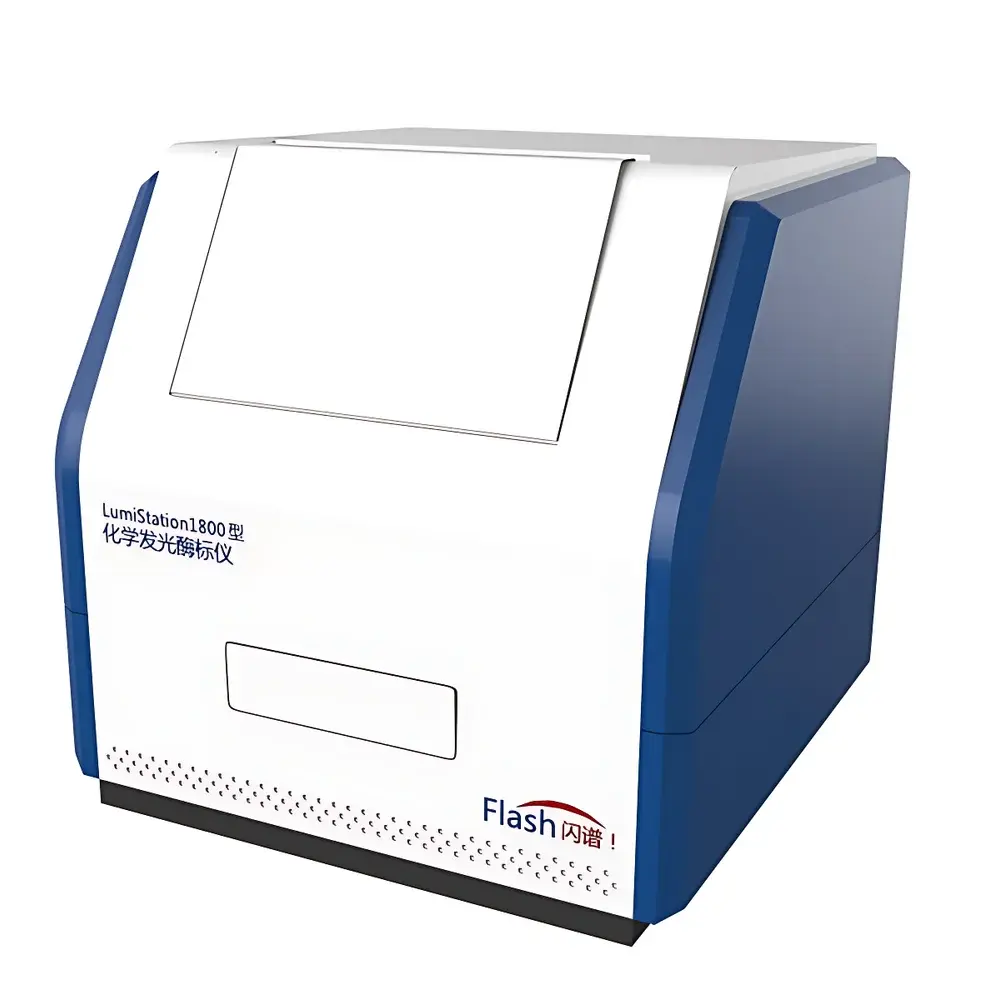
Flash Spectrum LumiStation 1800 Chemiluminescence Microplate Reader
| Brand | Flash Spectrum |
|---|---|
| Origin | Shanghai, China |
| Manufacturer Type | Authorized Distributor |
| Product Category | Domestic |
| Model | LumiStation 1800 |
| Functionality | Dedicated Chemiluminescence Detection |
| Automation Level | Fully Automated |
| Assay Modes | Endpoint, Kinetic, Scanning |
| Curve Fitting | Linear Regression |
| Detector | Photon-Counting Photomultiplier Tube (PMT) |
| Wavelength Range | 300–650 nm |
| Absorbance Range | 0.000–4.000 Abs |
| Absorbance Linearity | 0.000–2.000 Abs |
| Single-Wavelength Kinetic Read Time | 6 sec per well |
| Sensitivity | 7 amol ATP per well |
| Plate Formats | 96-well and 384-well microplates |
| Incubation Range | Ambient +2 °C to 65 °C |
| Shaking Modes | Linear, Orbital, Cross |
| Integration Time | User-Configurable |
| Software Interface | USB-Controlled Data Acquisition & Analysis Workstation |
Overview
The Flash Spectrum LumiStation 1800 is a dedicated, fully automated chemiluminescence microplate reader engineered for high-sensitivity, low-background luminescent detection in life science research and applied diagnostics. Unlike absorbance or fluorescence readers, the LumiStation 1800 employs photon-counting photomultiplier tube (PMT) technology operating across a broad spectral range (300–650 nm), optimized for quantifying ultra-low-intensity light emissions from enzymatic, oxidative, or reporter-based reactions—such as luciferase assays, ATP bioluminescence, immunoassays, and enzyme activity profiling. Its optical architecture incorporates an integrated light-trap system to minimize cross-well signal crosstalk, ensuring high well-to-well reproducibility and enabling reliable kinetic monitoring over extended timeframes. Designed for rigorous laboratory environments—including academic core facilities, pharmaceutical discovery labs, and clinical assay development units—the instrument delivers performance metrics aligned with international standards for luminescence detection sensitivity and dynamic range.
Key Features
- Photon-counting PMT detector with sub-picoamp dark current and >6-decade linear dynamic range
- Integrated temperature-controlled incubation module (ambient +2 °C to 65 °C), supporting on-board kinetic assays without external incubators
- Programmable shaking modes: linear, orbital, and cross-pattern agitation—optimized for uniform reagent mixing in heterogeneous assays
- Dedicated time-integration acquisition mode for precise control of integration duration, critical for transient or low-yield luminescent signals
- Optical isolation design with proprietary light-trap geometry, reducing inter-well interference by >99.9% in 384-well formats
- USB 2.0 interface for deterministic instrument control, real-time data streaming, and synchronization with external peripherals (e.g., liquid handlers)
- Pre-calibrated detection path validated against NIST-traceable luminance standards for inter-laboratory comparability
Sample Compatibility & Compliance
The LumiStation 1800 supports standard ANSI/SLAS-compliant 96-well and 384-well microplates—including white opaque, black, and clear-bottom plates—enabling compatibility with diverse assay chemistries (e.g., firefly and Renilla luciferase dual-reporter systems, acridinium ester-based immunoassays, and ATP-dependent kinase assays). It meets essential requirements for GLP-compliant workflows: audit-trail-enabled software logging, user-access controls, and electronic signature support. While not FDA 21 CFR Part 11-certified out-of-the-box, its data export structure (CSV, XML, PDF) and metadata-rich output facilitate validation under ISO/IEC 17025, CLIA, and USP analytical instrument qualification frameworks. All firmware and software revisions are version-controlled and documented per ICH GCP Annex 11 guidance.
Software & Data Management
The LumiStation Workstation software provides a unified platform for protocol definition, real-time monitoring, raw-data visualization, and statistical analysis. It includes built-in modules for dual-luciferase normalization, ATP standard curve generation (with 4PL/5PL fitting), kinetic rate calculation (slope, AUC, t1/2), and plate mapping with well-level QC flags. Data files retain full acquisition metadata—including integration time, gain setting, temperature log, and shake parameters—for traceable reanalysis. Export options comply with MIAME and MIAPE reporting guidelines; outputs integrate seamlessly with third-party platforms such as GraphPad Prism, JMP, and LabArchives ELN. The software architecture supports multi-user role assignment (admin, operator, reviewer) and encrypted local storage compliant with GDPR and HIPAA data handling prerequisites.
Applications
- Reporter gene assays (e.g., NF-κB, p53, CREB activation via firefly/Renilla dual-luciferase systems)
- Cell viability and cytotoxicity screening using ATP-bioluminescence (e.g., CellTiter-Glo®-compatible protocols)
- Luminescent ELISA and immunocapture assays employing HRP- or AP-conjugated secondary antibodies
- Enzyme kinetics studies: β-galactosidase, β-glucuronidase, alkaline phosphatase, and caspase activity profiling
- High-throughput antimicrobial susceptibility testing via metabolic luminescence endpoints
- ROS-mediated oxidative burst assays in primary immune cells
- Environmental toxin screening using recombinant bacterial biosensors expressing luciferase operons
FAQ
What assay types is the LumiStation 1800 specifically optimized for?
It is purpose-built for chemiluminescent and bioluminescent assays requiring single-photon sensitivity—particularly endpoint, kinetic, and scanning-mode detection in 96- and 384-well formats.
Does the instrument support dual-luciferase reporter assays?
Yes—its rapid sequential reading capability, programmable delay intervals, and integrated quenching protocols enable robust Firefly/Renilla normalization without manual plate repositioning.
Is temperature control available during kinetic measurements?
Yes—the on-board incubator maintains setpoint stability ±0.3 °C across the full 384-well plate during continuous kinetic acquisition.
Can raw photon-count data be exported for custom analysis?
Yes—time-stamped, unprocessed counts-per-second (CPS) values are accessible in ASCII-delimited format with full acquisition parameter metadata.
What regulatory documentation is provided for instrument qualification?
A comprehensive IQ/OQ protocol template, factory calibration certificate, and traceable sensitivity verification report (using ATP standard) are included with each unit.




