
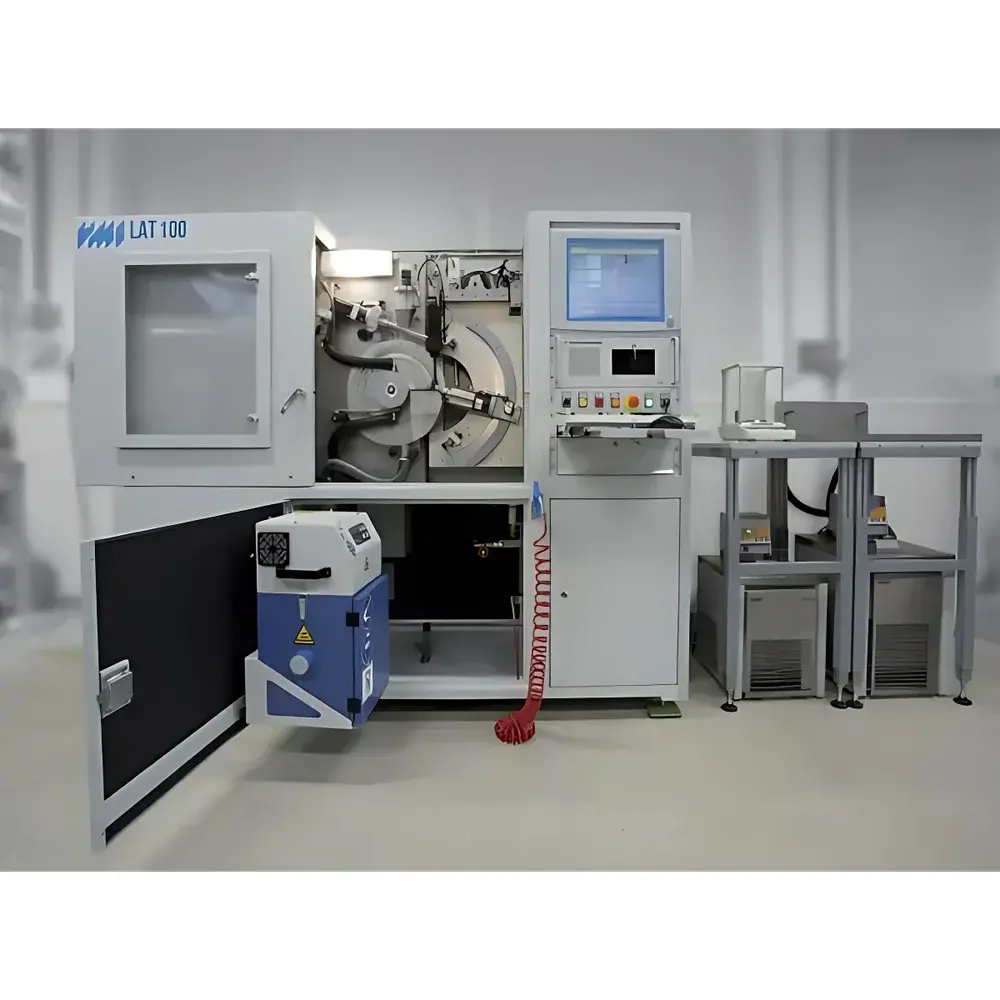
VMI LAT-100 Laboratory Abrasion and Wet-Skidding Tester
| Brand | VMI |
|---|---|
| Origin | Netherlands |
| Model | LAT-100 |
| Instrument Type | Multi-Functional Tribological Tester |
| Normal Load Range (Fz) | 10–140 N |
| Lateral Force Range (Fy) | −120 to +120 N |
| Friction Force Range (Fx) | 5–100 N |
| Speed Range (Low) | 0.002–2 km/h |
| Speed Range (High) | 2–100 km/h |
| Slip Angle Range | −45° to +45° |
| Mass Measurement Range | 220 g |
| Surface Temperature Range | −18°C to +150°C |
| Water Temperature Range | 1°C to 80°C |
| Cryo Temperature Range (with optional Kryo module) | −30°C to +80°C |
| Abrasion Disc Diameter | 350 mm |
| Abrasion Disc Thickness | 25 mm |
| Disc Materials | Al₂O₃ (EKW 60, EKW 180), SGG Glass |
| Dual-Sided Discs | Yes |
Overview
The VMI LAT-100 Laboratory Abrasion and Wet-Skidding Tester is an engineered tribological platform designed to replicate real-world road–tire interaction under controlled, repeatable laboratory conditions. It operates on the principle of controlled slip-roll contact between a rotating abrasion disc and a loaded, rotating test wheel—mimicking the kinematics of tire tread deformation, energy dissipation, and surface interaction during dry, wet, or contaminated pavement contact. Unlike empirical wear testers, the LAT-100 quantifies three orthogonal force components (normal Fz, lateral Fy, and longitudinal friction Fx) simultaneously while enabling independent variation of slip angle, velocity, normal load, surface texture, and thermal boundary conditions. This multi-axis force resolution supports ISO 23233:2009 compliance for rubber compound abrasion testing and extends into dynamic friction characterization relevant to wet grip, rolling resistance, and viscoelastic hysteresis modeling.
Key Features
- Triaxial force transducer system with calibrated ranges: Fz = 10–140 N, Fy = ±120 N, Fx = 5–100 N—enabling high-fidelity decomposition of contact mechanics under variable slip regimes.
- Programmable dual-speed drive: low-speed mode (0.002–2 km/h) for quasi-static viscoelastic evaluation; high-speed mode (2–100 km/h) for dynamic friction and thermal buildup studies.
- Adjustable slip angle from −45° to +45°, mechanically set and digitally recorded—critical for mapping the transition between elastic shear response (low-angle lateral stiffness) and adhesive/plowing-dominated friction (high-angle regime).
- Integrated environmental control: water spray system with closed-loop filtration and temperature-regulated reservoir (1–80°C); optional cryogenic module (−30°C to +80°C) for sub-zero surface temperature testing using thermally stabilized discs.
- Clean-abrasion architecture: MgO particle dosing system maintains consistent abrasive surface cleanliness; dust extraction directs particulate away from the measurement zone and operator workspace—ensuring long-term sensor integrity and GLP-compliant operation.
- Infrared surface temperature monitoring of the test wheel tread in real time—correlating thermal history with instantaneous friction coefficient decay and compound-specific glass transition effects.
- Industrial PC-based automation: fully scripted test sequences including load ramping, speed profiling, slip angle stepping, and data logging—all synchronized with external analytical balance readings (220 g capacity, RS-232/USB interface).
Sample Compatibility & Compliance
The LAT-100 accepts standard cured rubber test wheels (typically 76 mm diameter × 12.7 mm width, per ISO 23233). It accommodates both solid and segmented tread geometries and supports comparative evaluation across compound families—including silica-reinforced, carbon-black-filled, and novel bio-based elastomers. The system is validated for ISO 23233:2009 (determination of abrasion resistance of rubber compounds), and its force-resolution architecture aligns with ASTM D5963 (abrasion resistance of rubber) and ISO 4649 (rubber—determination of abrasion resistance). Optional configurations support traceable calibration per ISO/IEC 17025 requirements, and audit-ready data export includes timestamped raw force traces, environmental metadata, and user-defined test parameters—fully compatible with FDA 21 CFR Part 11–compliant electronic record workflows when integrated with validated LIMS environments.
Software & Data Management
VMI’s proprietary LAT Control Suite runs on Windows-based industrial PCs and provides intuitive test configuration via parameter input forms (load, speed, slip angle, duration, water flow rate). All measurements are acquired at ≥1 kHz sampling rate and stored in HDF5 format—preserving hierarchical metadata (sensor IDs, calibration coefficients, environmental setpoints). Export options include CSV (for Excel/Python analysis), MATLAB .mat, and XML-based reports compliant with internal QA documentation standards. Built-in statistical post-processing calculates mean friction coefficient (μ = Fx/Fz), lateral stiffness (dFy/dα), wear volume (via pre/post mass delta × density), and thermal decay curves. Audit trails log all user actions, parameter changes, and calibration events—supporting GLP/GMP validation protocols and regulatory inspections.
Applications
- Formulation screening of tread compounds for wet grip performance (ISO 23233 Annex B correlation)
- Rolling resistance optimization through viscoelastic loss tangent (tan δ) mapping across temperature–frequency domains
- Quantification of filler–polymer interaction effects on hysteresis and surface adhesion
- Validation of predictive tire models (e.g., Magic Formula derivatives) using empirical Fx, Fy, and Mz datasets
- Accelerated aging studies combining thermal cycling, humidity exposure, and mechanical fatigue
- Regulatory submission support for UNECE R117 (wet grip classification) and EU Tire Labeling Regulation (EC) No 1222/2009
FAQ
Does the LAT-100 comply with ISO 23233:2009 for abrasion testing?
Yes—the LAT-100 implements all mandatory mechanical and procedural requirements defined in Clause 6 and Annex A of ISO 23233:2009, including disc geometry, load application method, and wear path definition.
Can wet-surface friction be measured without abrasive wear occurring?
Yes—by disabling the abrasive disc rotation and activating the filtered water spray system, the LAT-100 performs pure hydrodynamic friction measurements on static or rotating surfaces under controlled water film thickness.
Is calibration traceable to national metrology institutes?
Force transducers are supplied with DAkkS-accredited calibration certificates (traceable to PTB); temperature sensors are certified to DIN EN ISO/IEC 17025 standards upon installation.
What abrasive disc options are included as standard equipment?
The system ships with three dual-sided discs: EKW 60 (Al₂O₃, sharp, 60 grit), EKW 180 (Al₂O₃, blunt, 180 grit), and SGG (float glass)—all 350 mm diameter × 25 mm thick.
How is test wheel temperature monitored during high-speed runs?
A non-contact infrared pyrometer (spectral range 8–14 µm) continuously measures tread surface temperature at up to 100 Hz, with emissivity compensation applied per compound type.



