
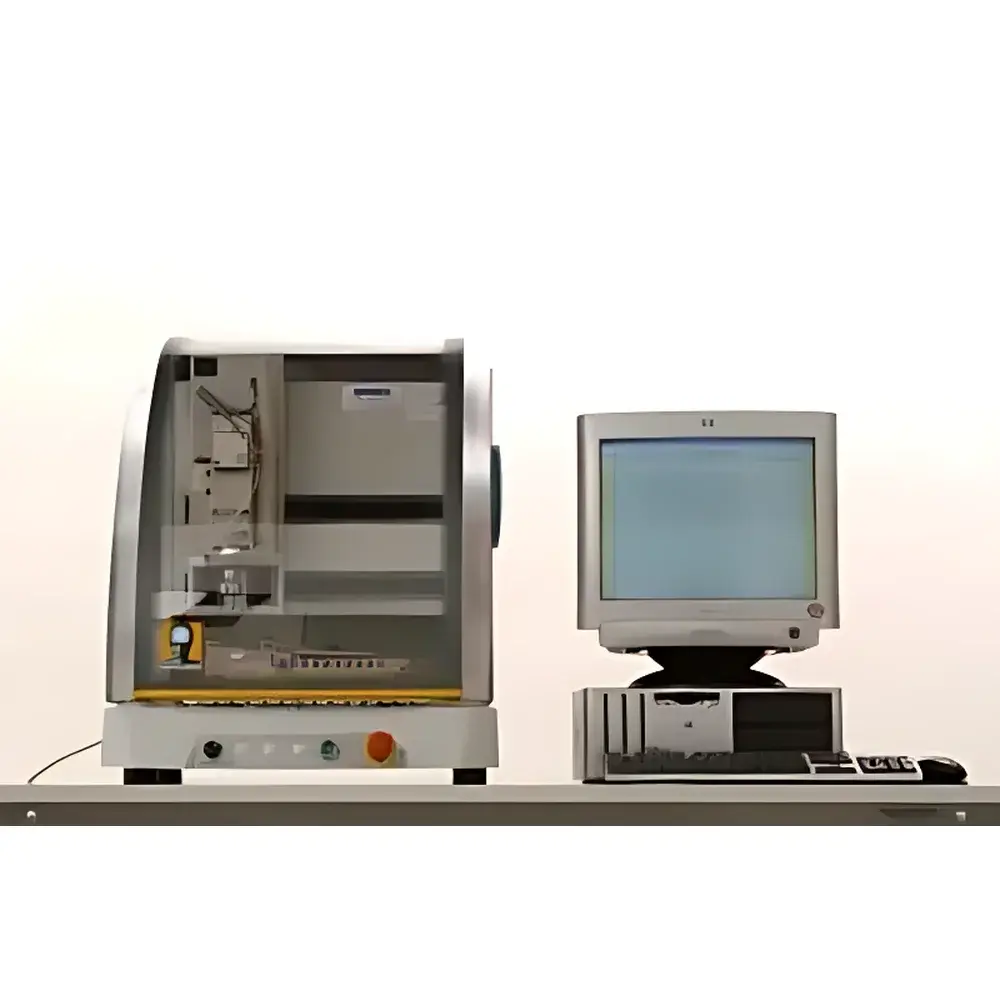
KARG C4U / C2U CNC Profiling Milling Sample Preparation System
| Brand | KARG |
|---|---|
| Origin | Germany |
| Model | C4U / C2U |
| Type | Precision CNC Milling Cutter for Specimen Preparation |
| Axes | 3-axis (X, Y, Z) with T-slot milling table |
| Worktable Dimensions | Standard large-format T-slot surface (compatible with ISO/ASTM fixture systems) |
| Fixturing | Quick-release clamping system for plates, semi-finished components, pipes, and notched specimens |
| Control | Microprocessor-based CNC controller with integrated CAD/CAM software interface |
| Compliance | Designed to support ISO 178, ISO 527, ASTM D638, ASTM D256, and EN ISO 13477 specimen geometry requirements |
Overview
The KARG C4U and C2U CNC Profiling Milling Sample Preparation Systems are high-precision, microprocessor-controlled milling platforms engineered for the reproducible fabrication of standardized and custom test specimens in materials science, polymer testing, composites R&D, and quality control laboratories. Unlike conventional saw-based or manual cutting equipment, these systems employ controlled 3-axis (X, Y, Z) end-milling kinematics—based on proven Couette-type toolpath generation—to remove material with sub-millimeter positional accuracy and surface finish consistency critical for mechanical property validation. The machines are purpose-built to produce specimens compliant with international standards including ISO 178 (flexural testing), ISO 527 (tensile testing), ASTM D638 (plastic tensile properties), ASTM D256 (impact testing), and EN ISO 13477 (notched specimen preparation). Their rigid cast-iron frame, precision-ground T-slot worktable, and thermally stable servo-driven axes ensure long-term dimensional repeatability across batched sample sets—essential for GLP-compliant testing environments and inter-laboratory comparison studies.
Key Features
- 3-axis CNC motion architecture with backlash-compensated ball screws and optical encoder feedback for ±0.02 mm positional accuracy over full travel range
- Large-format T-slot milling table (standard dimensions: 600 × 400 mm for C4U; 400 × 300 mm for C2U) enabling simultaneous fixturing of multiple blanks or irregularly shaped substrates
- Dedicated quick-release clamping system—including modular vise jaws, pipe supports, and notch-specific fixtures—for rapid reconfiguration between ISO 179 Charpy bars, ASTM D638 Type I dogbones, and custom geometries
- Integrated CAD/CAM software suite supporting DXF import, parametric feature definition (e.g., notch depth, radius, taper angle), and G-code simulation with collision detection
- Tool library management with automatic spindle speed/feed rate optimization based on material class (thermoplastics, thermosets, fiber-reinforced composites, metals up to HB 250)
- IP54-rated enclosure with interlocked safety door, emergency stop circuitry, and dust extraction port compatible with central lab ventilation systems
Sample Compatibility & Compliance
The C4U/C2U systems accommodate a broad spectrum of raw stock forms: flat sheets (0.5–50 mm thick), extruded profiles, molded plaques, tubular sections (OD 10–120 mm), and machined billets. Specimen output includes—but is not limited to—ISO 178 flexural bars (80 × 10 × 4 mm), ASTM D256 Izod/Charpy notched bars (63.5 × 12.7 × 3.2 mm), ASTM D638 Type I–V tensile coupons, and EN ISO 13477 single-edge notched tension (SENT) specimens. All machining parameters (cutting speed, feed per tooth, depth of cut) are traceable and auditable, supporting compliance with ISO/IEC 17025 accreditation requirements. The system’s deterministic toolpath execution eliminates operator-dependent variability—critical for labs undergoing FDA 21 CFR Part 11 or EU Annex 11 assessments where process validation and electronic record integrity are mandated.
Software & Data Management
Operation is managed via an embedded industrial PC running real-time Linux-based CNC firmware. The included CAD/CAM module (licensed for perpetual use) provides dual-mode operation: 2D contour milling for standard geometries and 3D surface profiling for complex features such as radiused transitions or multi-level notches. Each milling job generates a structured XML log containing timestamp, tool ID, spindle RPM, feed rate, total cycle time, and deviation metrics against nominal geometry. Logs are exportable in CSV or PDF formats and integrate natively with LIMS platforms via OPC UA or RESTful API endpoints. Audit trails retain full revision history for program edits, satisfying ALCOA+ data integrity principles (Attributable, Legible, Contemporaneous, Original, Accurate, Complete, Consistent, Enduring, Available).
Applications
- Polymer and composite laboratories preparing specimens for mechanical testing per ISO, ASTM, and DIN standards
- Automotive and aerospace suppliers validating batch-to-batch consistency of structural resins and laminates
- Contract testing facilities requiring documented, repeatable specimen fabrication for client reporting
- Academic research groups fabricating custom geometries for fracture mechanics, fatigue, or creep studies
- Quality assurance departments performing incoming material verification against specification-defined dimensions and edge quality
FAQ
Does the system support automated tool changing?
No—the C4U and C2U models utilize fixed-tool configurations optimized for specific material families; manual tool change is required between dissimilar machining tasks.
Can it mill metallic specimens?
Yes—when equipped with carbide end mills and appropriate feeds/speeds, the system processes non-ferrous metals and hardened plastics up to Brinell hardness 250 HB.
Is remote monitoring or network integration available?
Standard Ethernet connectivity enables remote diagnostics, firmware updates, and log retrieval; optional OPC UA server license enables seamless integration into plant-wide MES or SCADA infrastructure.
What documentation is provided for IQ/OQ validation?
KARG supplies a complete qualification package including Factory Acceptance Test (FAT) report, installation checklist, operational qualification protocols, and blank performance verification templates aligned with ISO 17025 Annex A.2.
Are spare parts and service support available outside Germany?
Yes—global distributor network ensures 72-hour delivery of critical spares; certified field service engineers are deployed within 5 business days for on-site calibration and maintenance under extended warranty contracts.



