
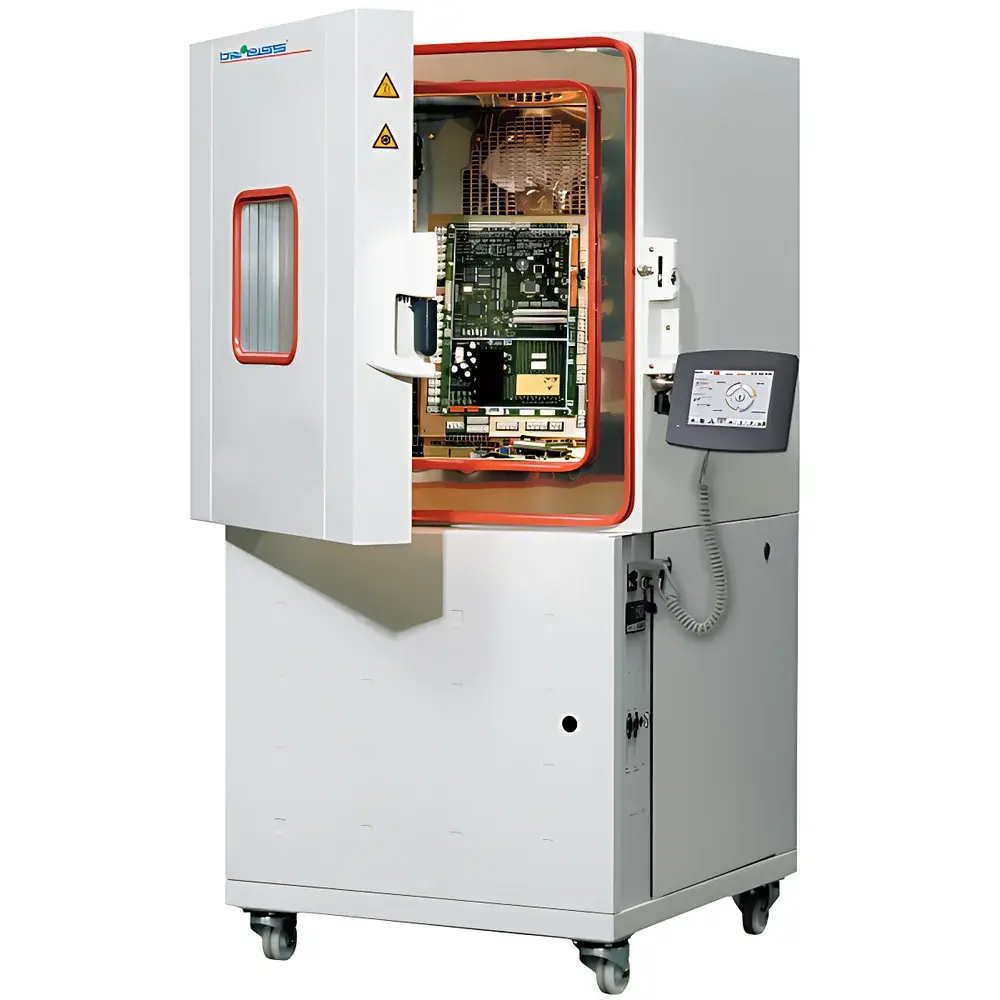
Bareiss DT Chamber Temperature-Controlled Hardness Testing System
| Brand | Bareiss |
|---|---|
| Origin | Germany |
| Model | DT Chamber |
| Temperature Range | -70 °C to +180 °C (customizable) |
| Hardness Scales | Shore A, Shore D, IRHD |
| Sample Capacity | Up to 25 specimens (customizable) |
| Test Modes | Single-point, continuous, programmable, hysteresis recovery (IRHD) |
| Instrument Type | Shore / IRHD Hardness Tester |
Overview
The Bareiss DT Chamber Temperature-Controlled Hardness Testing System is an engineered solution for precision elastomer characterization under thermally regulated conditions. Unlike conventional hardness testers operating at ambient temperature only, the DT Chamber integrates a high-stability environmental chamber with a calibrated Shore and International Rubber Hardness Degree (IRHD) testing module—enabling direct correlation between thermal state and mechanical response. The system operates on the fundamental principle of indentation depth measurement under standardized static load application (per ISO 7619-1, ISO 48-4, ASTM D2240, and DIN 53505), where indenter geometry, force profile, and dwell time are rigorously controlled. This architecture ensures traceable, reproducible hardness values across wide thermal gradients—from cryogenic (-70 °C) to elevated (+180 °C) regimes—critical for validating material behavior in automotive sealing systems, aerospace elastomeric components, medical device gaskets, and industrial hose formulations.
Key Features
- Integrated dual-function design: simultaneous temperature conditioning and hardness measurement within a single, sealed chamber—eliminating thermal lag and specimen handling errors.
- Programmable temperature ramping and stabilization with ±0.5 °C uniformity across the test zone (verified per IEC 60068-3-5).
- Automated indenter positioning and force application compliant with Shore A/D and IRHD N/M methods; load accuracy certified to ±0.5 % of full scale.
- Modular sample holder accommodating up to 25 specimens (standard); configurable for custom geometries including O-rings, sheets, molded parts, and extrusions.
- Full test sequence automation: pre-conditioning → temperature equilibration → hardness measurement → hysteresis recovery (IRHD) → data logging—all executable via embedded controller or external PC interface.
- Robust stainless-steel chamber construction with double-wall insulation, inert gas purge option (N₂), and condensation management for low-temperature operation.
Sample Compatibility & Compliance
The DT Chamber supports a broad range of elastomeric and thermoplastic materials—including natural rubber (NR), nitrile butadiene rubber (NBR), silicone (VMQ), fluoroelastomers (FKM), thermoplastic elastomers (TPE), and polyurethanes (TPU). Specimen thickness requirements align with ISO 48-4 (minimum 6 mm for IRHD, 4 mm for Shore) and ASTM D2240 (minimum 6.4 mm). All hardness measurements adhere to international standards for instrument calibration, operator training, and environmental control—ensuring audit readiness for GLP, GMP, and ISO/IEC 17025-accredited laboratories. Optional traceable calibration certificates (DAkkS or UKAS) are available for both hardness module and temperature sensor subsystems.
Software & Data Management
The system is operated via Bareiss’ proprietary WinHardness software (Windows-based), supporting multi-user access control, electronic signatures, and full 21 CFR Part 11 compliance—including audit trails, data integrity checks, and immutable raw-data archiving. Test protocols are fully parameterized: temperature setpoints, dwell times, indenter type, load magnitude, cycle count, and pass/fail thresholds can be saved as reusable templates. Export formats include CSV, PDF reports (with embedded metadata), and XML for LIMS integration. Real-time graphing displays hardness vs. temperature curves, hysteresis loops, and time-dependent relaxation profiles—enabling quantitative analysis of viscoelastic transitions (e.g., glass transition onset, crosslink density effects).
Applications
- Development and validation of low-temperature seal performance in automotive door modules and EV battery enclosures.
- Quality assurance of medical-grade silicone tubing subjected to sterilization-cycle thermal stress.
- Material screening for aerospace O-rings operating in stratospheric or re-entry thermal environments.
- Correlation of Shore hardness drift with aging studies (heat aging per ASTM D573, compression set per ISO 815).
- Research into polymer nanocomposite reinforcement efficiency across thermal domains.
- Supporting regulatory submissions requiring temperature-dependent mechanical property documentation (e.g., FDA 510(k), EU MDR Annex I).
FAQ
Does the DT Chamber support both Shore and IRHD measurements in the same test run?
Yes—switching between Shore A/D and IRHD modes is software-configurable without hardware modification; indenter exchange is tool-free and validated per ISO 48-4 Annex B.
Can the system perform automated hysteresis testing (IRHD-M) across temperature steps?
Yes—the WinHardness software enables multi-step temperature sweeps with sequential loading/unloading cycles at each setpoint, generating full hysteresis loops with energy loss quantification.
Is third-party calibration documentation available for regulatory audits?
Yes—DAkkS-accredited calibration certificates for hardness transducers and PT100 temperature sensors are provided upon request, with documented uncertainty budgets per ISO/IEC 17025.
What safety certifications does the chamber hold?
The DT Chamber complies with CE marking requirements (2014/30/EU EMC Directive, 2014/35/EU Low Voltage Directive) and meets UL 61010-1 for laboratory equipment safety.
Can the sample tray be customized for non-standard part geometries?
Yes—Bareiss offers OEM engineering services for bespoke fixtures, including vacuum-assisted clamping, rotational indexing, and in-situ dimensional monitoring integration.



