
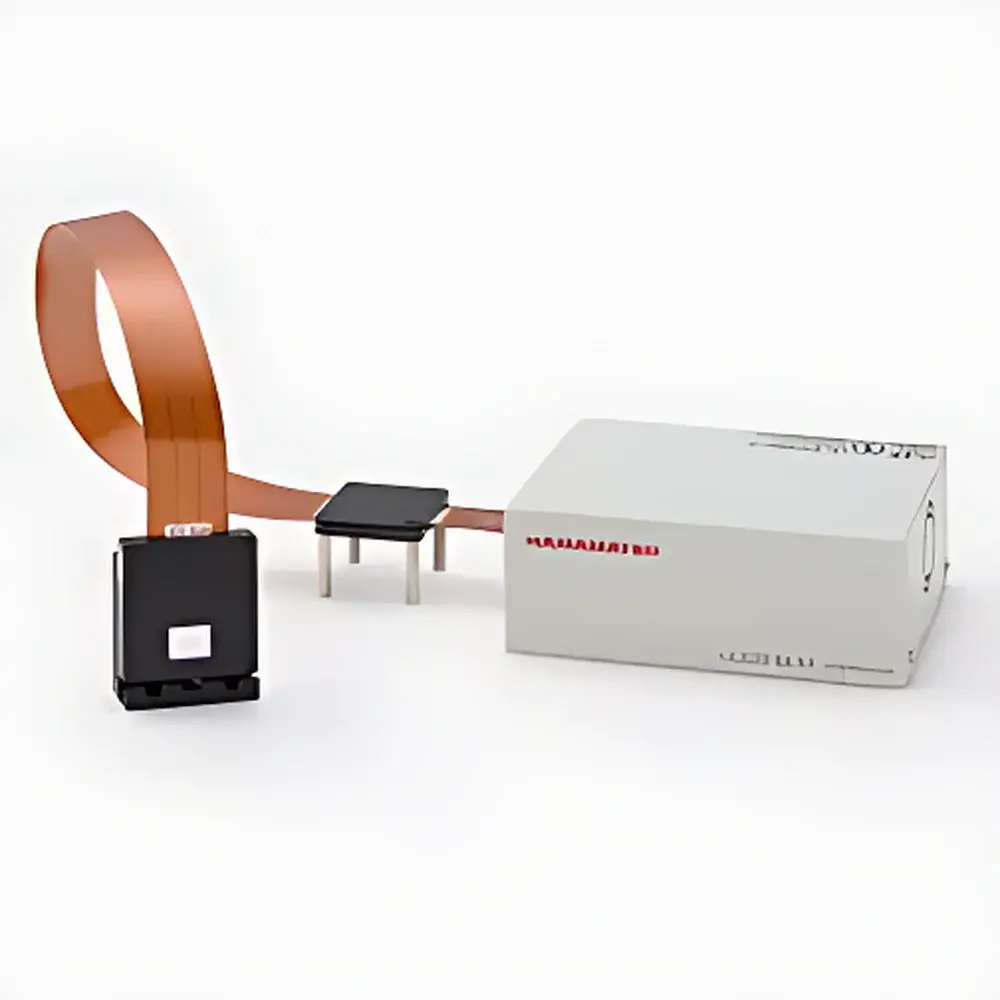
Hamamatsu LCOS-SLM X15213-01 Reflective Pure-Phase Spatial Light Modulator
| Brand | Hamamatsu |
|---|---|
| Origin | Japan |
| Manufacturer Type | Original Equipment Manufacturer (OEM) |
| Import Status | Imported |
| Model | X15213-01 |
| Pricing | Upon Request |
| Pixel Pitch | 12.5 µm |
| Active Area | 15.9 × 12.8 mm |
| Resolution | 1272 × 1024 pixels (SXGA) |
| DVI Interface | DVI-D |
| USB Interface | USB-B 2.0 High-Speed |
| DVI Frame Rate | 60 Hz |
| Input Gray Levels | 256 (8-bit) |
| Fill Factor | 96% |
| Rise Time | 5 ms |
| Fall Time | 25 ms |
| Operating Wavelength Range | 400–700 nm |
| Optical Efficiency (at λ = 633 nm) | 79% |
| Maximum Spatial Frequency | 40 lp/mm |
Overview
The Hamamatsu LCOS-SLM X15213-01 is a high-performance reflective pure-phase spatial light modulator engineered for precision wavefront shaping in advanced optical systems. Based on silicon-on-silicon liquid crystal on silicon (LCOS) technology, this device enables pixel-level voltage-controlled phase modulation of incident light without amplitude interference—critical for applications demanding high-fidelity beam steering, holographic projection, adaptive optics, and quantum optics experiments. Unlike transmissive SLMs, its reflective architecture minimizes thermal load and supports higher average optical power handling. The X15213-01 operates across the visible spectrum (400–700 nm), with optimized optical efficiency of 79% measured at 633 nm, achieved through rigorous suppression of diffraction artifacts via proprietary pixel layout design and high fill factor (96%). Its monolithic LCOS chip integrates direct-drive electrodes and low-voltage addressing circuitry, enabling linear, repeatable phase response over the full 0–2π range with minimal hysteresis or temporal drift.
Key Features
- Reflective pure-phase modulation architecture—eliminates unwanted intensity modulation and preserves input beam polarization fidelity
- High-resolution SXGA active array (1272 × 1024 pixels) with 12.5 µm pitch and 15.9 × 12.8 mm effective aperture
- Optimized optical throughput: 79% system-level light utilization at 633 nm, validated under collimated illumination and standard alignment conditions
- Dual-interface control: native DVI-D video input for real-time phase pattern streaming at 60 Hz frame rate, plus USB-B 2.0 for firmware updates and calibration data exchange
- Fast electro-optic response: 5 ms rise time and 25 ms fall time enable dynamic phase correction in closed-loop adaptive optics systems
- Factory-calibrated nonlinearity compensation: built-in controller applies per-pixel look-up tables to correct LC birefringence dispersion and wavefront distortion
- Robust thermal management: aluminum housing with passive conduction path ensures stable operation under continuous-wave illumination up to 2 W/cm² (unfocused, CW, 532 nm)
Sample Compatibility & Compliance
The X15213-01 is compatible with standard optical benches and modular laser systems operating in the visible band. Its reflective geometry supports integration into folded-path interferometers, Shack-Hartmann wavefront sensors, and multi-plane light conversion (MPLC) setups. The device complies with IEC 61000-6-3 (EMC emission standards) and IEC 61000-6-2 (immunity requirements) for laboratory environments. While not certified for medical or aerospace use, its design adheres to ISO 10110-7 surface quality specifications for optical components and meets mechanical stability criteria defined in ANSI Z80.10 for optical instrumentation. Calibration data—including phase-response curves, pixel uniformity maps, and temperature-dependent drift coefficients—is provided in machine-readable HDF5 format, supporting traceability in GLP-compliant research workflows.
Software & Data Management
Hamamatsu provides the SLM Control Suite—a platform-independent application programming interface (API) supporting Windows, Linux, and macOS. The API exposes low-level register access for custom phase encoding, real-time gamma correction, and synchronized trigger I/O (TTL-compatible). All phase patterns are loaded as 8-bit grayscale bitmaps conforming to DVI-SXGA timing standards; no proprietary image format is required. Audit logs record timestamped configuration changes, firmware version, and thermal sensor readings—enabling full reproducibility per ALR (Audit-Ready) documentation guidelines. Export functions support CSV and FITS formats for post-acquisition analysis in MATLAB, Python (NumPy/SciPy), or LabVIEW environments. The system does not implement FDA 21 CFR Part 11 electronic signature functionality, as it is intended for R&D—not regulated manufacturing or clinical use.
Applications
- Dynamic holography and computer-generated hologram (CGH) projection for optical trapping and micromanipulation
- Wavefront correction in astronomical adaptive optics and ophthalmic aberrometry systems
- Beam shaping for ultrafast laser pulse compression and spectral phase modulation
- Quantum information processing: spatial mode sorting, orbital angular momentum (OAM) state generation, and entanglement engineering
- Structured illumination microscopy (SIM) and programmable point-spread function (PSF) engineering
- Education and prototyping: undergraduate and graduate optics laboratories requiring accessible, PC-controllable SLM platforms
FAQ
Is the X15213-01 suitable for pulsed laser applications?
Yes—its reflective LCOS architecture supports nanosecond-scale pulses at repetition rates up to 1 kHz when operated within specified fluence limits (≤ 0.5 J/cm² at 1064 nm, 10 ns FWHM). Thermal lensing effects are negligible under these conditions.
Can multiple X15213-01 units be synchronized?
Yes—external trigger input (SMA, TTL-compatible) allows hardware-level frame synchronization across up to four units with sub-millisecond jitter, enabling multi-SLM interferometric configurations.
Does Hamamatsu provide phase calibration data for custom wavelengths?
Yes—upon request, users may receive wavelength-specific phase-response LUTs derived from interferometric measurement at user-specified λ values (400–700 nm, ±1 nm resolution).
What is the recommended optical alignment procedure?
A 4f telescope configuration with f = 200 mm achromats is advised for optimal diffraction-limited performance; alignment tolerances: < ±0.3° tip/tilt and < ±50 µm lateral offset relative to SLM center.
Is third-party software integration supported?
Yes—the documented C/C++ and Python bindings allow integration with open-source frameworks such as PySLM, HOLOPLOT, and the Adaptive Optics Toolbox (AOTbx).





