
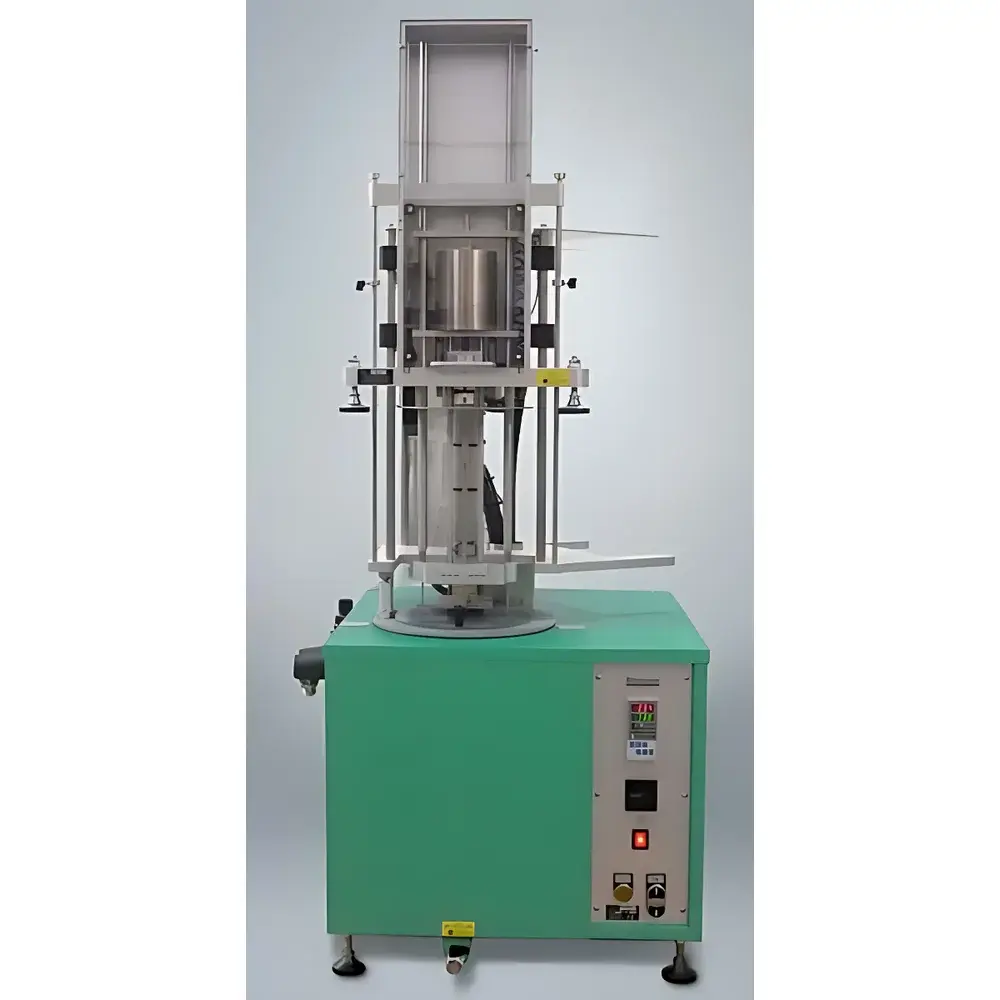
Elastocon ET 05II Low-Temperature Brittleness Tester
| Brand | Elastocon |
|---|---|
| Origin | Sweden |
| Model | ET 05II |
| Compliance Standards | ISO 812, ISO 974, ASTM D746, ASTM D2137 |
| Operating Pressure | 6 bar compressed air required |
| Test Principle | Instrumented drop-weight impact with controlled thermal conditioning |
| Temperature Control | Computer-regulated cryogenic chamber (–70 °C to +50 °C typical range) |
| Impact Velocity Measurement | High-speed optical sensor with pre- and post-impact velocity verification |
| Energy Delivery | Adjustable via drop height and calibrated hammer mass |
| Software | Windows-based control & analysis suite with audit trail and report generation |
Overview
The Elastocon ET 05II Low-Temperature Brittleness Tester is an instrumented, computer-controlled drop-weight impact system engineered for precise determination of the brittle-to-ductile transition temperature (BDTT) of elastomeric, polymeric, and thermoplastic materials under standardized cryogenic conditions. It operates on the principle of controlled-energy impact testing, where a calibrated hammer is elevated to a defined height and released onto a conditioned specimen mounted in a thermally stabilized test chamber. The system measures both the initiation of fracture and the energy absorption characteristics at sub-ambient temperatures—critical parameters for validating material performance in cold environments such as automotive sealing systems, aerospace gaskets, cryogenic piping insulation, and medical device components. Unlike manual or semi-automated alternatives, the ET 05II integrates real-time velocity monitoring before and after impact, enabling quantification of kinetic energy loss and correlation with material failure mode (e.g., brittle cleavage vs. ductile yielding). Its architecture complies with the mechanical and thermal requirements specified in ISO 812 (rubber—determination of low-temperature brittleness), ISO 974 (plastics—determination of brittleness temperature by impact), ASTM D746 (standard test method for brittleness temperature of plastics and elastomers), and ASTM D2137 (standard test methods for rubber property—brittleness point of vulcanized rubber).
Key Features
- Computer-controlled cryogenic chamber with programmable temperature ramping (–70 °C to +50 °C, ±0.5 °C stability) and integrated Pt100 sensor feedback
- Instrumented drop-weight mechanism with pneumatically actuated cylinder lift (6 bar compressed air supply required) and adjustable drop height for precise energy calibration
- High-resolution optical velocity measurement system capturing pre-impact and post-impact hammer speed to calculate energy dissipation
- Automated pass/fail evaluation per standard criteria: absence of cracks or splits observed under 2× magnification after impact at specified temperature
- Modular specimen holder accommodating standard dumbbell, strip, or cylindrical geometries per ISO/ASTM specimen dimensions
- Robust mechanical frame with vibration-dampened base and safety interlock system compliant with EN ISO 13857
Sample Compatibility & Compliance
The ET 05II accommodates a broad range of flexible polymeric materials including natural and synthetic rubbers (NR, SBR, EPDM, NBR), thermoplastic elastomers (TPEs), PVC compounds, silicone elastomers, and fluoropolymers. Specimens must conform to dimensional tolerances defined in ISO 812 (30 × 25 × 2 mm strips), ISO 974 (10 × 10 × 2 mm cubes), or ASTM D746 (63.5 × 12.7 × 3.2 mm bars). All test protocols are fully traceable to international standards and support GLP/GMP documentation workflows. Data integrity is maintained through time-stamped test logs, user authentication, and electronic signatures—enabling compliance with FDA 21 CFR Part 11 when configured with validated software modules.
Software & Data Management
The included Windows-based control software provides full sequence automation: thermal equilibration, specimen loading confirmation, impact execution, velocity capture, visual inspection prompting, and result classification. Each test record stores raw sensor data (temperature vs. time, velocity waveform), operator ID, environmental conditions, and digital image capture (optional camera integration). Reports are exportable in PDF and CSV formats, with configurable templates aligned to laboratory quality management systems (QMS). Audit trails log all parameter modifications, user actions, and system events—supporting internal audits and regulatory inspections per ISO/IEC 17025 requirements.
Applications
- Validation of low-temperature service limits for automotive weatherstrips and fluid hoses
- Quality control of rubber compounds during compounding and vulcanization
- Comparative assessment of plasticizer efficiency in PVC formulations
- Development testing of cold-resistant medical tubing and syringe plungers
- Failure analysis of polymer seals exposed to arctic or refrigerated storage conditions
- Regulatory submission support for ISO 10993-1 biocompatibility assessments requiring thermal stability data
FAQ
What compressed air specifications are required for operation?
A clean, dry, oil-free compressed air supply at 6 bar (±0.2 bar) is mandatory for pneumatic actuation of the lifting cylinder. A dedicated filter-regulator-lubricator (FRL) unit is recommended.
Can the ET 05II be used for non-standard specimen geometries?
Yes—custom fixtures can be designed and validated for non-standard shapes, provided thermal uniformity and impact alignment are verified per ISO/IEC 17025 method validation guidelines.
Is temperature calibration traceable to national standards?
The integrated Pt100 sensor is factory-calibrated against NIST-traceable references; users may perform periodic verification using certified reference thermometers per ISO/IEC 17025 clause 6.6.
Does the system support multi-step thermal cycling protocols?
While the primary function is single-point brittleness temperature determination, sequential tests across a temperature gradient (e.g., –40 °C → –35 °C → –30 °C) can be programmed and executed with automated reporting.
How is impact energy calibrated and verified?
Energy is calculated from hammer mass and drop height per ASTM E23 definitions; calibration certificates for mass and height gauges are supplied, and periodic verification follows ISO 17025 Annex A.2 procedures.



