
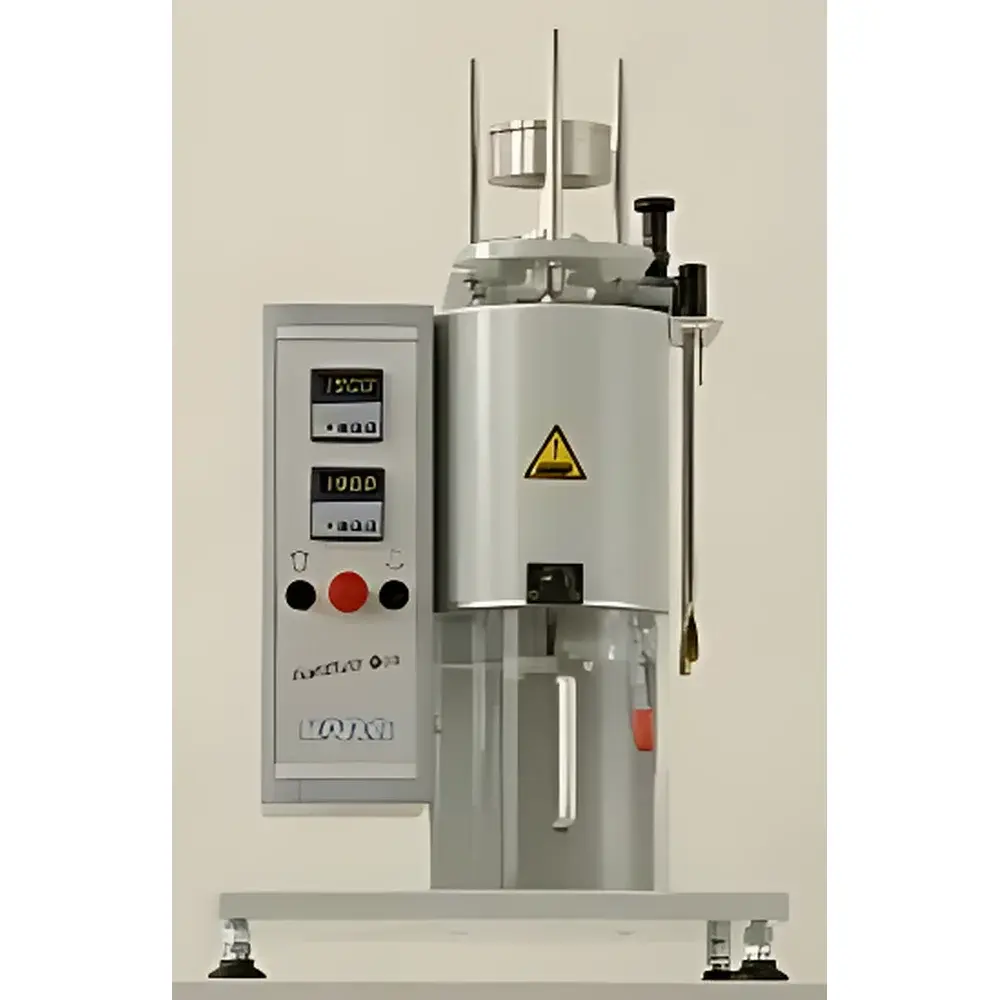
Kaige MeltFloW Series Melt Flow Indexer
| Brand | Kaige |
|---|---|
| Origin | Germany |
| Model | MeltFloW |
| Temperature Range | Up to 400 °C (optional 450 °C) |
| Load Capacity | Up to 21.6 kg |
| Compliance | DIN EN ISO 1133, ASTM D 1238, BS 2782 Method A |
| Output Unit | g/10 min |
| Control System | Microprocessor-based PID temperature controller |
| Optional Features | Inert gas purge, pneumatic nozzle cleaning, mechanical piston lift, linear column displacement sensor (50-point resolution), k-BASA/k-BASE software suite |
Overview
The Kaige MeltFloW Series Melt Flow Indexer is a precision-engineered instrument designed for the quantitative determination of melt mass-flow rate (MFR) and, in advanced configurations, melt volume-flow rate (MVR) of thermoplastic polymers under standardized load and temperature conditions. Based on the fundamental principle of extrusion plastometry—where molten polymer is forced through a standardized die under controlled gravitational or mechanically assisted load—the MeltFloW system delivers high reproducibility and long-term thermal stability essential for quality assurance, process validation, and R&D applications. Its core measurement methodology aligns strictly with internationally recognized test standards including DIN EN ISO 1133-1 & -2, ASTM D1238 (Condition E and F), and BS 2782 Part 1 Method A. The instrument operates by heating a pre-weighed polymer sample in a cylindrical barrel to a specified temperature (ranging from ambient up to 400 °C, extendable to 450 °C upon request), applying a defined dead weight to the piston, and measuring the extrudate mass collected over a fixed time interval (typically 10 minutes). This yields the MFR value expressed in grams per 10 minutes (g/10 min), a critical rheological parameter correlated with molecular weight distribution and processability.
Key Features
- Thermally robust barrel assembly with ±0.2 °C temperature uniformity across the zone, enabled by a microprocessor-controlled PID heating system and high-efficiency insulation
- Modular architecture supporting field-upgradable configurations—from basic manual operation (MeltFloW Basic) to fully automated testing (MeltFloW @on Plus) with motorized piston lift, programmable auto-cutting, and real-time displacement monitoring
- High-load capacity piston system rated for standard test loads up to 21.6 kg (e.g., 5.0 kg, 10.0 kg, 21.6 kg per ISO 1133 Annex A), with precision-machined hardened steel components ensuring dimensional stability over thousands of cycles
- Integrated linear column sensor (50 data points per stroke) in @on variants enables MVR calculation and flow curve derivation, supporting advanced characterization beyond single-point MFR
- Optional inert gas purging (N₂ or Ar) minimizes oxidative degradation during high-temperature or extended-duration tests, particularly critical for polyolefins and engineering thermoplastics
- Ergonomic, corrosion-resistant stainless-steel housing with tool-free access to barrel, die, and piston for rapid cleaning and maintenance
Sample Compatibility & Compliance
The MeltFloW Series accommodates a broad spectrum of thermoplastic resins—including polyethylene (PE), polypropylene (PP), polycarbonate (PC), ABS, PET, PBT, and high-temperature polymers such as PEEK and PEI—provided they exhibit measurable melt flow within the operational load and temperature envelope. All configurations comply with the metrological and procedural requirements of ISO/IEC 17025-accredited laboratories when operated according to manufacturer-specified calibration and verification protocols. Test reports generated via k-BASA/k-BASE software include full audit trails compliant with FDA 21 CFR Part 11 (when configured with electronic signature and user role management), supporting GLP and GMP environments. Routine verification includes die dimension certification (±0.005 mm tolerance), temperature calibration traceable to NIST or DAkkS-certified references, and load verification using certified test weights.
Software & Data Management
The Kaige k-BASA (Basic Automated Software Application) and k-BASE (Advanced Statistical Environment) platforms provide comprehensive instrument control, data acquisition, and post-processing capabilities under Windows OS. k-BASA supports method-driven workflows for routine MFR testing, automatic timer synchronization with cutting events, and direct export to CSV or PDF. k-BASE extends functionality with statistical process control (SPC) charts, comparative analysis across material batches or processing conditions, outlier detection algorithms, and customizable report templates aligned with internal QA documentation or external regulatory submissions. Both packages enforce secure user authentication, timestamped test logs, and immutable raw data storage—enabling full traceability from raw extrudate mass entries to final certified MFR values.
Applications
- Raw material acceptance testing in polymer compounding and masterbatch production
- In-process monitoring of extrusion, injection molding, and blow molding parameters
- Stability assessment of recycled or regrind materials exposed to thermal history
- Correlation studies between MFR and mechanical properties (e.g., tensile strength, impact resistance)
- Development of new polymer grades requiring precise melt rheology profiling
- Educational demonstration of polymer melt behavior and standard test methodology in university polymer science laboratories
FAQ
What standards does the MeltFloW Series support?
DIN EN ISO 1133-1 (MFR), ISO 1133-2 (MVR), ASTM D1238 (Conditions E, F, G), BS 2782 Part 1 Method A, and JIS K 7210.
Can the instrument be upgraded after purchase?
Yes—modular design allows retrofitting of mechanical piston lift, auto-cutting units, linear displacement sensors, and inert gas modules without replacing the base unit.
Is temperature calibration traceable to national standards?
Yes—calibration certificates are provided with traceability to DAkkS-accredited laboratories or NIST-traceable reference thermometers.
What maintenance intervals are recommended?
Barrel and die cleaning after each test series; annual verification of temperature uniformity, die dimensions, and load accuracy per ISO 1133 Annex B.
Does the software support multi-user environments with role-based access?
k-BASE supports configurable user roles (Operator, Supervisor, Administrator), electronic signatures, and audit-log retention exceeding 10 years per FDA 21 CFR Part 11 requirements.





