
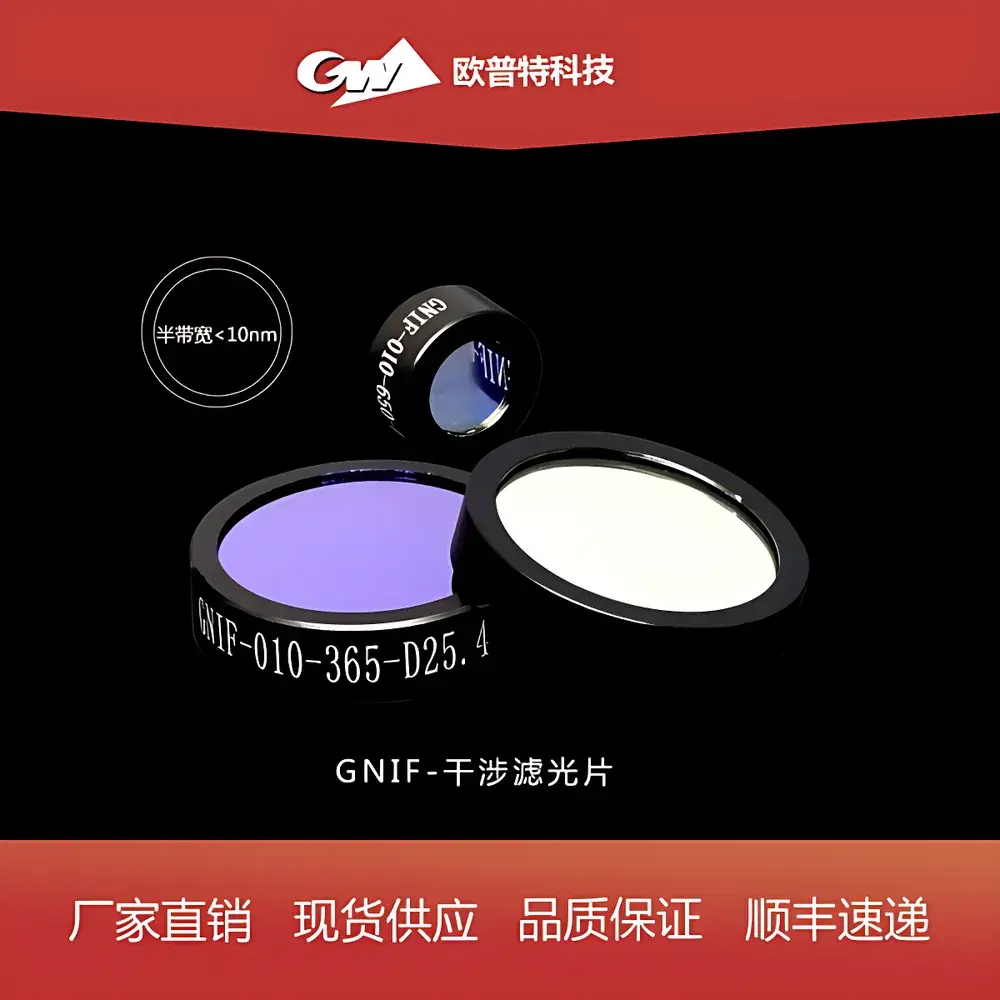
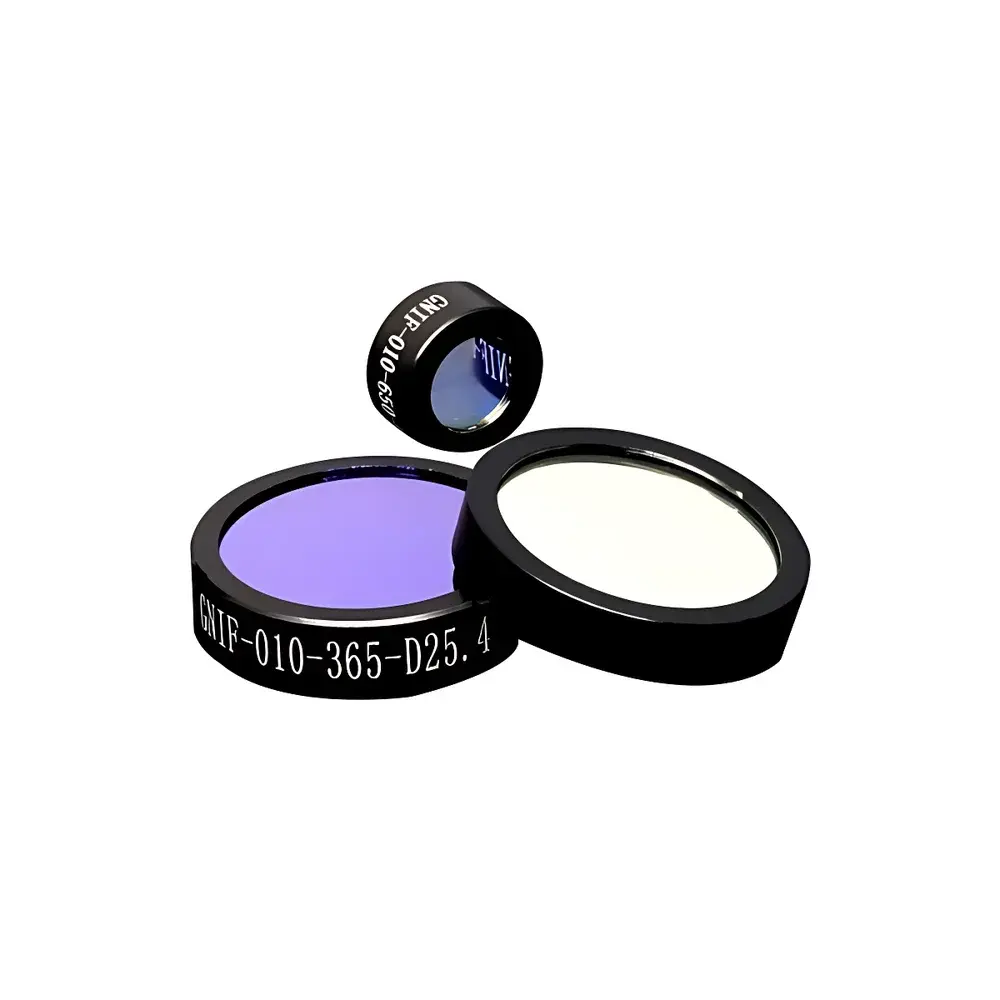
GNIF Interference Filter (FWHM < 10 nm)
| Origin | Beijing, China |
|---|---|
| Manufacturer Type | Authorized Distributor |
| Product Origin | Domestic (PRC) |
| Model | GNIF |
| Component Category | Optical Element |
| Available Diameters | 12.7 mm & 25.4 mm |
| Center Wavelength Tolerance | ±0.2 to ±2.0 nm |
| FWHM Tolerance | ±0.5 to ±2.0 nm |
| Peak Transmission | 30–40% |
| Substrate Material | Optical-grade fused silica or BK7 (standard) |
Overview
The GNIF Interference Filter is a precision optical bandpass filter engineered for high-spectral-selectivity applications in laser systems, fluorescence microscopy, spectroscopy, and optical sensing. Based on multi-layer dielectric thin-film interference technology, it delivers narrow spectral transmission windows with full width at half maximum (FWHM) strictly controlled below 10 nm—enabling effective isolation of specific atomic or molecular emission lines. Designed for integration into collimated beam paths, the filter exhibits steep edge roll-off, minimal out-of-band leakage (<0.1% OD4+ typical), and high environmental stability under standard laboratory conditions (20–25 °C, 40–60% RH). Its performance adheres to fundamental principles of constructive and destructive interference in quarter-wave stack architectures, ensuring reproducible spectral response across production batches.
Key Features
- Narrowband transmission with FWHM options of 1 nm and 3 nm, both specified with tight tolerances (±0.5 nm or ±0.7 nm for 1 nm variants; ±2.0 nm for 3 nm variants)
- Precise center wavelength (CWL) control: ±0.2 nm tolerance available for critical laser line isolation (e.g., 488 nm, 532 nm, 632.8 nm); ±2.0 nm tolerance offered for broader spectroscopic applications
- Peak transmittance ranging from 30% to 40%, optimized for signal-to-noise ratio in low-light detection scenarios
- Standard substrates: UV-grade fused silica (for deep-UV to NIR coverage) or BK7 optical glass (visible-range optimized), both polished to λ/10 surface flatness and λ/20 transmitted wavefront error
- Hard-coated, ion-assisted deposition (IAD) multilayer stacks ensure mechanical durability, humidity resistance, and long-term spectral stability per ISO 9211-4
- Two standard clear apertures: Ø12.7 mm (0.5″) and Ø25.4 mm (1.0″), each with laser-etched product identifiers for traceability (e.g., GNIF-001-532-D12)
Sample Compatibility & Compliance
The GNIF series is compatible with standard optomechanical mounts (SM1- and SM2-threaded lens tubes, kinematic filter holders) and integrates seamlessly into OEM optical engines and benchtop instrumentation. All filters are manufactured in accordance with ISO 10110-7 for surface quality (scratch-dig 20–10) and ISO 9211-3 for coating spectral performance. While not certified to FDA or IEC 61000 standards as standalone medical or industrial devices, the filters meet material and coating specifications referenced in ASTM E275 (spectrophotometric terminology), ISO/IEC 17025 calibration traceability frameworks (when used with NIST-traceable spectroradiometers), and common GLP-compliant optical setup requirements. No hazardous substances are employed in coating processes, complying with RoHS Directive 2011/65/EU.
Software & Data Management
As a passive optical component, the GNIF filter requires no embedded firmware or driver software. Spectral characterization data—including measured transmission curves, CWL drift over temperature (±0.01 nm/°C typical), and angular sensitivity profiles—is provided in vendor-supplied CSV and PDF format upon request. These datasets are compatible with industry-standard analysis tools such as Thorlabs’ OpticStudio, Ocean Insight’s OceanView, and MATLAB-based spectral modeling workflows. For batch-level traceability, each filter bears a unique alphanumeric code enabling linkage to its individual spectral test report archived per internal QA protocol (retention period: 10 years).
Applications
- Laser line cleanup and rejection in confocal and Raman microscopes
- Excitation/emission filtering in epifluorescence and super-resolution imaging systems
- Wavelength selection in tunable diode laser absorption spectroscopy (TDLAS)
- Spectral calibration references in monochromator-based UV-Vis-NIR spectrophotometers
- Beam combining/splitting in multi-laser interferometry setups (e.g., heterodyne detection)
- Environmental monitoring sensors requiring stable, narrowband optical channel definition (e.g., DOAS, cavity ring-down)
FAQ
What is the typical damage threshold for GNIF filters under continuous-wave laser illumination?
For fused silica substrates with hard dielectric coatings, the nominal LIDT is ≥5 J/cm² at 1064 nm, 10 ns pulse width, 10 Hz (ISO 21254-1). CW thresholds depend on beam diameter and cooling; consult application engineering for power density limits above 1 W/mm².
Can GNIF filters be customized for non-standard center wavelengths or diameters?
Yes—custom CWLs between 350 nm and 1100 nm and diameters up to Ø50.8 mm are available under NRE-supported development; lead time is 8–12 weeks.
Do these filters exhibit polarization-dependent transmission shifts?
Yes—angular incidence >5° introduces CWL shift and slight T( p )/T( s ) divergence. For polarization-sensitive applications, specify AOI requirements during ordering to optimize coating design.
Is mounting hardware included with the filter?
No—filters ship unmounted. Compatible SM1-threaded retention rings and kinematic mounts are available separately under part numbers M-RET-1.0 and KM100, respectively.
How is spectral performance verified prior to shipment?
Each unit undergoes full spectral scanning (350–1100 nm) on a calibrated PerkinElmer Lambda 1050+ spectrophotometer; reports include CWL, FWHM, peak T, blocking range (OD ≥4 from 200–1200 nm), and pass/fail against specification limits.



