
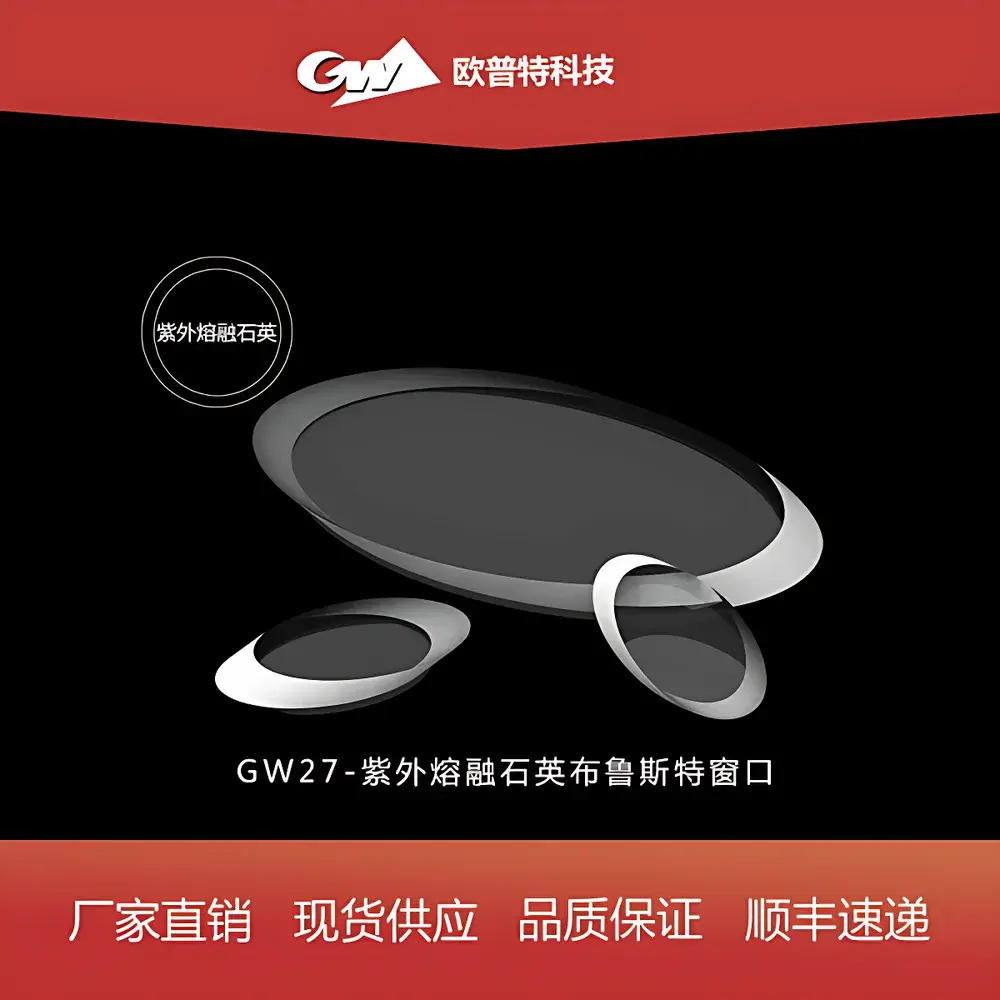
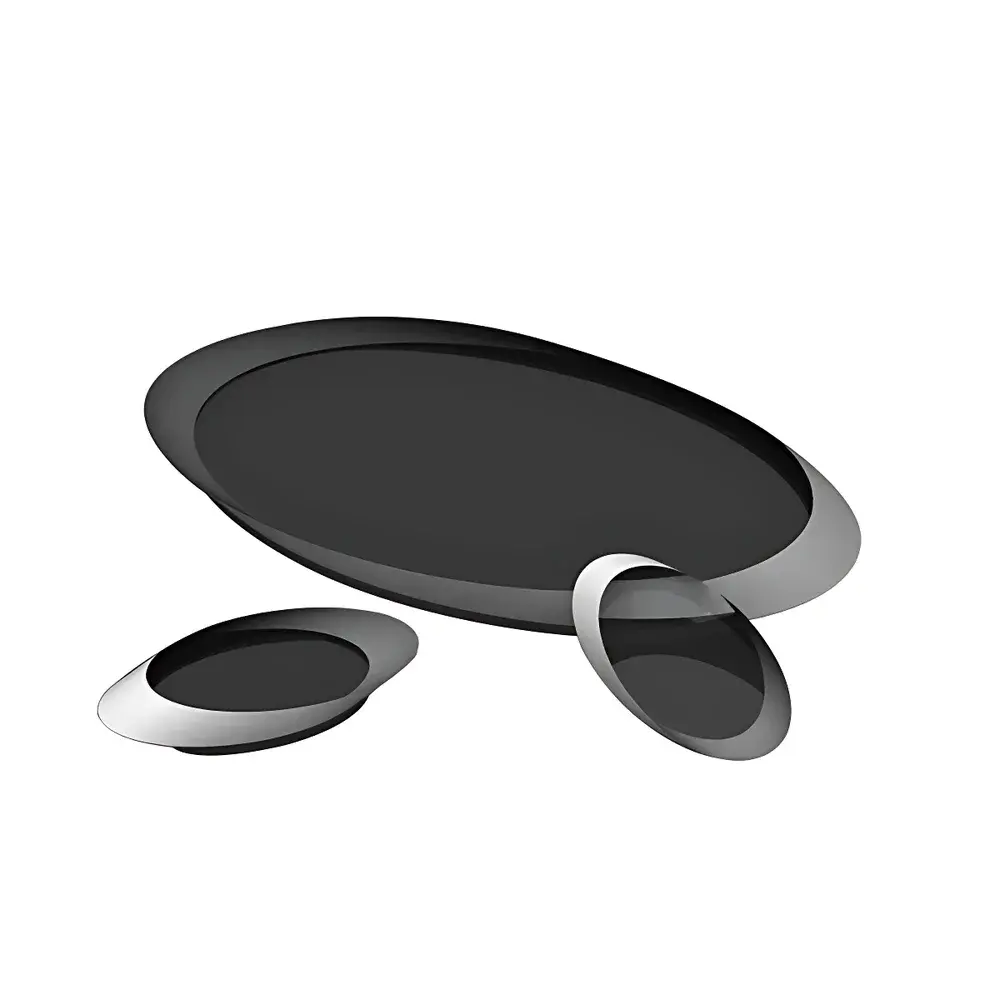
GW27 UV-Fused Silica Brewster Window
| Material | UV-Fused Silica |
|---|---|
| Brewster Angle | 55°34′ @ 633 nm |
| Wavefront Distortion | < λ/10 @ 633 nm |
| Parallelism | < 5 arcsec |
| Surface Quality | 1–2 scratch-dig |
| Diameter Tolerance (minor axis) | +0.0 / −0.1 mm |
| Thickness Tolerance | ±0.2 mm |
| Edge | Protective 0.2–0.5 mm × 45° chamfer |
| Coating | Optional (see model variants) |
| Component Type | Optical Element |
Overview
The GW27 UV-Fused Silica Brewster Window is a precision optical component engineered for high-transmission, polarization-selective applications in ultraviolet to near-infrared laser systems and vacuum-compatible optical cavities. Designed around the fundamental principle of Brewster’s angle incidence, this window enables near-zero reflection loss for p-polarized light while maintaining defined reflectivity for s-polarized components—making it indispensable in intracavity optics, laser resonators, and ellipsometry setups. Fabricated from synthetic UV-grade fused silica (SiO₂), the GW27 exhibits exceptional transmission down to 185 nm, low thermal expansion (≈0.55 × 10⁻⁶ /°C), and outstanding resistance to thermal shock and UV-induced compaction. Its specified Brewster angle of 55°34′ at 633 nm is derived from the material’s refractive index (n ≈ 1.458 at 633 nm) and remains stable across the operational wavelength range due to the homogeneity and low dispersion of the substrate.
Key Features
- Optimized for Brewster-angle operation in laser cavity alignment, harmonic generation, and polarized beam routing
- UV-fused silica substrate with certified OH-content < 1 ppm, ensuring minimal absorption below 250 nm
- Wavefront distortion controlled to < λ/10 @ 633 nm (measured via interferometry per ISO 10110-5)
- Parallelism maintained within 5 arcseconds, critical for minimizing beam deviation in multi-pass configurations
- Surface quality rated to 1–2 scratch-dig per MIL-PRF-13830B, verified by automated dark-field inspection
- Consistent edge geometry: protective 0.2–0.5 mm × 45° chamfer applied to all peripheries to mitigate chipping and coating delamination
- Dimensional tolerances traceable to NIST-calibrated gage blocks and coordinate measuring machines (CMM)
Sample Compatibility & Compliance
The GW27 series is compatible with standard kinematic mounts, vacuum flanges (CF-35/CF-63), and ultra-high vacuum (UHV) environments up to 10⁻⁹ mbar when properly baked. All substrates are cleaned per ISO 14644-1 Class 5 cleanroom protocols and undergo solvent-based, megasonic-assisted cleaning prior to metrology verification. The component complies with ISO 10110 optical drawing standards for surface form, irregularity, and coating specifications. While uncoated variants meet general laboratory requirements, optional anti-reflection (AR) coatings—available upon request—are designed for specific wavelength bands (e.g., 248 nm, 355 nm, 532 nm, or broadband 250–700 nm) and conform to ISO 9211-3 for coating adhesion and environmental durability.
Software & Data Management
As a passive optical element, the GW27 requires no embedded firmware or software integration. However, its metrological data—including interferometric wavefront maps, spectral transmittance curves (200–2500 nm), and surface roughness profiles (measured via AFM)—are delivered in standardized formats (CSV, TIFF, ZMX) compatible with Zemax OpticStudio, CODE V, and FRED optical design platforms. Each unit ships with a Certificate of Conformance (CoC) listing measurement conditions, equipment IDs, calibration dates, and uncertainty budgets per ISO/IEC 17025-accredited procedures. Traceability to national standards (NIST, PTB) is documented for all dimensional and optical tests.
Applications
- Intracavity Brewster windows in Ti:sapphire, dye, and excimer laser resonators
- Polarization purification stages in ultrafast amplifier chains and OPCPA systems
- Beam entry/exit ports in UHV spectroscopy chambers and synchrotron beamlines
- Reference elements in ellipsometric calibration kits (ASTM E1931, ISO 1561)
- Substrates for in-situ deposited thin-film polarizers and dichroic filters
- Alignment fiducials in photolithography steppers and EUV metrology tools
FAQ
What is the maximum recommended laser fluence for the uncoated GW27 window?
For continuous-wave (CW) operation at 532 nm, the damage threshold exceeds 10 MW/cm²; for nanosecond pulses (10 ns, 10 Hz), it is ≥5 J/cm². Exact values depend on beam profile, repetition rate, and thermal management—consult application-specific LIDT reports available upon request.
Can the GW27 be used in deep-UV (193 nm) lithography environments?
Yes—UV-fused silica grade “Grade 1” (as used in GW27) meets SEMI F28 specifications for 193 nm transmission stability and shows <0.1% cumulative absorption after 10 GJ/m² exposure under ArF excimer conditions.
Is the Brewster angle temperature-dependent?
Yes—the angle shifts approximately −0.003°/°C due to thermo-optic coefficient (dn/dT ≈ 1.1 × 10⁻⁶ /°C); for precision cavity alignment, thermal stabilization of ±0.5°C is recommended.
Are custom diameters or thicknesses available?
Yes—custom geometries are supported under OEM agreements, subject to minimum order quantities and extended lead times; dimensional deviations beyond standard tolerances require full interferometric validation.
Does the product comply with RoHS and REACH directives?
Yes—all materials, including adhesives and packaging, are fully compliant with EU Directive 2011/65/EU (RoHS 2) and Regulation (EC) No. 1907/2006 (REACH), with full SVHC screening documentation provided.





