
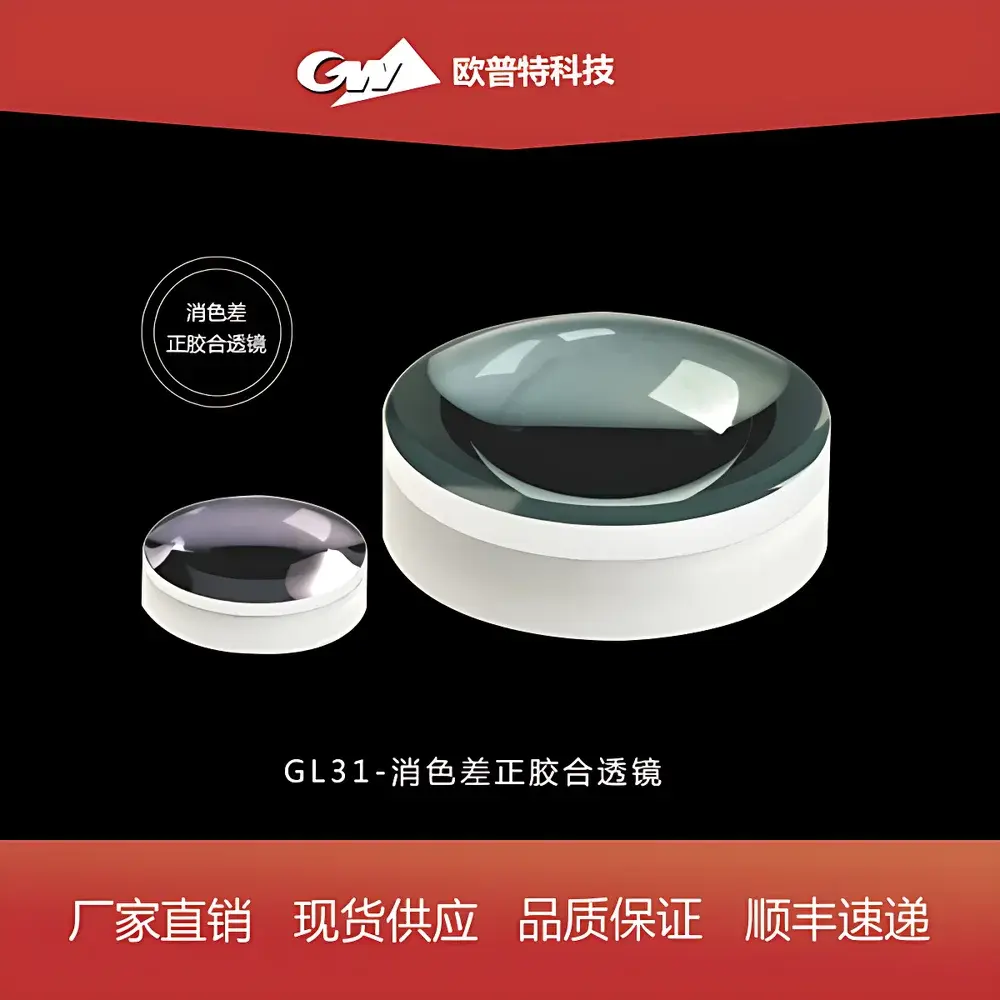
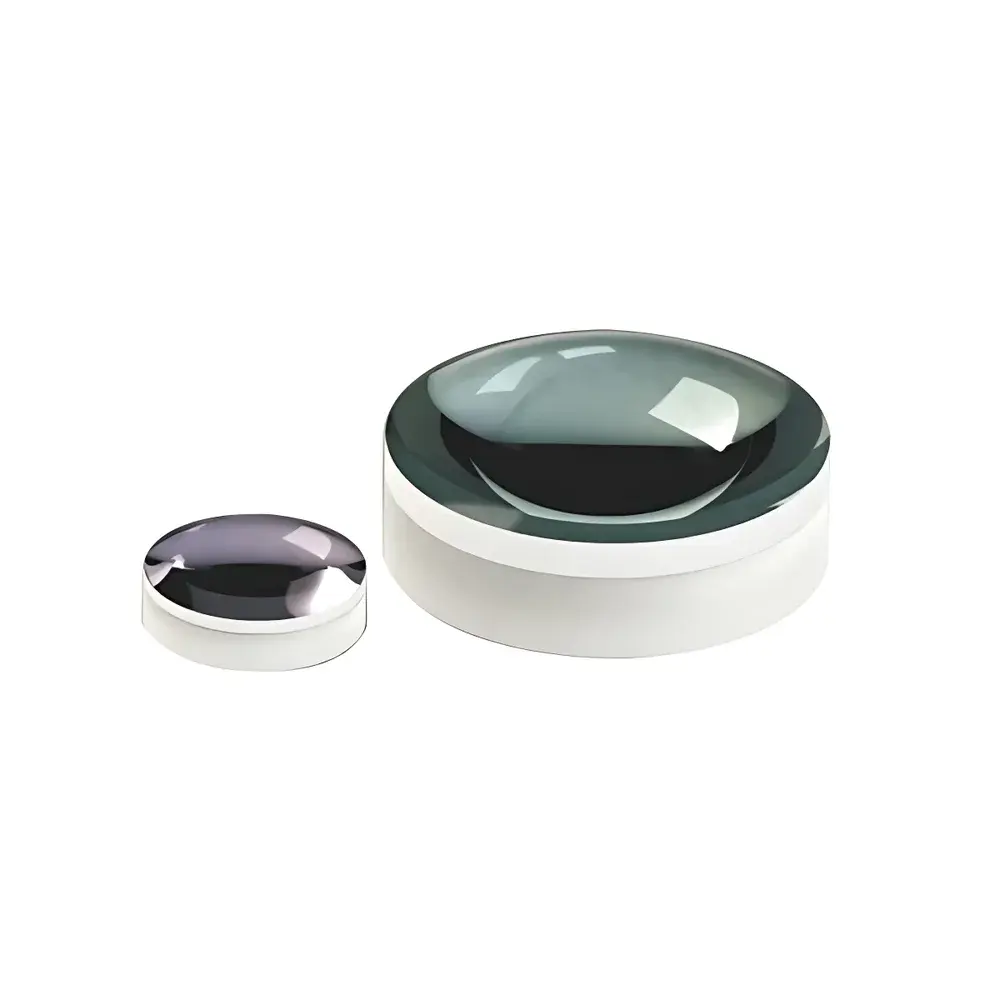
GL31 Achromatic Positive Cemented Lens (VIS, NIR, SWIR Coated)
| Origin | Beijing |
|---|---|
| Manufacturer Type | Distributor |
| Regional Origin | Domestic (China) |
| Model | GL31 |
| Price Range | USD 0.15–75.00 |
| Component Category | Optical Element |
| Wavelength Range | 400–700 nm (AR-coated) |
| Available Diameters | 3.0–5.0 mm |
| Focal Lengths (EFL) | 4.0–10.0 mm |
| Back Focal Lengths (BFL) | 2.5–7.9 mm |
| Center Thickness (T₁) | 2.9–4.5 mm |
| Edge Thickness (T₂) | 2.32–3.7 mm |
| Substrate Materials | H-ZBAF52/H-ZF7LA, BaK2/SF15, N-BAF10/N-SF6HT, N-BAK4/SF5 |
| Compatible Mounting Rings | e.g., PN35037-LM040-D (for 4 mm variants) |
Overview
The GL31 series comprises precision-engineered achromatic positive cemented lenses optimized for broadband performance across the visible spectrum (400–700 nm). Designed using a two-element cemented doublet architecture, each lens corrects for both spherical aberration and axial chromatic aberration through strategic pairing of low-dispersion crown and high-dispersion flint glass materials—such as H-ZBAF52/H-ZF7LA, BaK2/SF15, N-BAF10/N-SF6HT, and N-BAK4/SF5. This optical design ensures minimal focal shift (99.0% average per surface) and minimal residual reflectance (<0.25% R avg) in the VIS range. Their compact form factor—diameters from 3.0 to 5.0 mm and effective focal lengths ranging from 4.0 to 10.0 mm—makes them suitable for integration into space-constrained optomechanical assemblies including fiber-coupling stages, miniature spectrometers, laser diode collimation modules, and OEM sensing platforms.
Key Features
- Achromatic correction validated per ISO 10110-2:2018 for wavefront error (PV ≤ λ/4 @ 632.8 nm, typical)
- AR coating conforming to MIL-C-48497A specifications for environmental durability (humidity, abrasion, adhesion)
- Centering tolerance ≤ 3 arcmin; surface quality per ISO 10110-7: 60-40 scratch-dig standard
- Thermal stability characterized over −10 °C to +60 °C; focal length drift < 80 ppm/°C (typ.)
- Cemented interface integrity verified via ultrasonic immersion testing and thermal cycling (−40 °C ↔ +85 °C, 100 cycles)
- Compliant with RoHS 2011/65/EU and REACH (EC) No. 1907/2006 material restrictions
Sample Compatibility & Compliance
The GL31 lenses are compatible with standard SM-threaded lens mounts (e.g., Thorlabs SM05, SM1), as well as proprietary holders such as PN35037-LM040-D for 4 mm variants. Mechanical interfaces adhere to ANSI/OEOSC OP1.002-2021 dimensional tolerancing guidelines. All substrates meet ASTM F2733-19 requirements for optical glass homogeneity (Δn ≤ 5 × 10⁻⁶) and striae classification ≤ Grade 2. Batch-certified test reports include interferometric wavefront maps, spectral transmittance curves (200–1100 nm), and coating adhesion data per ISO 2409:2013. Traceability is maintained to NIST-traceable radiometric standards for spectral characterization.
Software & Data Management
While the GL31 is a passive optical component, full metrological traceability is provided via digital calibration certificates (PDF + XML) compliant with ISO/IEC 17025:2017. Each shipment includes a unique serial-numbered certificate containing measured EFL, BFL, T₁/T₂, radius of curvature (R₁/R₂), and coating spectral performance. Certificates support automated import into laboratory information management systems (LIMS) and comply with FDA 21 CFR Part 11 requirements for electronic records when hosted on validated enterprise servers. Raw interferogram data (Zygo .dat format) and spectral scans (.spc) are available upon request for internal QA validation.
Applications
- Laser beam shaping and collimation in 405 nm, 488 nm, 532 nm, and 635 nm diode-based systems
- Input/output optics in miniature VIS-NIR spectrophotometers (e.g., Ocean Insight HDX, Hamamatsu C12880MA)
- Objective elements in compact fluorescence microscopes and machine vision inspection optics
- Reference optics in optical alignment stations and interferometric null testing setups
- Secondary focusing elements in multi-stage imaging relays for SWIR-compatible sensors (when used with extended-coating variants)
FAQ
What is the damage threshold for the AR coating under CW laser illumination?
The standard VIS AR coating has a certified LIDT of ≥5 J/cm² at 532 nm, 10 ns pulse width, 20 Hz repetition rate (ISO 21254-1:2011). For CW applications, power density should remain below 1 MW/cm².
Can GL31 lenses be customized with alternate coatings (e.g., NIR or dual-band)?
Yes—custom MgF₂, V-coat, or broadband BBAR coatings (400–1100 nm or 900–1700 nm) are available under OEM agreement with minimum order quantities of 50 pcs.
Is mounting hardware included with purchase?
No—mounting rings (e.g., PN35037-LM040-D) and retaining rings must be ordered separately; compatibility references are provided in the mechanical drawings.
Are Zemax or Code V optical design files available?
Yes—non-proprietary sequential raytrace files (.zmx, .cv) and surface geometry definitions (STEP AP214) are supplied with volume orders ≥200 units.
What is the lead time for standard GL31 stock items?
In-stock SKUs ship within 3 business days; custom configurations require 4–6 weeks after drawing approval and deposit receipt.





