
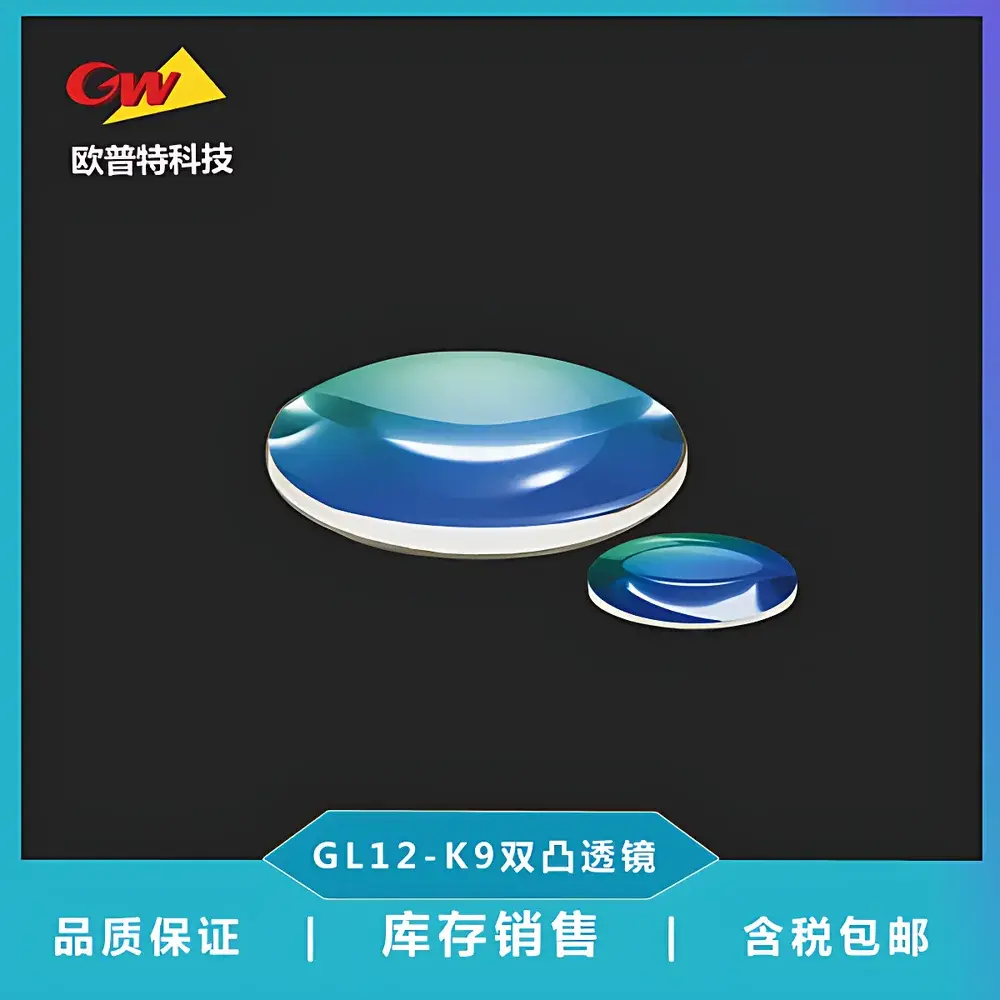
OptoPro GL12 K9 Double-Convex Lens with Broadband AR Coating (Visible to SWIR)
| Origin | Beijing, China |
|---|---|
| Manufacturer Type | Authorized Distributor |
| Regional Origin | Domestic (PRC) |
| Model | GL12 |
| Component Category | Optical Element |
| Coating Range | 400–2500 nm (Visible + NIR + SWIR) |
| Substrate Material | Precision-Annealed K9 Crown Glass |
| Design Wavelength | 587.6 nm (d-line) |
| Diameter Tolerance | +0.0 / −0.1 mm |
| Center Thickness Tolerance | ±0.2 mm |
| Surface Irregularity | λ/4 @ 632.8 nm |
| Effective Focal Length (EFL) Tolerance | ±2% |
| Centration Error | ≤3 arcmin |
| Surface Quality | 3–4 scratch-dig |
| Edge Treatment | 0.2 mm × 45° chamfer |
Overview
The OptoPro GL12 is a precision-engineered double-convex (DCX) lens fabricated from optically homogeneous, precision-annealed K9 borosilicate crown glass. Designed for high-fidelity imaging and beam manipulation in demanding optical systems, the GL12 leverages symmetrical geometry—two identical convex surfaces—to deliver a positive focal length with minimized spherical aberration at unity conjugate ratios. Its optical performance is optimized at the helium d-line (587.6 nm), serving as the reference wavelength for paraxial design and specification validation. The lens is manufactured under strict metrological control: surface irregularity is held to λ/4 measured at 632.8 nm (HeNe laser wavelength), centration error is limited to ≤3 arcminutes, and dimensional tolerances—including diameter (+0.0/−0.1 mm) and center thickness (±0.2 mm)—adhere to ISO 10110-3 standards for precision optical components. As a fundamental element in relay optics, collimation assemblies, and finite-conjugate imaging paths, the GL12 provides predictable Gaussian behavior when used within its design envelope, where increasing conjugate ratio introduces progressively higher off-axis aberrations—primarily coma and astigmatism—that must be compensated by system-level correction.
Key Features
- Precision-annealed K9 optical glass substrate with low bubble/inclusion content per ISO 10110-2 Class 3
- Symmetrical double-convex geometry enabling balanced aberration distribution and simplified mounting alignment
- Broadband anti-reflection (BBAR) coating deposited via ion-assisted e-beam evaporation, covering 400–2500 nm (visible through short-wave infrared)
- Surface quality rated 3–4 scratch-dig per MIL-PRF-13830B, verified via automated dark-field inspection
- Controlled edge treatment: 0.2 mm × 45° protective chamfer applied to both peripheries to mitigate chipping during handling and integration
- Compliant with RoHS 2015/863/EU and REACH SVHC screening requirements for optical component supply chains
Sample Compatibility & Compliance
The GL12 lens is compatible with standard optomechanical mounts (e.g., SM1-threaded lens tubes, kinematic lens holders, and cage system adapters) and integrates seamlessly into both free-space and fiber-coupled architectures. Its broadband AR coating ensures <0.5% average reflectance across the 400–2500 nm range, reducing ghosting and stray light in multi-element systems—critical for spectrophotometry, hyperspectral imaging, and NIR process monitoring applications. All production units undergo 100% interferometric verification of surface figure (Zygo Verifire™ or equivalent) and spectral transmittance (PerkinElmer Lambda 1050+ with integrating sphere). Documentation includes individual test reports traceable to NIM (National Institute of Metrology, China) standards. While not certified to ISO 9001 at the component level, the distributor maintains full AS9100D-aligned quality records—including material certifications, coating deposition logs, and final inspection data—for audit readiness in regulated environments (e.g., medical device OEMs, defense subcontractors).
Software & Data Management
No embedded firmware or proprietary software is associated with the GL12 lens, as it is a passive optical component. However, comprehensive digital asset support is provided: Zemax OpticStudio-compatible .ZMX and CODE V .SEQ files are available upon request, including full surface prescription, coating dispersion models (based on ellipsometric measurement), and thermal expansion coefficients (α = 7.1 × 10⁻⁶ /K). Spectral transmittance datasets (.CSV) spanning 350–2600 nm (0.5 nm step) are delivered with each batch certificate. All documentation conforms to ISO 10110-12 requirements for optical drawing annotations and is archived for ≥10 years per distributor quality policy—supporting long-term system recalibration, failure analysis, and GLP-compliant lab record retention.
Applications
- Finite-conjugate imaging in machine vision systems operating from visible to SWIR bands (e.g., silicon- and InGaAs-based sensors)
- Beam collimation and focusing in laser diode modules (635 nm, 785 nm, 980 nm, 1550 nm, 1950 nm)
- Relay optics in FTIR spectrometers and dispersive NIR analyzers
- Objective elements in compact endoscopic and borescope optical trains
- Reference lenses in metrology setups requiring stable EFL and low wavefront distortion
- Education platforms for undergraduate optics laboratories studying Gaussian optics, aberration theory, and thin-lens approximation limits
FAQ
What is the damage threshold of the BBAR coating under CW laser illumination?
The coating has been tested to >5 J/cm² at 1064 nm, 10 ns, 20 Hz (ISO 21254-1); for CW operation, maximum power density is 1 MW/cm² at 532 nm and 2 MW/cm² at 1550 nm, assuming proper heat sinking and clean beam profiles.
Can the GL12 be customized with alternate coatings or substrates?
Yes—custom MgF₂ single-layer, V-coats at specific wavelengths (e.g., 1064 nm), or fused silica substrates are available under NRE-supported engineering change orders (ECOs) with MOQ ≥50 pcs.
Is there batch-to-batch consistency in coating performance?
Yes—coating runs are monitored via real-time quartz crystal microbalance (QCM) and post-deposition spectrophotometry; spectral deviation between batches is maintained within ±0.15% absolute transmittance across the specified band.
Do you provide mounting hardware or alignment fixtures?
Standard SM1-threaded lens retainers and kinematic mounts are stocked and sold separately; custom machined cells (e.g., anodized aluminum housings with tilt/centering adjustments) are offered under OEM agreement.
Are test reports supplied with every order?
Yes—each shipment includes a Certificate of Conformance (CoC) listing measured EFL, centration, surface figure, and spectral transmittance summary; full metrology reports are available on request.





