
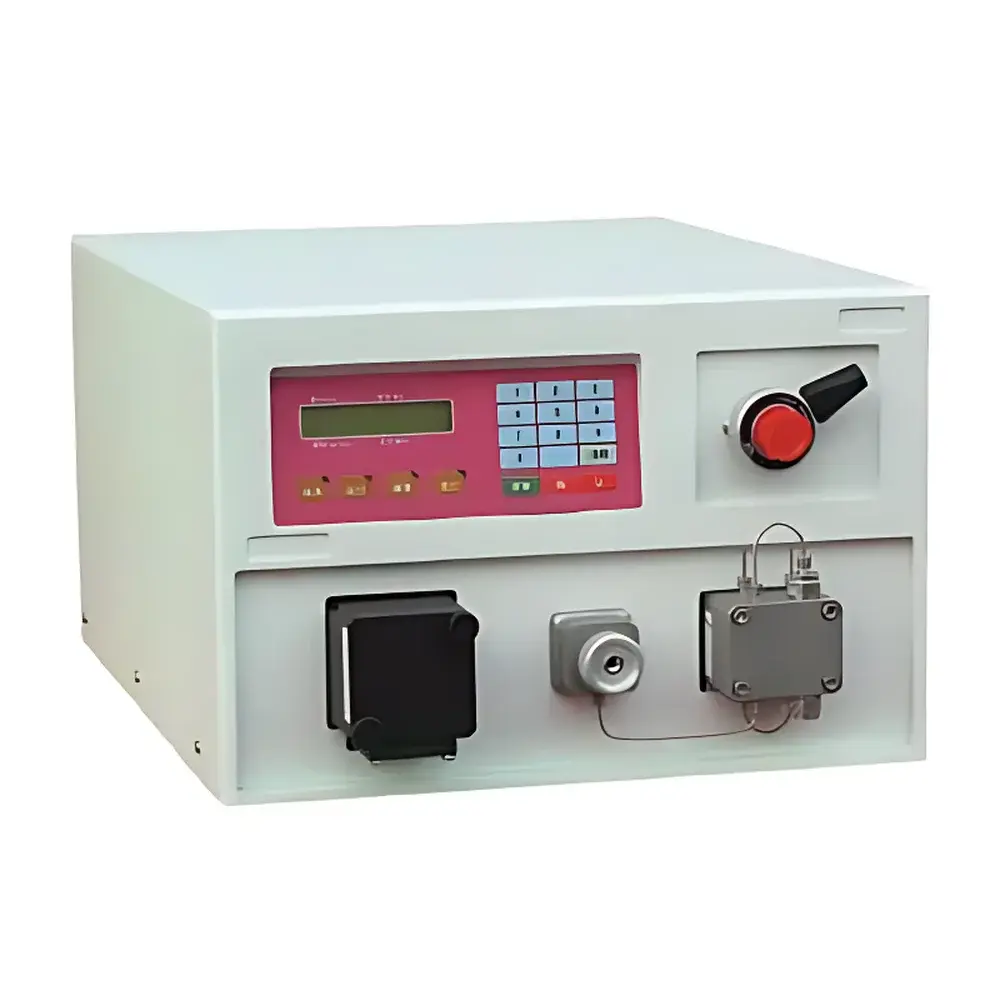
UC-3220 Integrated Isocratic HPLC System
| Brand | Ulink Optoelectronics |
|---|---|
| Origin | Beijing, China |
| Model | UC-3220 |
| Instrument Type | Conventional High-Performance Liquid Chromatograph |
| Flow Rate Range | 0.001–9.999 mL/min |
| Pump Configuration | Dual-piston serial design with electronic pressure pulsation suppression |
| Flow Accuracy | <0.4% RSD at 1 mL/min (deionized water, 25°C) |
| Flow Precision | 0.1% RSD at 1 mL/min (deionized water, 25°C) |
| Maximum Pressure | 40 MPa at 1 mL/min (deionized water, 25°C) |
| Pressure Pulsation | <0.05 MPa at 1 mL/min (deionized water, 25°C) |
| Gradient Accuracy | ±1% (optional binary low-pressure gradient module) |
| Wavelength Range | 190–740 nm |
| Light Source | Deuterium lamp |
| Wavelength Accuracy | ±1 nm |
| Spectral Scanning Mode | Stop-flow automatic scan |
| Baseline Noise | 2×10⁻⁵ AU at 240 nm (25°C) |
| Baseline Drift | 15×10⁻⁵ AU/h at 240 nm (25°C) |
| LOD | 5×10⁻⁹ g/mL (naphthalene standard, methanol mobile phase, 254 nm, 25°C) |
| Control Interface | RS-232 for full bidirectional computer control |
| Display | 2×16-character LCD (English) |
| Power Supply | 220 V AC, 3 A, 200 W |
| Dimensions (L×H×D) | 306×210×420 mm |
| Weight | 12 kg |
Overview
The UC-3220 Integrated Isocratic HPLC System is an engineered solution for laboratories requiring high reliability, minimal footprint, and operational flexibility in liquid chromatographic analysis. Designed around a compact monolithic architecture, it integrates a dual-piston high-pressure solvent delivery pump, a digitally processed UV-Vis absorbance detector (190–740 nm), and a manually operated 7725i injection valve into a single chassis. This integration reduces system dwell volume to <120 µL and eliminates inter-unit tubing connections—critical for preserving chromatographic resolution and minimizing carryover in trace-level applications. The system operates on isocratic elution principles, delivering stable flow and pressure profiles essential for method reproducibility across routine QC testing, environmental screening, and pharmaceutical stability-indicating assays. Its mechanical and electronic design—including electronic pressure pulsation suppression instead of passive mechanical dampers—ensures long-term baseline stability and reduced maintenance frequency compared to legacy modular configurations.
Key Features
- Monolithic chassis housing pump, detector, and injection valve—reducing total system volume by >40% versus conventional benchtop HPLC setups
- Dual-piston serial pump with real-time electronic pressure feedback and active pulsation compensation, achieving <0.05 MPa pressure ripple at 1 mL/min
- UV-Vis detector featuring deuterium lamp illumination, digital signal processing, and stop-flow spectral scanning for peak identification and purity assessment
- Configurable wavelength programming: users may define time-resolved wavelength switching during a run to optimize sensitivity across multi-analyte separations
- Full bidirectional RS-232 interface enabling remote instrument control—including flow rate, pressure limit, detection wavelength, and injection timing—from compliant chromatography data systems
- Self-diagnostic firmware supporting automated leak detection, pressure calibration verification, and lamp energy monitoring
- Modular fluidic components: replaceable pump heads and flow cells allow field-upgradable service life extension without system replacement
- Optional binary low-pressure gradient module supports method development flexibility while maintaining compatibility with the integrated platform
Sample Compatibility & Compliance
The UC-3220 accommodates standard 3.9–4.6 mm I.D. analytical columns and is compatible with reversed-phase (C8, C18), normal-phase, and ion-exchange chemistries. It supports mobile phases ranging from aqueous buffers (e.g., phosphate, acetate) to organic modifiers (acetonitrile, methanol) and acidic or basic additives within pH 2–8. All wetted parts are constructed from stainless steel 316, sapphire, and PEEK—ensuring chemical resistance and minimizing metal ion leaching. While the system itself does not carry CE or FDA 510(k) certification, its hardware architecture and software control logic support alignment with GLP/GMP documentation requirements when deployed with validated chromatography data systems (CDS). Data integrity features—including audit-trail-enabled parameter logging and electronic signature-ready operation—are implementable via third-party CDS platforms compliant with 21 CFR Part 11.
Software & Data Management
The UC-3220 communicates exclusively via ASCII-based RS-232 protocol using standardized command sets compatible with industry-standard chromatography software (e.g., Chromeleon, Empower, OpenLab CDS). No proprietary drivers are required; configuration is handled through terminal emulation or native CDS instrument method editors. All acquisition parameters—including flow program steps, wavelength schedule, detector gain, and integration event markers—are stored in human-readable ASCII method files. Raw analog detector output is digitized at 10 Hz with 16-bit resolution, and baseline-corrected chromatograms are exported in .csv or .cdf formats. Instrument status logs—including pressure history, lamp hours, and error codes—are timestamped and retained in non-volatile memory for up to 30 days, facilitating root-cause analysis during method troubleshooting or regulatory audits.
Applications
- Routine quality control of small-molecule pharmaceuticals per USP and EP 2.2.46 guidelines
- Environmental analysis of priority pollutants (e.g., PAHs, phenols, pesticides) in water and soil extracts per EPA Method 8330B and ISO 17993
- Food safety testing for preservatives (sorbic acid, benzoic acid), sweeteners (aspartame, sucralose), and mycotoxins (aflatoxin B1)
- Academic research requiring portable HPLC capability—such as field-deployable water quality monitoring or on-site forensic sample screening
- Method transfer validation between laboratory and mobile analytical units under ISO/IEC 17025-accredited workflows
FAQ
Is the UC-3220 suitable for gradient elution?
The base configuration supports isocratic operation only. A binary low-pressure gradient module is available as an optional add-on, enabling linear or step gradients with ≤1% compositional accuracy.
What column dimensions and fittings are supported?
Standard 3.9 mm × 150 mm and 4.6 mm × 250 mm stainless-steel columns with 1/16″ stainless-steel tubing and zero-dead-volume unions are fully compatible.
Can the system be integrated into a LIMS environment?
Yes—via RS-232 to serial-to-Ethernet converters and middleware that maps instrument status and result data to HL7 or ASTM E1384-compliant LIMS interfaces.
Does the detector support post-run spectral library matching?
No—the stop-flow scanning function provides single-spectrum acquisition per peak but lacks embedded spectral library search algorithms; spectral interpretation requires external software such as Chromeleon’s PeakIdent or commercial spectral databases.
What maintenance intervals are recommended for routine operation?
Pump seal replacement every 6 months at 1 mL/min average flow; deuterium lamp replacement every 1,000–1,500 operating hours; annual calibration verification of flow and wavelength accuracy per ISO 17025 Clause 6.5.2.




