
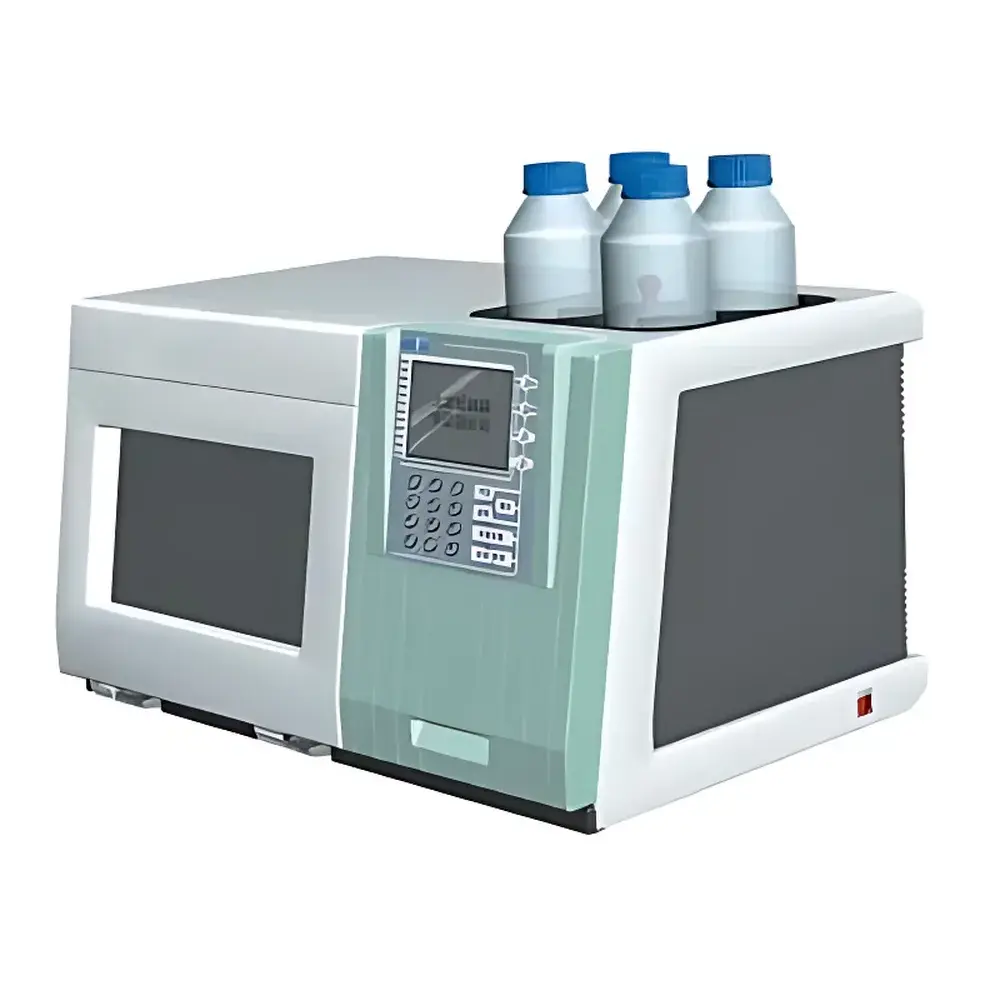
UltimateOpto UC-3218 Integrated Binary High-Pressure Gradient HPLC System
| Brand | UltimateOpto |
|---|---|
| Model | UC-3218 |
| Instrument Type | Conventional High-Performance Liquid Chromatograph |
| Flow Rate Range | 0.001–9.999 mL/min |
| Pump Type | Dual-Piston Series Configuration with Electronic Pressure Pulsation Damping |
| Flow Accuracy | <0.4% RSD (at 1 mL/min, deionized water, 25 °C) |
| Flow Precision | 0.1% RSD (at 1 mL/min, deionized water, 25 °C) |
| Maximum Pressure | 40 MPa (at 1 mL/min, deionized water, 25 °C) |
| Pressure Pulsation | <0.05 MPa (at 1 mL/min, deionized water, 25 °C) |
| Gradient Accuracy | ±1% |
| Autosampler | XYZ-Driven Robotic Sampler (120 positions for 1.8 mL vials) |
| Sample Tray Temperature Control | 4–40 °C |
| Injection Reproducibility | 0.5% RSD (20 µL naphthalene standard at 254 nm, methanol mobile phase, 1 mL/min) |
| UV-Vis Detector Wavelength Range | 190–740 nm |
| Light Source | Deuterium Lamp |
| Wavelength Accuracy | ±1 nm |
| Spectral Scanning Mode | Stop-Flow Auto-Scan |
| Baseline Noise | 2 × 10⁻⁵ AU (240 nm, 25 °C) |
| Baseline Drift | 15 × 10⁻⁵ AU/h (240 nm, 25 °C) |
| LOD | 5 × 10⁻⁹ g/mL (naphthalene, 254 nm, methanol, 25 °C) |
| Communication Interface | RS-232 |
| Display | 5.6-inch True-Color TFT LCD |
| Power Supply | 220 V AC, 3 A |
| Dimensions (W×H×D) | 650 × 410 × 465 mm |
| Weight | 35 kg |
Overview
The UltimateOpto UC-3218 Integrated Binary High-Pressure Gradient HPLC System is a fully automated, benchtop liquid chromatography platform engineered for precision, reproducibility, and unattended operation in regulated and research laboratory environments. Built upon high-pressure mixing architecture—where two independent solvent streams are delivered by dual piston pumps and mixed under pressure prior to the column—the system delivers superior gradient accuracy and minimal dwell volume (< 800 µL), enabling rapid method development and robust method transfer across laboratories. Unlike low-pressure quaternary systems, this binary high-pressure design ensures minimal compressibility-induced delay and enhanced retention time stability, particularly critical for gradient elution of complex small-molecule pharmaceuticals, natural products, and synthetic intermediates. The system integrates all core HPLC components—including dual high-pressure pumps, a variable-wavelength UV-Vis detector, a 120-position refrigerated autosampler, and a thermostatically controlled column oven—within a single, compact chassis, eliminating inter-unit cabling, alignment variability, and external controller dependencies.
Key Features
- Binary high-pressure gradient architecture with electronic pressure pulsation damping—replacing mechanical dampers—to ensure long-term pump reliability and sub-0.05 MPa pressure ripple at operational flow rates.
- Full system integration with unified firmware control: all modules (pumps, detector, autosampler, column oven) operate under synchronized timing and shared calibration references, minimizing inter-device latency and drift.
- Autosampler with XYZ robotic arm and programmable tray cooling (4–40 °C), supporting up to 120 × 1.8 mL vials; injection precision maintained at ≤0.5% RSD across full volume range (1–100 µL).
- UV-Vis detector featuring digital signal processing, stop-flow spectral scanning, wavelength programming, and real-time baseline correction algorithms compliant with ASTM E260 and ISO 17025 data integrity expectations.
- Self-diagnostic capability: automated leak detection, pressure sensor validation, lamp energy monitoring, and flow verification routines executed at startup and user-defined intervals.
- 5.6-inch true-color graphical interface with intuitive touch-enabled navigation—supporting method setup, real-time chromatogram display, and error diagnostics without PC dependency.
Sample Compatibility & Compliance
The UC-3218 accommodates standard 3.0–4.6 mm ID analytical columns (up to 250 mm length) and supports reversed-phase, normal-phase, ion-exchange, and size-exclusion chromatography applications. Its low-dead-volume fluidic path (< 15 µL from mixer to detector cell) minimizes band broadening and preserves peak resolution for early-eluting compounds. All wetted parts—including pump heads, check valves, and flow cells—are constructed from chemically inert materials (e.g., sapphire, PEEK, and stainless steel 316L) compatible with aqueous, organic, and mildly corrosive mobile phases (pH 1.5–12). The system meets key regulatory requirements for GLP and GMP environments: audit trail functionality, electronic signatures, and secure method/data archiving are enforced through its native chromatography data system (CDS). It supports 21 CFR Part 11-compliant operation when paired with validated CDS software, including role-based access control, immutable raw data storage, and time-stamped event logging.
Software & Data Management
The UC-3218 operates under a fully integrated, bidirectional chromatography workstation that provides complete instrument control—including gradient profile definition, temperature ramping, injection scheduling, and detector parameter optimization—alongside advanced data acquisition and reporting. Raw data are stored in vendor-neutral, open-format .CDF files (compatible with ASTM E1947 and ISO/IEC 17025 traceability standards). The software includes built-in tools for peak integration (tangent skim, valley-to-valley, exponential curve fitting), system suitability testing (SST) per USP , and customizable report templates aligned with internal SOPs or external submission requirements (e.g., ICH M4). Data backup, version-controlled method libraries, and remote monitoring via secure LAN connection are supported without third-party middleware.
Applications
This system is routinely deployed in QC/QA labs for assay quantification of active pharmaceutical ingredients (APIs), impurity profiling per ICH Q3B, dissolution testing, and stability-indicating method validation. In academic and industrial research settings, it supports metabolite identification workflows, polymer molecular weight distribution analysis, chiral separation using polysaccharide-based columns, and multi-component environmental contaminant screening (e.g., PAHs, pesticides, pharmaceutical residues in wastewater). Its thermal control fidelity (±0.2 °C column oven stability) and low baseline noise enable sensitive detection of trace-level analytes in biological matrices—such as plasma or tissue homogenates—following solid-phase extraction or protein precipitation sample preparation.
FAQ
Does the UC-3218 support method transfer from legacy HPLC systems?
Yes—its low dwell volume, precise gradient delivery, and standardized .CDF data format facilitate seamless method portability. Retention time shifts are minimized via dwell volume compensation algorithms embedded in the CDS.
Can the system be configured for GMP compliance out-of-the-box?
The hardware meets mechanical and electrical safety standards (IEC 61010-1); however, full 21 CFR Part 11 compliance requires validated CDS software, documented IQ/OQ/PQ protocols, and site-specific administrative controls.
Is column switching or valve-based fraction collection supported?
The base configuration does not include switching valves or fraction collectors, but the RS-232 and optional Ethernet interfaces allow third-party peripheral integration via TTL or relay-triggered I/O signals.
What maintenance intervals are recommended for routine operation?
Pump seals should be inspected every 3,000 injections or 6 months; UV lamp replacement is advised after 2,000 hours; and system suitability tests must be performed before each analytical batch per USP .
How is detector linearity verified during qualification?
Linearity is assessed using serial dilutions of a certified reference standard (e.g., caffeine or naphthalene), with correlation coefficient (r²) ≥0.999 over a 3-log concentration range and %RSD ≤2.0% across replicate injections.





