
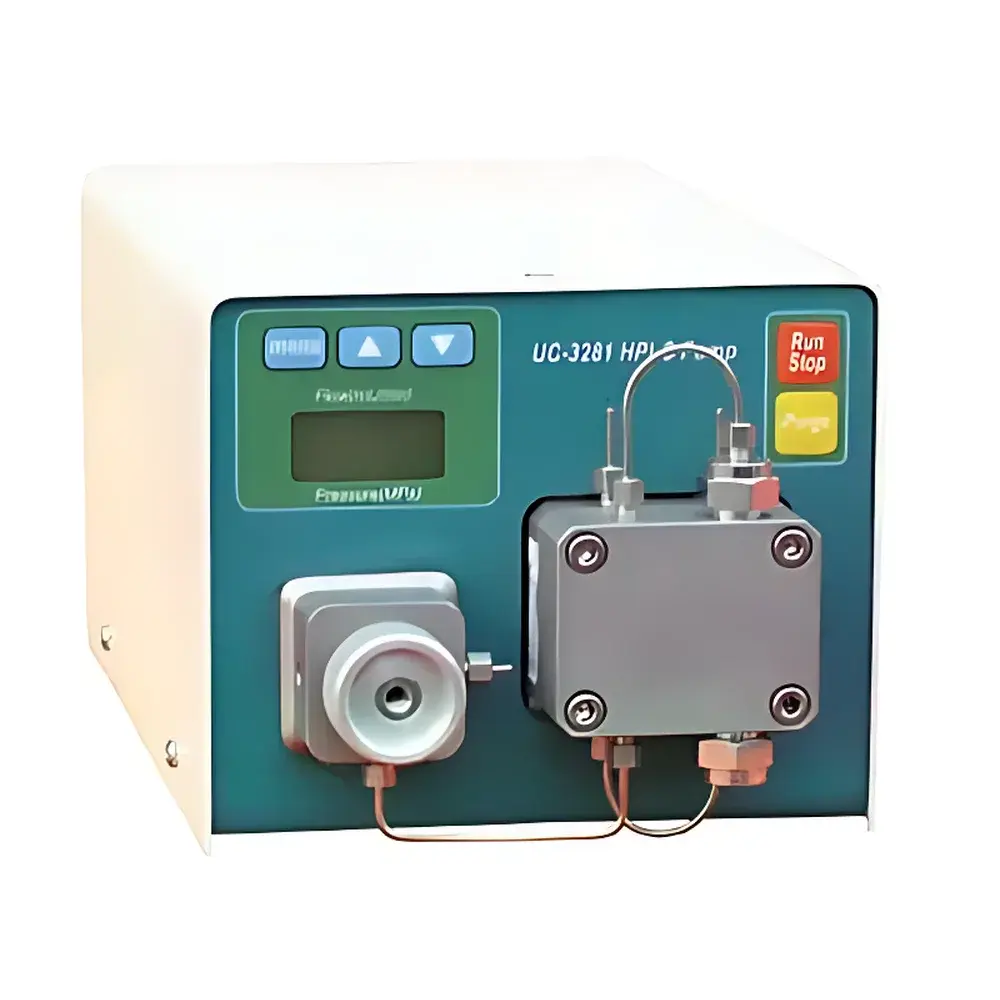
Ulunion UC-3281 Miniature High-Pressure Liquid Chromatography (HPLC) Isocratic Pump
| Brand | Ulunion |
|---|---|
| Model | UC-3281 |
| Pump Type | Isocratic Single-Channel High-Pressure Solvent Delivery Pump |
| Flow Rate Range | 0.001–9.999 mL/min (10 mL pump head) / 0.01–49.99 mL/min (50 mL pump head) |
| Flow Accuracy | <0.5% |
| Flow Precision (RSD) | ≤0.2% |
| Pressure Pulsation | <0.1 MPa (deionized water, 1 mL/min @ 10 MPa |
| Maximum Operating Pressure | 40 MPa (10 mL head) / 25 MPa (50 mL head) |
| Pump Mechanism | Dual-Piston Serial Reciprocating Pump |
| Control Interface | RS-232/RS-485 (PC remote control supported) |
| Pressure Limit Protection | User-configurable upper pressure threshold |
| Display | 2×8-character LCD (English only) |
| Power Supply | 24 V DC, 3 A |
| Dimensions (L×H×D) | 130×210×110 mm |
| Weight | 2.8 kg |
Overview
The Ulunion UC-3281 is a compact, high-precision isocratic HPLC solvent delivery pump engineered for reliability and integration in analytical and preparative chromatographic workflows. Based on a dual-piston serial reciprocating architecture, it delivers stable, pulse-minimized flow under high backpressure—critical for consistent retention time and peak shape in reversed-phase, ion-exchange, and size-exclusion separations. Unlike conventional pumps relying on mechanical dampeners, the UC-3281 implements real-time electronic pressure pulsation suppression via ARM7-based embedded firmware, dynamically compensating for pressure transients during piston reversal without passive components. Its modular pump head design supports rapid interchange between 10 mL and 50 mL displacement volumes, enabling seamless transition from analytical-scale (e.g., 4.6 mm ID columns) to semi-preparative applications (e.g., 10–20 mm ID columns), all within a footprint of just 130 × 210 × 110 mm.
Key Features
- Ultra-compact form factor (2.8 kg, <3 L volume) optimized for benchtop HPLC systems, portable GC-HPLC hybrids, and OEM instrument integration.
- Electronic pressure pulsation suppression—no mechanical accumulator or pulse damper required—ensuring baseline stability in UV-Vis and electrochemical detection.
- Dual-piston serial reciprocating mechanism with ceramic-coated plungers and sapphire check valves for extended service life and chemical compatibility with common HPLC solvents (acetonitrile, methanol, aqueous buffers, THF).
- Wide dynamic flow range: 0.001–9.999 mL/min (10 mL head) and 0.01–49.99 mL/min (50 mL head), supporting both capillary/nano-LC interfacing and mid-scale purification.
- User-configurable pressure limit protection with immediate flow halt upon exceeding preset threshold—compliant with ISO 13849-1 functional safety principles for lab instrumentation.
- RS-232 and RS-485 serial interfaces enable bidirectional communication with external controllers, chromatography data systems (CDS), or PLC-based automation platforms.
Sample Compatibility & Compliance
The UC-3281 is compatible with standard HPLC mobile phases including polar organic solvents, buffered aqueous solutions (pH 2–10), and low-viscosity ionic liquids. Wetted materials include PEEK, sapphire, ruby, and chemically inert ceramics—ensuring resistance to hydrolysis, oxidation, and halogenated solvent exposure. The pump meets CE marking requirements per EN 61326-1 (EMC for laboratory equipment) and EN 61010-1 (safety for electrical equipment). Its pressure and flow specifications align with ASTM D7595 (standard test method for HPLC pump performance verification) and support GLP-compliant operation when integrated into validated CDS environments with audit-trail-enabled control software.
Software & Data Management
The UC-3281 operates as a slave device under host command via ASCII-based serial protocol (ASCII CR/LF termination). It supports full parameter readback—including actual flow rate, current pressure, status flags (running/idle/error), and error codes—for real-time monitoring and logging. When paired with compliant chromatography data systems (e.g., Chromeleon, OpenLab CDS, or custom LabVIEW/Python drivers), it enables automated method sequencing, pressure-triggered shutdown, and timestamped event recording. Firmware supports firmware-upgradable logic for future protocol extensions (e.g., Modbus RTU mapping), ensuring long-term interoperability in evolving lab IT infrastructures.
Applications
- Analytical HPLC for pharmaceutical QC (USP , ICH Q2(R2)) where flow precision ≤0.2% RSD ensures reproducible assay validation.
- Semi-preparative purification of natural products and synthetic intermediates using 10–20 mm ID columns at up to 25 MPa.
- Modular gradient system expansion: two UC-3281 units can be synchronized as a binary high-pressure mixing system; four units (with low-pressure selector valve) configure a quaternary low-pressure gradient setup.
- Field-deployable LC modules for environmental monitoring (EPA Method 8330B, 8082A) requiring low power draw (24 V DC) and shock-resistant packaging.
- OEM integration into microfluidic LC-MS interfaces, dissolution testers, and continuous manufacturing PAT tools where space and thermal management are constrained.
FAQ
Can the UC-3281 be used with aggressive solvents such as concentrated acids or bases?
Yes—wetted parts are chemically resistant to pH 2–10 aqueous solutions and common organics; however, prolonged exposure to >1 M HCl, HF, or >0.5 M NaOH is not recommended without prior compatibility testing.
Is firmware update capability available in the field?
Yes—firmware updates are performed via RS-232 using vendor-provided utility software; no hardware modification is required.
Does the pump support analog input/output for external process control?
No—only digital serial control is provided; analog I/O requires external signal conditioning modules.
What maintenance intervals are recommended for routine operation?
Plunger seals and check valves should be inspected every 2,000 operating hours or annually, whichever occurs first; pump head cleaning is advised after switching solvent families.
Is the UC-3281 compliant with FDA 21 CFR Part 11 for electronic records?
The pump itself does not store data or enforce user authentication; compliance is achieved at the CDS level when configured with audit-trail, electronic signature, and role-based access controls.






