
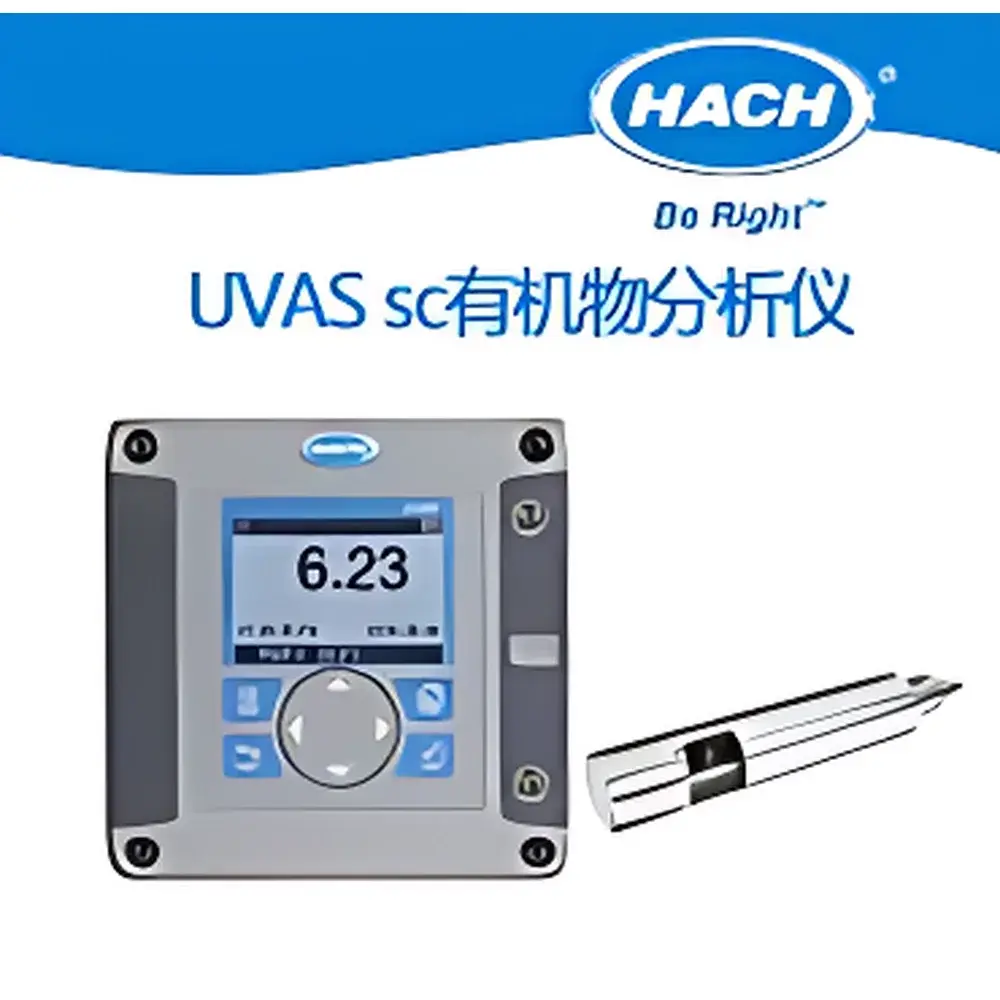
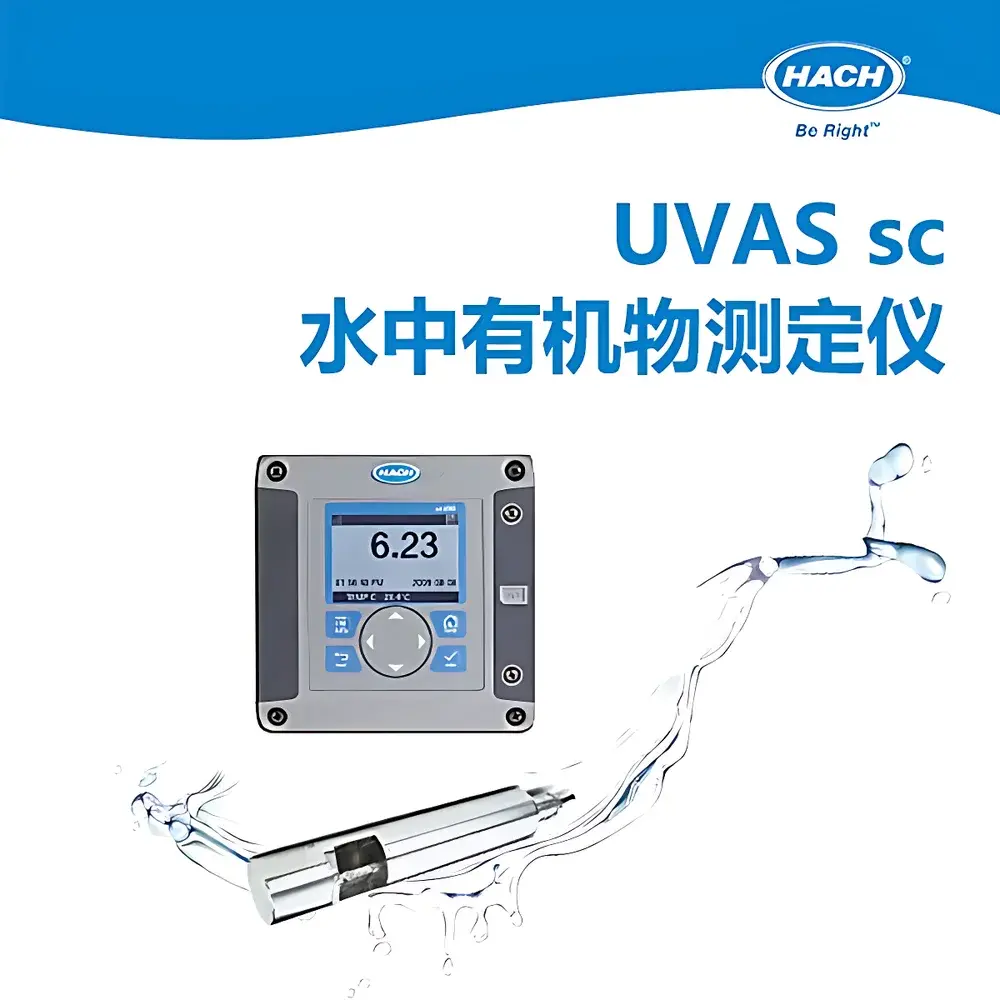
Hach UVAS sc Organic Matter Analyzer
| Brand | Hach |
|---|---|
| Origin | Imported |
| Manufacturer | Hach Company |
| Model | UVAS sc |
| Measurement Principle | UV Absorption at 254 nm (SAC₂₅₄) |
| Optical Path Length Options | 1 mm, 2 mm, 5 mm, 50 mm |
| Measuring Range (SAC₂₅₄) | 0.01–60 m⁻¹, 0.1–600 m⁻¹, 0–1500 m⁻¹, 2–3000 m⁻¹ |
| Derived Parameter Ranges | COD (0–20,000 mg/L), BOD (0–20,000 mg/L), TOC (0–10,000 mg/L) |
| Accuracy | ±3% of reading + 0.5 mg/L |
| Response Time | >1 min (adjustable) |
| Auto-Cleaning | Mechanical wiper (frequency programmable) |
| Output | Dual 4–20 mA (500 Ω load) |
| Communication | Modbus RTU or Profibus DP (optional) |
| Operating Temperature | 2–40 °C |
| Submersion Pressure Rating | 0.5 bar (max depth 2 m) |
| Power Supply | 230 VAC ±10%, 50 Hz, 15 VA or 24 VDC/AC ±25%, 800 mA |
| Sensor Dimensions | Ø70 × 333 mm |
| Sensor Weight | ~3.6 kg |
| Compliance | Designed for continuous operation in compliance with ISO 7027 (turbidity compensation), ASTM D5540 (UV absorbance correlation to organic carbon), and supports GLP/GMP data integrity requirements via sc200 controller audit trail |
Overview
The Hach UVAS sc Organic Matter Analyzer is an industrial-grade, online ultraviolet absorption spectrophotometer engineered for real-time quantification of dissolved organic matter in water streams. It operates on the well-established principle of specific ultraviolet absorbance at 254 nm (SAC254), a robust optical proxy for aromatic and conjugated organic compounds—including humic substances, phenols, and polycyclic aromatic hydrocarbons (PAHs)—commonly present in wastewater, surface water, drinking water sources, and industrial recirculation systems. Unlike wet-chemistry methods, the UVAS sc requires no reagents, zero sample pretreatment, and delivers measurement cycles every 60 seconds. Its dual-beam optical architecture inherently compensates for turbidity-induced scattering effects, ensuring stable performance even in moderately suspended-solids environments. The analyzer is designed for integration into continuous monitoring networks and meets the operational rigor expected in municipal utilities, industrial effluent control, and source water early-warning systems.
Key Features
- Reagent-free, maintenance-light operation based on 254 nm UV absorption spectroscopy
- Four selectable optical path lengths (1 mm, 2 mm, 5 mm, 50 mm) to optimize sensitivity and dynamic range across diverse matrices—from low-DOC raw water to high-COD wastewater
- Integrated mechanical wiper system with user-programmable cleaning frequency, minimizing biofouling and signal drift in long-term deployments
- Modular architecture: sensor-only, immersion-mount, or flow-cell configurations (LZX867/LZX868/LZX869) compatible with existing infrastructure
- Dual isolated 4–20 mA analog outputs supporting simultaneous transmission of SAC254 and derived parameters (e.g., COD, TOC)
- Field-configurable digital communication via Modbus RTU (RS-485) or Profibus DP, enabling seamless integration with SCADA, DCS, and PLC platforms
- sc200 universal controller compatibility—providing local display, calibration logging, alarm management, and full audit-trail functionality per FDA 21 CFR Part 11 requirements
Sample Compatibility & Compliance
The UVAS sc is validated for continuous immersion or flow-through operation in ambient water matrices with temperatures between 2 °C and 40 °C and submersion depths up to 2 meters (0.5 bar pressure rating). It performs reliably in applications ranging from groundwater abstraction points to activated sludge return lines and cooling tower blowdown. While SAC254 is not a direct chemical measurement, its empirical correlation with laboratory-determined COD, BOD, and TOC has been established under controlled conditions per ASTM D5540 and ISO 8245 methodologies. Calibration transfer coefficients must be determined site-specifically using parallel grab sampling and standard reference methods. The system supports Good Laboratory Practice (GLP) and Good Manufacturing Practice (GMP) workflows when deployed with the sc200 controller’s time-stamped event logging, user access controls, and electronic signature capability.
Software & Data Management
Data acquisition and configuration are managed through the Hach sc200 multi-parameter controller or via Hach’s LinkComm software suite. The controller stores up to 12 months of high-resolution trend data (1-minute intervals) with automatic timestamping and configurable alarm thresholds. All calibration events, cleaning cycles, and parameter changes are recorded in an immutable audit trail compliant with FDA 21 CFR Part 11 Annex 11 guidelines. Raw SAC254 values and converted units (COD, TOC) can be exported in CSV format for LIMS integration or third-party statistical process control (SPC) platforms. Remote diagnostics and firmware updates are supported over Ethernet or cellular modems when paired with Hach’s IntelliLink gateway.
Applications
- Early detection of organic contamination events in raw water intakes and reservoirs
- Real-time optimization of coagulant dosing in conventional and membrane-based drinking water treatment plants
- Performance monitoring of biological treatment units (e.g., MBR, SBR, trickling filters) via surrogate organic load tracking
- Effluent compliance verification for municipal and industrial wastewater dischargers subject to COD or TOC limits
- Process control in food & beverage, pharmaceutical, and semiconductor manufacturing where organic carryover impacts rinse water quality
- Research applications requiring high-frequency, non-destructive organic carbon trending in mesocosm or pilot-scale studies
FAQ
How does the UVAS sc differ from laboratory TOC analyzers?
The UVAS sc measures SAC254 as a rapid, non-invasive surrogate—not total organic carbon directly. It provides continuous, in-situ estimation calibrated against lab TOC; it does not oxidize or quantify individual carbon species.
Can the UVAS sc be used in seawater or high-salinity brines?
No. High chloride and dissolved solids cause spectral interference and accelerated sensor fouling. It is specified for freshwater and low-conductivity wastewater only.
Is field recalibration required, and how often?
Zero-point verification using deionized water is recommended weekly; span calibration with NIST-traceable UV-absorbing standards (e.g., potassium hydrogen phthalate) is advised monthly or after major maintenance.
What is the minimum detectable SAC254 value, and how is it affected by optical path length?
Detection limit scales inversely with path length: ~0.005 m⁻¹ for 50 mm, ~0.05 m⁻¹ for 5 mm. Selection must balance sensitivity against saturation risk in high-organic matrices.
Does the mechanical wiper eliminate the need for manual cleaning?
It significantly extends service intervals but does not fully replace periodic inspection and manual cleaning—especially in algae-prone or high-fouling installations where biofilm accumulation may exceed wiper efficiency.







