
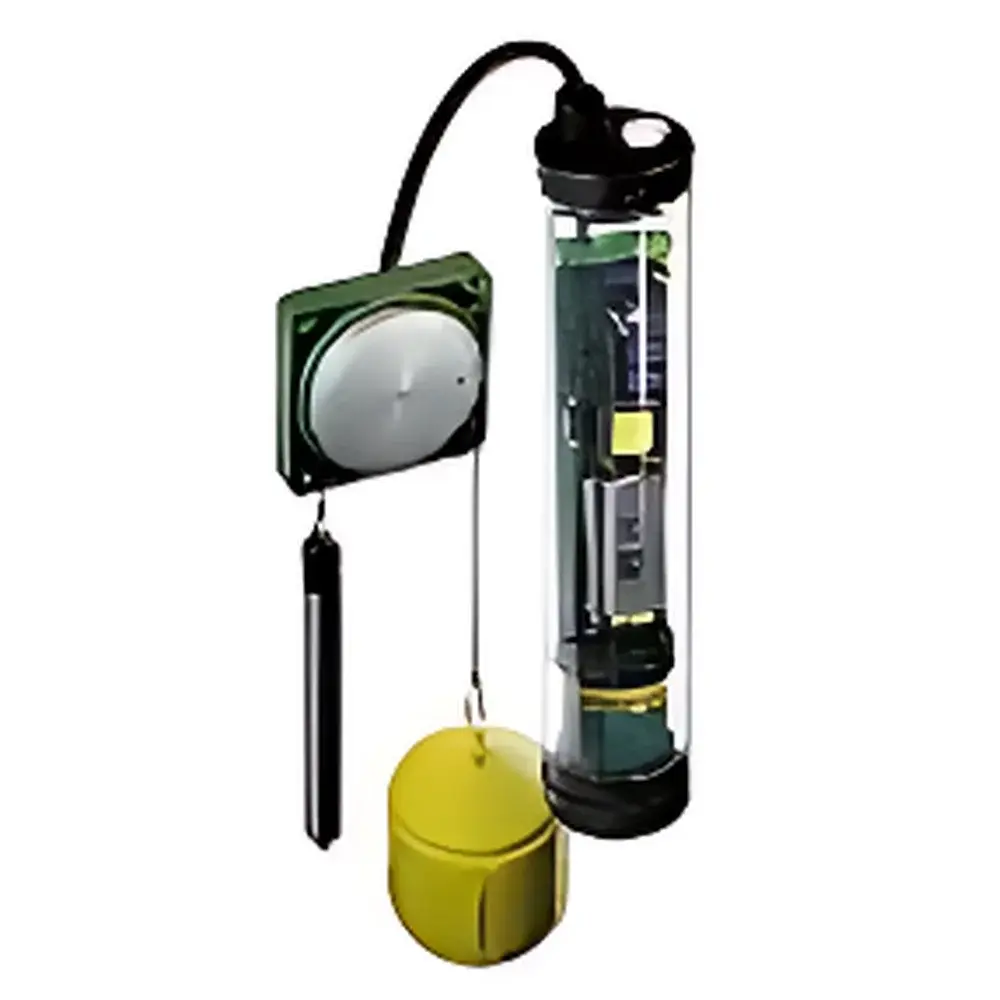
HACH OTT Thalimedes Float-Operated Water Level Recorder
| Brand | OTT Hydromet |
|---|---|
| Origin | Imported |
| Model | OTT Thalimedes |
| Resolution | 1 mm (upgradable to cm, ft) |
| Range | +19.999 m (mm scale) / +199.99 m (cm scale) |
| Enclosure Rating | IP68 |
| Operating Temperature | −20 °C to +70 °C |
| Power Supply | 1.5 V AA battery (typical 15-month operation at 1-hour logging interval) |
| Data Storage | ASCII-formatted files |
| Communication Interfaces | RS232 serial, IrDA infrared |
| Encoder Type | Rotary shaft encoder with float-driven pulley (200 mm circumference) |
| Housing Dimensions (Recorder) | 244 × 47 mm Ø |
| Weight | 320 g (incl. battery) |
| Housing Dimensions (Encoder Unit) | 82 × 82 × 34 mm |
| Weight | 140 g |
Overview
The HACH OTT Thalimedes Float-Operated Water Level Recorder is a robust, field-deployable hydrological monitoring instrument engineered for long-term, unattended measurement of water surface elevation in open channels, wells, reservoirs, and piezometers. It operates on the mechanical principle of buoyancy-driven displacement: as water level changes, a stainless-steel or polymer float moves vertically along a guide wire or stilling well, actuating a precision rotary encoder via a calibrated pulley system (200 mm circumference). This mechanical-to-electrical transduction delivers high repeatability and minimal hysteresis—critical for regulatory-grade hydrometric data collection. Unlike pressure-based or ultrasonic alternatives, the Thalimedes eliminates temperature-induced density errors and air-gap interference, making it especially suitable for low-flow, sediment-prone, or aerated environments where signal stability is paramount. Its self-contained architecture requires no external data logger, power supply, or telemetry hub—reducing system complexity and maintenance overhead across remote or infrastructure-limited sites.
Key Features
- True standalone operation: Integrated data logger, real-time clock, non-volatile memory, and battery management eliminate dependency on external acquisition hardware.
- High-visibility LCD display showing real-time water level, timestamp (date/time), battery status, and system diagnostics—enabling rapid field verification without external software.
- Dual communication pathways: RS232 serial interface supports direct PC connection, modem/GSM radio modems, satellite transceivers, or SCADA integration; IrDA infrared enables cable-free, dust- and moisture-immune data download in adverse field conditions.
- IP68-rated enclosures for both recorder (244 × 47 mm Ø) and encoder unit (82 × 82 × 34 mm), ensuring full submersion resistance and operational integrity in flooded pits, tidal zones, or high-humidity installations.
- Energy-optimized firmware: With default 1-hour logging intervals, the device achieves ≥15 months of continuous operation on two standard 1.5 V AA alkaline cells—validated per IEC 60086-2 specifications under −20 °C to +70 °C ambient conditions.
- Configurable resolution and scaling: Factory-default 1 mm resolution is upgradable in-field to centimeter or foot units via firmware update—supporting regional reporting standards without hardware replacement.
Sample Compatibility & Compliance
The Thalimedes is compatible with standard 1 mm stainless-steel or Dyneema® float cables, and accommodates installation in PVC, HDPE, or stainless-steel stilling wells (minimum internal diameter ≥50 mm). It meets ISO 11826-2:2021 (hydrometric instruments — Part 2: Stage gauges) for mechanical float systems and conforms to USGS Water Resources Mission Area (WRMA) Technical Memorandum No. 2020.02 for long-term stage monitoring accuracy. Its ASCII-formatted output (CR/LF-delimited, UTF-8 encoded) ensures compatibility with EPA STORET, WISKI, HydroOffice, and custom GIS pipelines. While not inherently 21 CFR Part 11 compliant, audit trails and data integrity can be enforced through validated third-party data ingestion platforms supporting electronic signature and change control protocols.
Software & Data Management
Data is stored in plain-text ASCII files containing timestamped level values (e.g., “2024-05-12T08:30:00Z,1245.3”), enabling direct import into Excel, MATLAB, Python (pandas), R, or hydrological modeling tools (HEC-RAS, MIKE SHE). OTT’s proprietary Thalimedes Configuration Tool (Windows-based) allows users to set logging intervals (1 min to 24 h), trigger thresholds, define time zones, and perform firmware updates. All configuration changes are logged with timestamps and user identifiers—supporting GLP-aligned documentation requirements. Exported datasets include metadata headers specifying sensor ID, calibration date, units, and firmware version—facilitating traceability in QA/QC workflows and regulatory submissions.
Applications
- Continuous groundwater level monitoring in observation wells for aquifer sustainability assessment and drought early-warning systems.
- Surface water stage recording in rivers, canals, and floodplains to support flood forecasting models and FEMA Base Flood Elevation (BFE) validation.
- Reservoir and dam safety surveillance—tracking drawdown rates, seepage anomalies, and seasonal storage trends.
- Wastewater network level monitoring in combined sewer overflows (CSOs) and pump station wet wells for predictive maintenance scheduling.
- Educational and research deployments where mechanical reliability, low power demand, and data transparency outweigh the need for wireless connectivity.
FAQ
Can the Thalimedes operate in freezing conditions?
Yes—the device is rated for continuous operation from −20 °C to +70 °C, and its mechanical float-pulley system remains functional under ice cover when installed in properly vented stilling wells.
Is calibration traceable to national standards?
Factory calibration is performed against NIST-traceable micrometer standards; field recalibration is achievable using certified gauge blocks or laser distance meters per ISO/IEC 17025-accredited procedures.
What file format is used for data export?
All measurements are saved as human-readable ASCII text (.txt), with comma-separated values and ISO 8601 timestamps—no proprietary binary formats or license-dependent viewers required.
Does the device support remote firmware updates?
No—firmware updates require local physical access via RS232 or IrDA; however, configuration parameters (logging interval, units, thresholds) can be modified remotely if integrated with a compatible telemetry gateway.
How is data integrity ensured during transmission?
RS232 transfers include CRC-16 error checking; IrDA sessions implement mandatory handshake and packet acknowledgment. ASCII logs retain original raw values without interpolation or smoothing—preserving measurement fidelity for forensic analysis.







