
ADCON AddVANTAGE Pro Cloud-Based Intelligent Wireless Monitoring System
| Key | Brand: ADCON |
|---|---|
| Origin | Imported |
| Device Type | Cloud-Connected Wireless Data Acquisition & Management Platform |
| Communication | Dual-Mode RF + GPRS/UMTS |
| Enclosure Rating | IP67 |
| Operating System | Embedded Linux |
| Software Version | AddVANTAGE Pro v6.4 |
| Database Backend | Oracle |
| Deployment Model | Web-Based SaaS Architecture |
| Compliance | WMO Certified Sensor Interface |
Overview
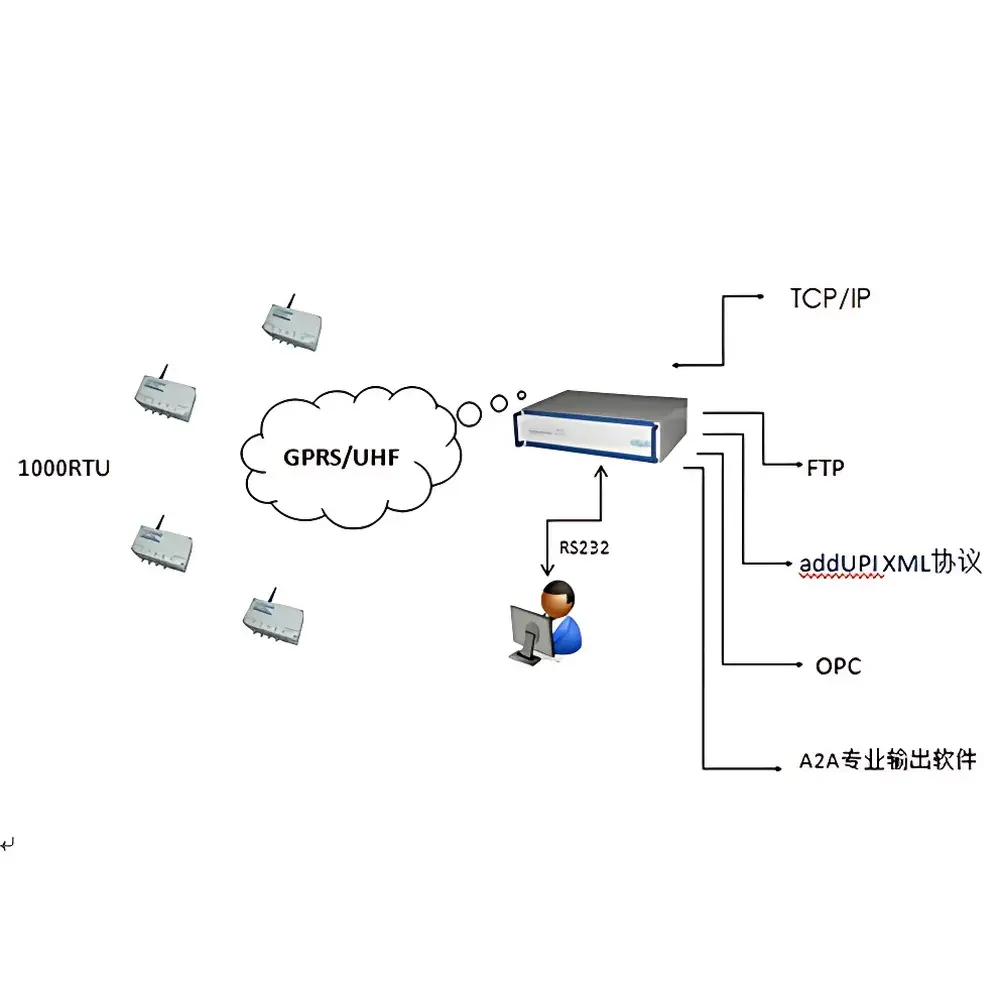
The ADCON AddVANTAGE Pro Cloud-Based Intelligent Wireless Monitoring System is a field-proven, end-to-end telemetry infrastructure engineered for continuous, low-power environmental and industrial data acquisition across geographically dispersed sites. Built upon a distributed architecture comprising ultra-low-power wireless sensor nodes, ruggedized base stations, secure cloud-hosted servers, and a web-native application layer, the system operates on a physics-informed measurement paradigm: analog/digital sensor signals are digitized at the edge, time-stamped with microsecond precision, buffered locally during communication outages, and transmitted via adaptive radio frequency (RF) or cellular (GPRS/UMTS) protocols to centralized repositories. This architecture ensures deterministic latency, high data integrity, and resilience in remote deployments where power grid stability, network coverage, and on-site technical support are constrained — making it especially suitable for long-term unattended monitoring in agriculture, hydrology, drinking water distribution, wastewater treatment, and meteorological networks.
Key Features
- Field-deployable wireless nodes with integrated sensing, local storage (up to 16 MB non-volatile memory), and adaptive transmission scheduling — certified to World Meteorological Organization (WMO) standards for environmental instrumentation.
- Industrial-grade base station operating on embedded Linux with real-time kernel extensions; supports dual-band RF (10 mW / 500 mW configurable), GSM/GPRS, and UMTS modems across multiple ISM and licensed frequency bands (e.g., 868 MHz, 915 MHz, 2.4 GHz).
- Integrated uninterruptible power supply (UPS) enabling >72-hour autonomous operation during mains failure; aluminum alloy enclosure rated IP67 for operation from −30 °C to +60 °C in high-humidity, saline, or dusty environments.
- Fully remote configuration, diagnostics, and firmware updates via secure SSH/TLS channels — eliminating need for physical site visits or local IT infrastructure.
- Web-native software platform (AddVANTAGE Pro v6.4) built on Oracle Database 19c with ACID-compliant transaction handling, role-based access control (RBAC), and audit-trail logging compliant with ISO/IEC 17025 and GLP requirements.
Sample Compatibility & Compliance
The system natively interfaces with over 200 ADCON-manufactured sensors (e.g., pressure transducers, ultrasonic level sensors, soil moisture probes, weather stations) and supports third-party analog (4–20 mA, 0–5 V, RS-485 Modbus RTU) and digital sensors through standardized driver frameworks. All sensor metadata — including calibration certificates, uncertainty budgets, and traceability to NIST or PTB standards — are stored in the Oracle database and linked to raw measurements. The platform meets IEC 61000-6-2/6-4 for electromagnetic compatibility, EN 60529 for ingress protection, and complies with EU RoHS and REACH directives. For regulated environments, AddVANTAGE Pro supports 21 CFR Part 11-compliant electronic signatures and audit trails when deployed with validated server configurations.
Software & Data Management
AddVANTAGE Pro serves as both a real-time visualization engine and a scalable data processing hub. Its web interface requires no client-side installation — compatible with Chrome, Firefox, Edge, and Safari on desktop and mobile devices. Time-series data is rendered using D3.js-powered interactive charts (line, scatter, gauge, heatmap), with drag-select temporal slicing for on-the-fly statistical computation (min/max/mean/cumulative sum). Advanced analytics include conditional logic scripting (IF-THEN-ELSE), multi-parameter arithmetic formulas (e.g., flow rate = K × √ΔP), crop-specific yield modeling, and pathogen risk forecasting (e.g., late blight index for Solanum tuberosum). LiveData — a public-facing module — publishes real-time values directly to Google Maps via RESTful JSON endpoints without authentication, supporting open-data initiatives and stakeholder transparency.
Applications
This system is routinely deployed in irrigation scheduling optimization, reservoir level surveillance, groundwater quality trend analysis (nitrates, conductivity, pH), stormwater overflow detection, and municipal SCADA augmentation. In drinking water networks, it monitors pressure transients and chlorination residuals to detect leaks or contamination events. In wastewater treatment plants, it tracks influent/effluent flow, dissolved oxygen, and sludge blanket levels for process control compliance with EPA NPDES permits. Academic and government users leverage its extensible API and Python SDK for integration with hydrological models (e.g., SWAT, HEC-RAS) and machine learning pipelines for anomaly detection.
FAQ
Does the system support integration with existing SCADA or ERP platforms?
Yes — via OPC UA, MQTT, and RESTful APIs with documented JSON/XML schemas and TLS 1.2+ encryption.
Can historical data be exported in CSV, Excel, or NetCDF formats for regulatory reporting?
Yes — batch exports include metadata headers, UTC timestamps, measurement units, and QA/QC flags per ISO 14040 lifecycle assessment conventions.
Is the Oracle database hosted on-premises or in a certified cloud environment?
Both deployment models are supported: private cloud (customer-managed Oracle RAC), hybrid (ADCON-managed AWS GovCloud with SOC 2 Type II attestation), or fully managed SaaS.
How is sensor calibration maintained across large-scale deployments?
Calibration schedules, certificate uploads, and drift correction coefficients are tracked in the sensor registry; automated alerts notify responsible personnel 30 days prior to expiry.
What cybersecurity measures protect data in transit and at rest?
AES-256 encryption for stored data; TLS 1.3 for all web and API traffic; hardware-enforced secure boot on base stations; annual penetration testing by independent third parties (report available under NDA).
Related Products







