
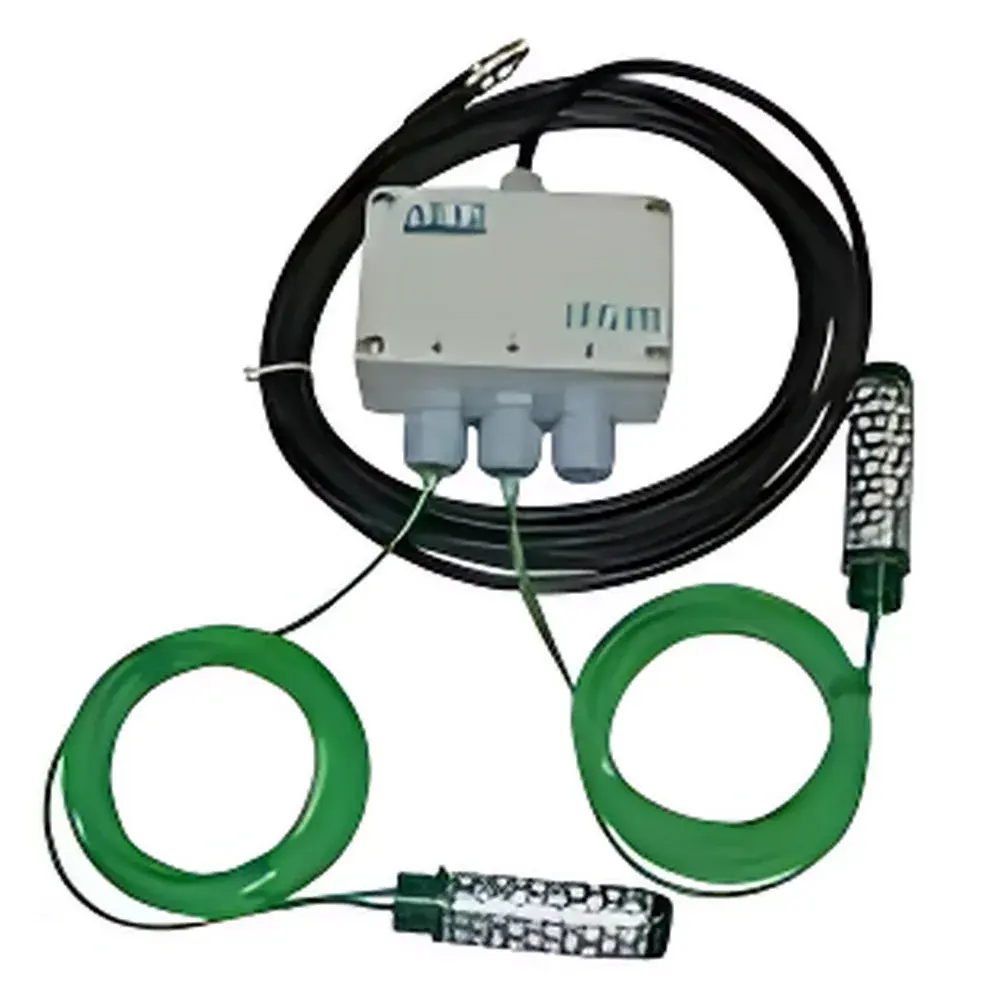
HACH ADCON A512 Soil Moisture Sensor Interface
| Brand | ADCON |
|---|---|
| Origin | Imported |
| Model | A512 |
| Measurement Principle | Resistive Soil Water Potential (Tensiometric Equivalent) |
| Max. Sensors Supported | 3 × Standard ADCON Model 200 Sensors |
| Output Signal | 0–2.5 V analog |
| Input Range | 0–200 cBar |
| Accuracy | ±5% of full scale |
| Enclosure Material | Anodized aluminum |
| IP Rating | IP67 |
| Dimensions (L×W×H) | 100 × 110 × 50 mm (incl. cable glands & mounting bracket) |
| Cable | 3 m, 7-pin PENTAX 53 waterproof connector |
| Compatible RTUs | A720, A723, A732, A733 |
| Sensor Housing | Stainless steel with patented dual concentric electrode geometry embedded in hydrophilic matrix |
| Operating Temperature | –20 °C to +60 °C |
| Long-term Stability | Non-dissolving, freeze-thaw resistant, no gypsum degradation |
| Mounting Flexibility | Single-depth multi-sensor or multi-depth profiling configuration |
Overview
The HACH ADCON A512 Soil Moisture Sensor Interface is an engineered interface module designed for high-reliability, long-term soil water potential monitoring in environmental and agricultural telemetry systems. It functions as a precision analog signal conditioner and multiplexer, enabling a single ADCON Remote Terminal Unit (RTU) — such as the A720, A723, A732, or A733 — to acquire synchronized readings from up to three standard ADCON Model 200 resistive soil moisture sensors. Unlike traditional tensiometers or capacitance-based probes, the Model 200 sensor operates on a validated resistive principle: its patented dual concentric stainless-steel electrodes are embedded within a stable, hydrophilic matrix material that equilibrates with surrounding soil water potential. As soil dries, matrix moisture decreases, increasing electrical resistance between electrodes — a change linearly converted to centibar (cBar) units (0–200 cBar), representing soil matric potential. This physical relationship aligns with established pedological definitions of plant-available water and is traceable to ISO 11274 and ASTM D4944 standards for soil water retention characterization.
Key Features
- Triple-sensor support: Simultaneous connection of up to three Model 200 sensors via dedicated spring-cage terminals — no custom adapters or proprietary connectors required.
- Tool-free sensor integration: Integrated cable grommets (three precision-machined rubber strain reliefs) secure bare sensor leads; simply thread cable through grommet, terminate at internal push-in terminal block, and close lid.
- Ruggedized enclosure: Die-cast anodized aluminum housing (100 × 110 × 50 mm), identical in construction to the field-proven addIT-series RTUs, providing mechanical robustness and corrosion resistance for permanent outdoor deployment.
- IP67-rated sealing: Fully protected against dust ingress and temporary immersion (1 m for 30 min), validated per IEC 60529, ensuring reliability in high-humidity, rain-prone, or flooded-field conditions.
- Long-term stability architecture: Sensor matrix is chemically inert and non-leaching; unaffected by freeze-thaw cycles, microbial activity, or soil pH variation — eliminating drift mechanisms common in gypsum-based sensors.
- Standardized analog output: Delivers calibrated 0–2.5 V DC signal per sensor channel, compatible with 12-bit or higher resolution ADC inputs on ADCON RTUs and third-party data loggers supporting 0–5 V differential input ranges.
Sample Compatibility & Compliance
The A512 interface is exclusively designed for use with ADCON Model 200 soil water potential sensors (Order No. 801.000.001, 5 m cable variant). These sensors meet field-deployable requirements for ISO 2859-1 sampling plans and are routinely specified in USDA NRCS irrigation scheduling protocols. The interface itself complies with EN 61326-1 (EMC for industrial measurement equipment) and carries CE marking for use within the European Economic Area. Its operational temperature range (–20 °C to +60 °C) supports year-round installation across USDA Plant Hardiness Zones 3–11. For regulatory environments requiring audit trails — such as USDA-certified conservation programs or EU CAP-funded precision agriculture projects — the A512’s deterministic analog signal path ensures compatibility with GLP-compliant data acquisition workflows when paired with Part 11–capable RTU firmware (e.g., A733 v4.2+ with secure logging).
Software & Data Management
Data acquired via the A512 is processed natively within ADCON’s ADAM software suite (v7.0+), which applies factory calibration coefficients stored in each Model 200 sensor’s EEPROM to convert raw voltage into cBar values. ADAM supports automated time-series interpolation, outlier rejection using Tukey’s fences (IQR-based), and export to CSV/NetCDF formats compliant with FAO’s WaPOR database schema. When integrated with ADCON Cloud or third-party platforms via Modbus TCP or MQTT (via A733 gateway), sensor-level metadata — including individual sensor serial numbers, calibration dates, and depth-specific installation coordinates — is preserved in structured JSON payloads. All data streams are timestamped with UTC-synced hardware clocks traceable to NTP servers, satisfying ISO/IEC 17025 clause 7.7.1 for measurement uncertainty documentation.
Applications
- Agricultural irrigation scheduling: Real-time cBar profiles across root zone depths (e.g., 15 cm, 30 cm, 60 cm) inform deficit irrigation decisions aligned with crop-specific permanent wilting point thresholds.
- Hydrological modeling: Multi-point vertical arrays generate high-resolution soil hydraulic conductivity estimates for SWAT or HYDRUS-1D parameterization.
- Vineyard and orchard water stress monitoring: Co-located sensors at drip emitters vs. inter-row positions quantify spatial heterogeneity in vine water status (Ψstem proxy).
- Ecological restoration sites: Long-term (>5 yr) tracking of soil water potential recovery post-remediation, with archival stability validated under repeated freeze-thaw exposure.
- Research-grade lysimeter networks: Synchronized A512–RTU deployments enable cross-site comparison studies under FAO-56 evapotranspiration frameworks.
FAQ
Can the A512 interface be used with non-ADCON sensors?
No. It is electrically and mechanically optimized for ADCON Model 200 sensors only. Interfacing with third-party resistive or capacitive probes will result in uncalibrated or unstable output.
What is the maximum recommended cable length between the A512 and the RTU?
3 meters is supplied as standard. Extension beyond this requires shielded twisted-pair cable (Belden 8761 or equivalent) and recalibration due to voltage drop and noise susceptibility.
Is firmware update capability available for the A512 itself?
No. The A512 is a passive analog interface without microcontroller or flash memory; all signal conditioning is hardware-defined.
How often must Model 200 sensors be recalibrated in situ?
Field validation studies indicate <±2% drift over 36 months under typical loam/sandy loam conditions. Annual verification against laboratory-standard tensiometers is recommended for GLP-regulated applications.
Does the A512 support digital communication protocols such as SDI-12 or RS-485?
No. It provides analog-only output. Digital sensor integration requires direct connection to RTUs with built-in SDI-12 or Modbus RTU interfaces (e.g., A733 with optional expansion module).
Related Products







